
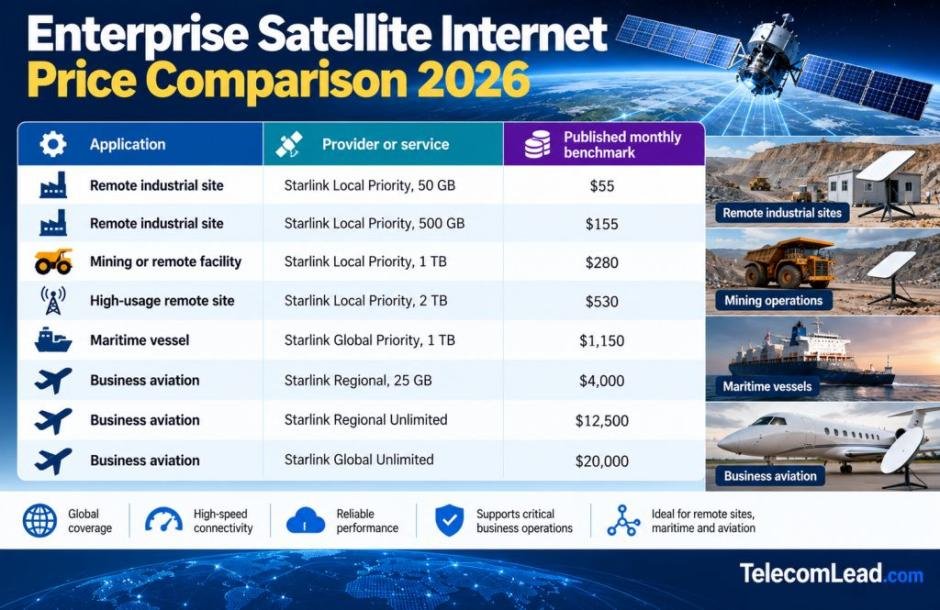
Enterprise satellite internet costs in 2026 range from $55 per month for a basic remote-site data package to $20,000 per month for unlimited global business aviation connectivity. However, subscription prices represent only part of the expenditure for mining companies, shipping fleets, airlines and industrial enterprises.
Starlink, Eutelsat OneWeb, SES, Viasat and Hughes compete through satellite capacity and connectivity platforms, while Speedcast, Marlink and KVH provide managed services, network integration and operational support.
Recent contracts involving CMA CGM, TGS, LATAM Airlines and Royal Brunei Airlines demonstrate growing demand for high-capacity satellite connectivity supporting industrial operations, fleet management and passenger services.
The above prices are published benchmarks for particular markets and plans, not universal global quotations. Equipment, installation, taxes, support and additional data charges are excluded.
Mining Satellite Internet: Cost per Site and Network Requirements
Mining companies require reliable connectivity for autonomous equipment, industrial IoT, video surveillance, worker communications and remote operational systems.
Starlink provides a comparatively transparent subscription benchmark.
Its business satellite internet plans list Local Priority packages ranging from $55 for 50 GB to $530 for 2 TB in the displayed billing market.
At $280 monthly for 1 TB, a mining company connecting 20 remote facilities would incur $5,600 in monthly subscription charges.
Annual expenditure would reach $67,200 before equipment, installation, cybersecurity and managed services.
However, this configuration may not meet the requirements of mining operations transmitting continuous industrial video or supporting critical production systems.
SES, Hughes and Speedcast Target Managed Mining Connectivity
SES competes through its O3b mPOWER medium Earth orbit network, targeting enterprises requiring high-capacity managed connectivity.
Hughes provides managed low Earth orbit connectivity using OneWeb satellite capacity.
Its HL1100W terminal supports peak download speeds of up to 75 Mbps and uploads of 14 Mbps, while the HL1120W supports up to 195 Mbps downloads and 32 Mbps uploads.
Speedcast integrates Starlink, OneWeb and traditional VSAT connectivity, allowing industrial customers to combine multiple networks.
For mining companies, the financial decision is therefore not simply between monthly satellite subscriptions.
It involves determining whether a low-cost shared connection is sufficient or whether operations require dedicated capacity, redundancy, cybersecurity and contractual service guarantees.
Maritime Satellite Internet: Starlink vs OneWeb, Viasat and Marlink
Shipping companies require satellite broadband for vessel monitoring, crew communications, navigation support, cargo systems and operational data transfers.
Starlink’s maritime Global Priority packages provide a starting point for evaluating fleet connectivity expenditure.
At an illustrative $1,150 monthly subscription for 1 TB, a fleet of 100 vessels would incur $115,000 in monthly connectivity charges.
Annual subscription expenditure would reach $1.38 million, excluding terminals, installation and additional services.
Actual costs depend on the billing country, service plan, vessel equipment and usage.
CMA CGM Selects OneWeb Connectivity for More Than 300 Vessels
In February 2026, CMA CGM, Marlink and Eutelsat announced an agreement to deploy OneWeb low Earth orbit connectivity across more than 300 vessels.
The deployment combines OneWeb services with existing LEO and geostationary satellite networks through Marlink’s XChange NextGen platform.
The agreement illustrates how major shipping companies are moving toward multi-network connectivity rather than depending on a single satellite system.
For large fleets, the ability to manage traffic across multiple networks can improve availability and support operational requirements.
However, the commercial contract value was not disclosed.
Speedcast Targets 1 Gbps Uploads for Seismic Vessels
In August 2026, Speedcast announced a connectivity agreement with TGS for seismic survey vessels.
The solution combines Starlink Dedicated Service, OneWeb and managed network infrastructure.
It is designed to support transmission of up to 10 TB of seismic data daily at sustained upload speeds of 1 Gbps.
Testing using eight Starlink Performance kits achieved peak upload speeds of approximately 950 Mbps.
That represented three to four times the performance of conventional bonded Starlink Global Priority connectivity in the reported comparison.
The deployment demonstrates why high-bandwidth industrial maritime services can require substantially different equipment and contracts from standard vessel broadband subscriptions.
KVH and Viasat Add Managed Maritime Services
KVH offers managed Starlink maritime connectivity with support packages priced at $49, $169, $349 and $549 monthly.
These support charges are additional to the underlying satellite connectivity subscription.
Viasat, including its Inmarsat portfolio, competes through managed maritime services and fleet-wide connectivity contracts.
For shipping companies, the relevant purchasing metric is total annual cost per vessel, including bandwidth, support, hardware, installation and backup connectivity.
Aviation Satellite Internet: $4,000 to $20,000 per Aircraft Monthly
Aviation represents one of the highest-priced enterprise satellite connectivity segments.
Starlink’s July 2026 business aviation pricing established three subscription categories.
| Starlink aviation package | Monthly subscription | Annual subscription |
| Regional, 25 GB | $4,000 | $48,000 |
| Regional Unlimited | $12,500 | $150,000 |
| Global Unlimited | $20,000 | $240,000 |
Starlink advertises maximum download speeds of up to 250 Mbps, 500 Mbps and 1 Gbps respectively across the three packages.
These are service-level maximums, not guaranteed speeds for every aircraft or flight.
A fleet of 20 aircraft using the $12,500 Regional Unlimited package would incur $3 million annually in subscription charges alone.
Aircraft antennas, certification, installation, maintenance and downtime create additional expenditure.
SES Expands Airline Connectivity Contracts
SES announced a multi-orbit connectivity agreement covering more than 60 LATAM Airlines aircraft in July 2026.
In October, SES and Royal Brunei Airlines completed the RB SkyConnect rollout across the airline’s Airbus A320neo fleet.
SES also reported 200 new aircraft wins during the first half of 2026 and more than 600 aircraft operating with its multi-orbit electronically steered antenna solution.
These figures demonstrate the scale of airline connectivity investment, although they do not disclose recurring revenue per aircraft.
Viasat competes through its aviation connectivity portfolio, including Inmarsat-derived services and its AMARA platform.
Hughes supports aviation connectivity through ground infrastructure and managed network capabilities.
In July 2026, Neo Space Group and Hughes deployed three ground gateways in Saudi Arabia and Europe to support in-flight connectivity.
Remote Enterprise Satellite Internet: Costs for 50 Sites
Construction sites, energy facilities, rural branches and temporary industrial locations use satellite connectivity as primary broadband or backup to terrestrial networks.
Starlink’s Local Priority pricing offers a useful benchmark.
A company connecting 50 sites with 500 GB packages at $155 monthly would spend $7,750 per month.
Annual subscription expenditure would total $93,000.
If all 50 sites used 1 TB packages at $280 monthly, annual expenditure would increase to $168,000.
The difference highlights the importance of matching data allowances to actual business requirements.
Hughes, Viasat and Iridium provide alternatives for different operational needs.
Iridium’s Certus portfolio addresses lower-bandwidth critical communications, telemetry and emergency connectivity rather than competing directly with high-throughput broadband services.
Enterprise Satellite Providers: Technology and Business Focus
| Provider | Main connectivity focus | Enterprise opportunity |
| Starlink | LEO broadband | Remote sites, vessels, aircraft |
| Eutelsat OneWeb | LEO enterprise connectivity | Maritime, industrial networks |
| SES | MEO and multi-orbit services | Aviation, high-capacity enterprise |
| Viasat | Managed satellite connectivity | Aviation, maritime, enterprise |
| Hughes | Managed satellite and ground infrastructure | Remote sites, aviation, industrial |
| Speedcast | Multi-network managed services | Mining, maritime, energy |
| Marlink | Maritime and enterprise integration | Commercial shipping fleets |
| KVH | Maritime connectivity and support | Vessel broadband and managed services |
| Iridium | Critical satellite communications | Remote telemetry and emergency services |
These providers are not directly comparable using published subscription prices because their service models, bandwidth guarantees and equipment requirements differ.
What Determines Enterprise Satellite Internet Costs?
The most important cost drivers are bandwidth requirements, data allowances, geographic coverage, terminal hardware, installation and managed service commitments.
For example, a mining company using satellite broadband for employee internet access has different requirements from a seismic vessel transmitting terabytes of data daily.
Likewise, a business aircraft requiring passenger Wi-Fi cannot be evaluated using the same pricing assumptions as a remote industrial sensor network.
Enterprises should calculate total connectivity expenditure over the contract term, including additional data charges, maintenance, backup links and equipment replacement.
Enterprise Satellite Internet Outlook for 2026
Enterprise satellite connectivity is expanding beyond basic broadband into high-capacity industrial, maritime and aviation applications.
Starlink provides transparent subscription benchmarks, while SES, Eutelsat OneWeb, Viasat and Hughes compete through specialised network capabilities.
Speedcast, Marlink and KVH add value through managed connectivity, integration and support.
For enterprise buyers, the lowest monthly subscription does not necessarily deliver the lowest total operating cost.
Mining companies, shipping operators, airlines and remote industrial enterprises should compare bandwidth requirements, network availability, installation costs and contractual service commitments before selecting a satellite connectivity provider.
FASNA SHABEER

