
Which 5G smartphone offers the strongest network reception in 2026? Mobile performance testing shows that the most expensive or newest smartphone does not always deliver the fastest mobile data speeds or most reliable connectivity.
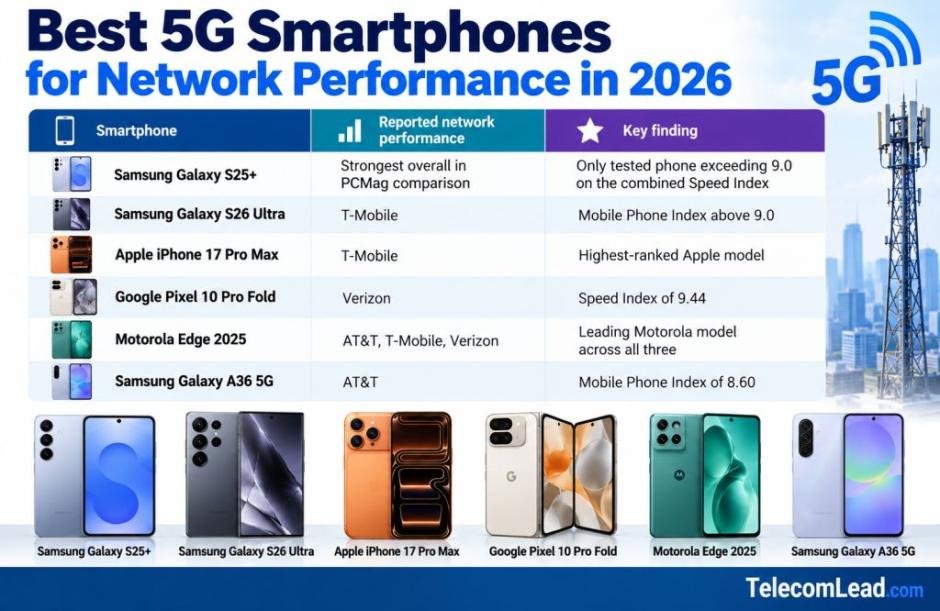
Samsung Galaxy S25+, Galaxy S26 Ultra, Apple iPhone 17 Pro Max, Google Pixel 10 Pro Fold and Motorola Edge 2025 emerged as notable performers in US mobile network testing. In India, Qualcomm and MediaTek modem comparisons revealed differences in download speeds, upload performance and network congestion.
For smartphone buyers, network reception depends on modem technology, antenna design, supported 5G bands, operator compatibility and local coverage.
Best 5G Smartphones for Network Performance in 2026
A September 2026 PCMag analysis examined 2,185,418 mobile network tests collected between January and June 2026.
The study compared smartphone performance across AT&T, T-Mobile and Verizon, using devices with at least 1,000 tests.
Its Mobile Phone Speed Index weighted download speed at 70 percent, upload speed at 20 percent and latency at 10 percent.
According to PCMag’s 2026 smartphone network performance study, leading devices differed considerably between operators.
| Smartphone | Reported network performance | Key finding |
| Samsung Galaxy S25+ | Strongest overall in PCMag comparison | Only tested phone exceeding 9.0 on the combined Speed Index |
| Samsung Galaxy S26 Ultra | T-Mobile | Mobile Phone Index above 9.0 |
| Apple iPhone 17 Pro Max | T-Mobile | Highest-ranked Apple model |
| Google Pixel 10 Pro Fold | Verizon | Speed Index of 9.44 |
| Motorola Edge 2025 | AT&T, T-Mobile, Verizon | Leading Motorola model across all three |
| Samsung Galaxy A36 5G | AT&T | Mobile Phone Index of 8.60 |
These results measure observed mobile data performance, not laboratory radio sensitivity or guaranteed indoor signal strength.
Samsung Galaxy S25+ Beats Newer Flagships in Overall Performance
Samsung Galaxy S25+ delivered the strongest overall smartphone result in PCMag’s 2026 comparison.
It was the only tested smartphone to exceed 9.0 on the study’s combined Mobile Phone Speed Index.
The result is significant because the Galaxy S25+ outperformed several newer and more expensive flagship devices, including Galaxy S26 Ultra, on the overall measure.
However, Galaxy S26 Ultra also achieved a score above 9.0 on T-Mobile.
Samsung Galaxy A36 5G recorded an 8.60 score on AT&T, demonstrating that midrange devices can deliver competitive connectivity.
On Verizon, Galaxy Z Fold 7 was Samsung’s leading device in the operator-specific comparison.
The findings suggest that antenna tuning, software optimisation and carrier compatibility can matter as much as smartphone price.
Apple iPhone 17 Pro Max: Strong T-Mobile Performance
Apple iPhone 17 Pro Max emerged as the highest-ranked Apple smartphone on T-Mobile.
The iPhone 17 Pro and standard iPhone 17 also achieved Mobile Phone Index scores exceeding 9.0 on that network.
However, Apple’s strongest model varied across operators.
The iPhone Air led Apple’s AT&T results, while the iPhone 16 performed best among Apple’s devices on Verizon.
This illustrates why buyers should not assume that upgrading to the newest iPhone automatically improves mobile reception.
For international travellers, regional 5G frequency support and operator certification are particularly important.
Google Pixel 10 Pro Fold Leads on Verizon
Google Pixel 10 Pro Fold achieved a Speed Index of 9.44 on Verizon, one of the strongest operator-specific results in the study.
Its score exceeded Samsung Galaxy Z Fold 7 by more than one point on the same network.
However, different Google smartphones performed better on other operators.
Google Pixel 9a led Google’s T-Mobile results, while Pixel 9 Pro ranked highest among Google’s devices on AT&T.
These findings indicate that flagship positioning alone cannot predict network performance.
A comparatively affordable smartphone may outperform a premium model under particular network conditions.
Motorola Edge 2025 Shows Consistent Operator Performance
Motorola Edge 2025 was the highest-ranked Motorola smartphone across AT&T, T-Mobile and Verizon.
Its performance is noteworthy because connectivity results often vary significantly between operators.
Motorola’s showing also demonstrates that strong mobile data performance is not limited to Samsung, Apple and Google.
For buyers evaluating Motorola smartphones, the results provide evidence that selected midrange and upper-midrange devices can offer competitive network connectivity.
However, the US results should not be treated as a direct ranking for Indian mobile networks.
Qualcomm vs MediaTek: Which 5G Modem Performs Better in India?
A May 2026 Indian comparison examined smartphones powered by four mobile chipsets using a Reliance Jio 5G SIM.
The tested platforms included Snapdragon 8 Elite Gen 5, MediaTek Dimensity 9500, Snapdragon 7 Gen 4 and Dimensity 7400.
According to Beebom’s Qualcomm vs MediaTek 5G modem comparison, the two chipset suppliers demonstrated different strengths.
| Performance factor | Reported advantage |
| Peak 5G download speed | Qualcomm |
| Idle latency | Qualcomm |
| Upload performance | MediaTek |
| Congested-network performance | MediaTek |
The comparison covered two locations and therefore cannot establish a nationwide ranking.
Antenna placement, device software, network congestion and radio-frequency design can affect results independently of the chipset.
For OnePlus, Xiaomi, vivo, OPPO and iQOO buyers, the study reinforces the importance of testing complete smartphones rather than judging reception solely by processor branding.
Qualcomm X85: Does a Faster Modem Improve 5G Reception?
Qualcomm’s X85 5G Modem-RF platform supports theoretical peak download speeds of 12.5 Gbps and uploads of 3.7 Gbps.
The platform supports six-component-carrier aggregation, up to 400 MHz of aggregated sub-6 GHz downlink bandwidth and 1024-QAM.
According to Qualcomm’s X85 technical specifications, the platform also incorporates six-receiver configurations, 5G Standalone support and AI-assisted connectivity features.
However, theoretical modem speed should not be confused with actual smartphone reception.
A device with excellent peak-speed specifications may still perform poorly indoors if its antenna implementation or supported frequency bands are unsuitable.
Equally important, the presence of an advanced modem platform does not establish that every smartphone using related technology delivers identical performance.
India 5G Reception: Jio vs Airtel vs Vodafone Idea vs BSNL
India’s mobile operators deliver different network experiences depending on location, spectrum, coverage and congestion.
The 2026 nPerf India Mobile Connections Barometer reported the following measurements.
| Operator | Reported download speed | Upload speed |
| Airtel 5G | 113.81 Mbps | 16.84 Mbps |
| Jio 5G | 94.22 Mbps | 8.97 Mbps |
| BSNL overall mobile network | 7.43 Mbps | 2.94 Mbps |
Airtel also recorded 58.98 milliseconds of 5G latency.
Vodafone Idea led the study’s 5G web-browsing and YouTube-streaming measures, with scores of 67.56 percent and 77.66 percent respectively.
BSNL’s figures represent overall mobile network performance rather than 5G-only measurements.
These operator-level results do not establish which smartphone has the strongest antenna or reception.
For Indian consumers, support for deployed 5G bands, including n28 and n78 where applicable, is important.
For BSNL users, compatible 4G bands, VoLTE support and reliable LTE fallback also deserve attention.
Indoor 5G Reception: What Smartphone Buyers Should Check
Indoor reception depends on more than advertised download speeds.
Two important radio measurements are:
RSRP: Reference Signal Received Power, measured in dBm, indicates received signal power.
SINR: Signal-to-Interference-plus-Noise Ratio, measured in dB, describes signal quality relative to interference and noise.
A smartphone maintaining usable speeds and stable calls under weak-signal conditions may provide a better experience than one delivering higher peak speeds near a mobile tower.
Consumers should also consider low-band coverage, antenna design, carrier aggregation and 5G-to-4G transitions.
India’s telecom regulator conducts field testing across cities and regions.
The TRAI Drive Test Reports provide operator-level measurements covering coverage, call performance, data throughput, latency and other quality indicators.
These reports help consumers evaluate local network quality but do not directly rank smartphone models.
Best 5G Smartphone for Reception in 2026: Final Comparison
Based on the cited 2026 smartphone-level US testing, Samsung Galaxy S25+ stands out for overall mobile data performance.
Samsung Galaxy S26 Ultra and Apple iPhone 17 Pro Max delivered competitive T-Mobile results, while Google Pixel 10 Pro Fold recorded particularly strong Verizon performance.
Motorola Edge 2025 demonstrated competitive results across all three major US operators.
For Indian consumers, however, there is insufficient comparable nationwide handset-level evidence to declare a single winner among Samsung, Apple, Google, OnePlus, Xiaomi, vivo and OPPO.
The best smartphone for 5G reception is the one that performs reliably on the buyer’s actual mobile network and in the locations where it is used most frequently.
Before purchasing, consumers should check supported frequency bands, operator compatibility, indoor coverage, call stability, modem performance and independent network test results.
A smartphone’s real-world connectivity matters more than its advertised maximum 5G speed.
FASNA SHABEER


