Telecom operators are expanding their role in digital identity verification as banks, fintech companies and online platforms seek stronger protection against account takeovers, SIM-swap fraud and authentication failures.
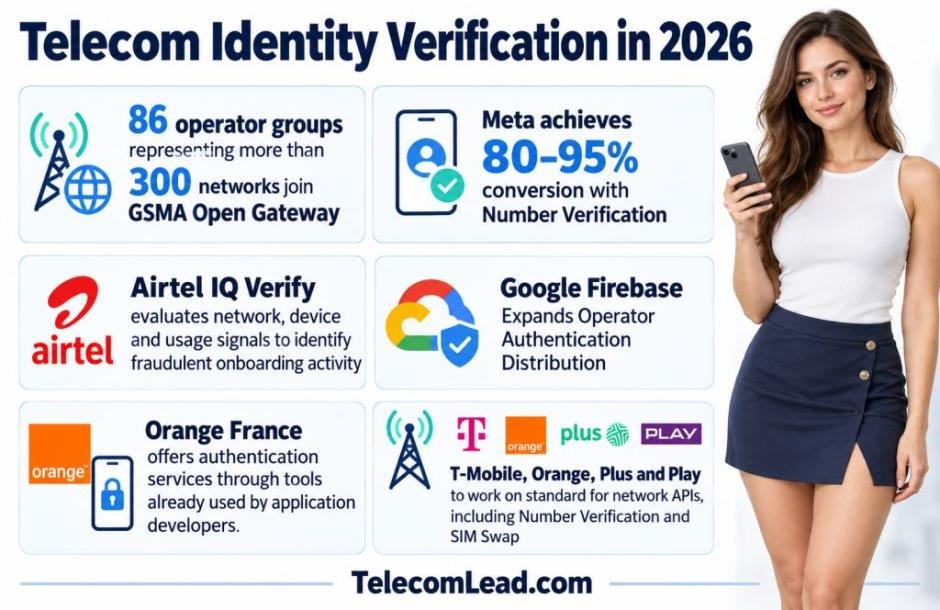
In March 2026, 86 operator groups representing more than 300 networks and 80 percent of global mobile connections were aligned with GSMA Open Gateway. The initiative recorded more than 300 commercial instances of 20 CAMARA API types across 65 markets, supported by more than 60 channel partners. These figures describe operator participation and commercial deployments; they do not mean every API is available across 80 percent of mobile connections.
The commercial opportunity extends beyond registering subscribers. Operators can supply network signals that help enterprises verify mobile numbers, identify recent SIM changes and assess suspicious activity during onboarding, account recovery and payments.
Open Gateway Makes Telecom Identity Services Easier to Integrate
The GSMA Open Gateway framework provides a common approach to exposing network capabilities through standardized application programming interfaces.
For enterprise customers, the benefit is simpler integration across participating networks. Banks and digital platforms can use common API specifications instead of building a different technical interface for each operator.
Two capabilities are particularly relevant to customer authentication:
Number Verification checks whether a supplied mobile number corresponds to the number associated with the device or connection being authenticated.
SIM Swap provides information about recent changes to the SIM associated with a number. Businesses can use that signal in their fraud-risk decisions.
These checks serve different purposes. Number verification establishes a mobile-number association; it does not independently establish a person’s legal identity. A recent SIM replacement indicates a change requiring assessment, rather than proof of fraud.
India’s Scam Figures Strengthen Demand for Network-Based Protection
The GSMA’s 2026 India research found that 12 percent of respondents had been scammed during the previous year, while 72 percent said scam risks had changed their behaviour.
Its India Consumer Scam Report 2026 also found that 67 percent of victims who lost money recovered nothing, and 33 percent of reported cases remained unresolved.
Meanwhile, 81 percent of respondents were comfortable with their mobile operator holding and using their data to detect fraud. This suggests consumer acceptance of operator involvement, although survey responses do not replace the permissions required for individual services.
For telecom operators, the opportunity is to provide timely signals throughout the customer lifecycle. Subscriber identity checks at registration and transaction authentication address different risks and can complement each other.
Meta Reports 80–95 percent Number Verification Conversion
The GSMA’s mobile authentication analysis reported that Meta achieved 80 percent to 95 percent conversion with the first version of Number Verification.
The comparison was 60 percent to 75 percent for SMS one-time passwords in the best-performing markets, with SMS OTP conversion below 50 percent in high-cost or high-risk markets.
The results illustrate the potential commercial value of removing manual authentication steps. Customers who no longer need to wait for a message and enter a code may be more likely to complete registration.
For example, an online marketplace could use number verification during account creation and measure completed registrations, verification time and support requests. Higher completion rates would demonstrate reduced friction; fraud reduction would require separate evidence.
Airtel IQ Gateway Combines Authentication With Enterprise Messaging
Airtel Business launched Airtel IQ Gateway on October 5, 2026, following trials with selected banks, financial institutions and other industry participants.
The platform combines SMS, WhatsApp, RCS, voice and number verification within one communications system.
Airtel IQ Verify evaluates network, device and usage signals to identify potentially fraudulent onboarding activity. Silent Authentication validates whether the entered number matches the active SIM in the device for supported login and SIM-binding flows.
The platform also addresses SMS pumping, in which artificial authentication traffic inflates messaging bills, alongside delivery visibility and automated routing between communications providers. Airtel did not disclose a quantified fraud-reduction result or revenue forecast in its launch announcement. airtel.in
This approach links identity services with an existing enterprise spending category: customer communications. Banks, retailers and logistics companies can assess authentication and messaging performance together.
Google Firebase Expands Operator Authentication Distribution
Google’s Firebase Phone Number Verification expansion, announced on September 28, 2026, added 10 carrier networks.
The additions included Vodafone networks in Germany, Greece, Ireland, the Netherlands, Romania and the UK, alongside Tune Talk and U Mobile in Malaysia, MasOrange in Spain and PTML in Pakistan.
Firebase enables supported applications to verify phone numbers through a consent-based process without requiring users to enter an SMS code. Google said verification can work over an internet connection even when mobile data is disabled.
Orange France separately announced that its network capabilities were available through Firebase in May 2026. This provides another distribution route for operator authentication services through tools already used by application developers.
European Operators Coordinate Number Verification and SIM Swap
In Poland, T-Mobile, Orange, Plus and Play announced collaboration at the MWC Barcelona in February 2026 to work on a joint open standard for network APIs, including Number Verification and SIM Swap.
In Greece, COSMOTE TELEKOM and Vodafone announced plans in March 2026 to introduce the same capabilities. Their announcement also outlined plans for Number Verification v2 to support third-party connections such as Wi-Fi and VPN.
Coordinated operator participation matters because enterprise customers serve subscribers across multiple networks. Common specifications improve integration consistency, while actual availability must still be checked by market, operator and API version.
Practical Examples: Banking, Account Recovery and Digital Commerce
The following illustrative applications show how businesses can incorporate telecom signals into existing security processes.
Bank transfers: Before approving an unusual payment, a bank could check whether the customer’s SIM changed recently. Combined with unfamiliar-device activity, that signal could trigger additional authentication.
Password recovery: An online retailer could check SIM-swap history before allowing an SMS-based password reset. CAMARA explicitly identifies password recovery as a use case for SIM-swap risk assessment.
Fintech onboarding: A financial application could verify that a customer’s submitted number corresponds to the supported device authentication flow, while retaining its separate identity-document checks.
Customer-service account changes: A provider could apply additional verification before changing payment details or recovery credentials when network signals indicate elevated risk.
E-commerce registration: A marketplace could test whether supported number-verification flows reduce abandoned registrations and repeated OTP requests.
Businesses should assess these applications through fraud losses, authentication completion, false alerts and customer-support demand.
Identity APIs Create a Measurable Enterprise Business Opportunity
Operator participation gives network identity services a broad potential distribution base. Commercial success depends on supported coverage, reliable responses, enterprise adoption and demonstrated customer outcomes.
For operators, relevant measures include paying enterprise customers, billable API usage, revenue per customer and delivery costs. For enterprises, the measures are lower fraud losses, fewer failed authentications and improved conversion.
Telecom identity verification can therefore become a recurring enterprise service when network signals deliver measurable protection and a smoother customer experience.
FASNA SHABEER