India is set to become even more strategically important for Chinese smartphone makers in 2027, but the opportunity will look very different from the volume-driven expansion that shaped the market over the past decade.
Xiaomi, vivo, OPPO, realme and OnePlus face rising component costs, longer smartphone replacement cycles, weaker entry-level demand and growing competition from Samsung and Apple. As a result, success in India will increasingly depend on higher average selling prices (ASPs), faster inventory turnover, stronger premium positioning and more productive retail channels rather than simply maximizing shipments.
The shift is occurring as the broader smartphone industry undergoes a significant reset. Omdia expects global smartphone shipments to fall about 12 percent to 1.097 billion units in 2026, while market value rises 12 percent to $651.6 billion and global ASP increases 27 percent to $594.
For Chinese OEMs, India sits at the center of this transition.
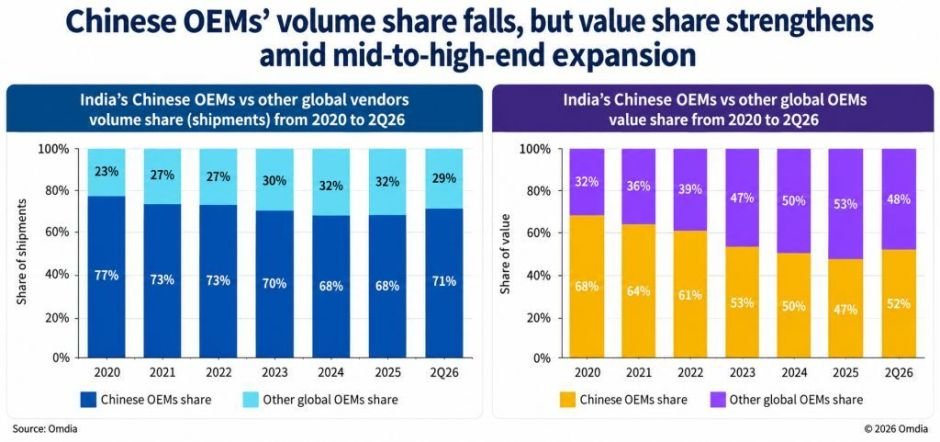
Chinese OEM Share in India Drops from 77 percent to 71 percent
India represents around 11 percent of global smartphone shipments in 2026, making it one of the world’s largest smartphone markets, Omdia’s Sanyam Chaurasia said.
Chinese smartphone companies have built their position through more than a decade of investment in local manufacturing, distribution, retail networks, service infrastructure and broad portfolios covering smartphones from entry-level models to premium flagships.
However, their collective volume share fell from approximately 77 percent in 2020 to 71 percent in 2Q26, its lowest level since 2020.
The decline comes as India’s smartphone market itself is under considerable pressure.
Shipments fell 13 percent year on year to 33.9 million units in 2Q26, following a 5 percent decline to 30.9 million units in the first quarter. Rising memory costs, rupee depreciation, inflation and higher handset prices have reduced affordability, particularly among mass-market buyers.
The change follows a relatively stable 2025, when India smartphone shipments declined just 1 percent to 154.2 million units.
The outlook has subsequently deteriorated. Omdia expects India’s smartphone shipments to decline approximately 13 percent to around 134 million units in 2026, followed by another 4 percent contraction in 2027.
India could therefore become more strategically important to Chinese smartphone companies while simultaneously becoming a smaller smartphone market.
vivo Leads India as Samsung Challenges Chinese Brands
The competitive landscape already illustrates the change.
In 2Q26, vivo remained India’s largest smartphone vendor with shipments of 6.3 million units. Samsung followed closely with 5.9 million, while OPPO shipped 4.6 million and Xiaomi 4.5 million. Apple entered the top five with 3.5 million iPhones.
Samsung has proved particularly resilient because it can compete across entry, mid-range and premium segments. Its financing, exchange, buyback and distributor-support programs have also strengthened retailer confidence.
Apple presents another challenge at the premium end. Financing, cashback and exchange programs are making iPhones accessible to a broader Indian consumer base while the company’s premium positioning protects it from some of the margin pressures affecting mass-market Android brands.
Chinese OEMs consequently face competition on two fronts: Samsung across multiple price segments and Apple as Indian consumers increasingly move toward premium devices.
India Accounts for 42 percent of realme’s Global Smartphone Shipments
India’s strategic importance becomes clearer when its contribution to individual smartphone brands is examined.
During 2026 year-to-date, India accounted for approximately 42 percent of realme’s global smartphone shipments, 33 percent of vivo’s, 29 percent of OnePlus’ and 25 percent of OPPO’s.
By comparison, India represented only around 10 percent of Samsung’s global smartphone shipments and 6 percent of Apple’s.
That creates a fundamentally different strategic equation.
Samsung and Apple can absorb weakness in India through highly diversified global operations. Several Chinese smartphone brands have considerably greater exposure to India, making sustained performance in the country much more important to their global shipment and revenue ambitions.
At the same time, replicating India’s scale elsewhere would be expensive. Vendors would need to build distribution networks, retailer relationships, service infrastructure, marketing operations and consumer awareness in new markets.
Protecting their established Indian businesses is therefore likely to be more economically attractive than attempting to replace lost Indian volumes elsewhere.
$200–$399 Smartphones Become the Critical Battleground
The answer, however, cannot simply be selling more inexpensive smartphones.
The $200–$399 segment accounts for around one-third of Indian smartphone shipments, making it increasingly important for Chinese brands seeking to combine meaningful volume with better margins.
This is where Xiaomi, vivo, OPPO and realme can potentially move existing users upward without abandoning the mass-market customer base that created their scale.
The industry’s wider price structure supports this strategy.
Omdia forecasts the global sub-$200 smartphone segment will shrink from 40.6 percent of shipments in 2025 to 25.6 percent in 2027. Meanwhile, smartphones costing more than $800 are expected to increase from 21.1 percent to 28.4 percent of global shipments.
The shift is being accelerated by the global smartphone memory and component cost crisis.
Memory and storage can now represent more than 60 percent of the bill of materials for budget smartphones, compared with more than 30 percent for high-end devices. Some smartphone vendors have faced memory costs four to five times higher than a year earlier.
This makes aggressive competition at the bottom of the market increasingly difficult.
Xiaomi, vivo and OPPO Need Fewer, Stronger Smartphones
Chinese brands therefore need to rethink portfolio design.
Instead of maintaining numerous smartphones with overlapping specifications and narrow price differences, OEMs can concentrate demand around fewer hero products, extend product lifecycles and optimize RAM and storage configurations.
Selective 4G smartphones can also help maintain affordable entry prices where 5G does not provide sufficient incremental consumer value.
There are already signs of this strategy.
vivo has streamlined parts of its entry portfolio around models such as the Y11 5G and Y21 5G while lowering the entry point of its V-series. Xiaomi continues using selected Redmi 4G devices to address highly price-sensitive customers while strengthening its premium upgrade path.
OPPO, meanwhile, is balancing its mass-market portfolio with stronger Reno and Find-series positioning.
The objective is no longer to have a device at every possible price point. It is to generate more sales from each SKU while reducing inventory fragmentation.
Inventory Turns Could Matter More Than Shipment Share
One of the biggest strategic changes in 2027 will take place away from consumers — inside India’s distribution and retail channels.
Higher smartphone prices mean retailers and distributors need more working capital to carry the same number of devices.
For example, if the average acquisition cost of smartphones held by a retailer rises 10 percent, maintaining an unchanged unit inventory theoretically requires approximately 10 percent more working capital.
That changes how retailers allocate shelf space and capital.
Brands offering faster sell-out, better inventory visibility, attractive financing, trade-ins and stronger retailer support become more valuable to the channel.
This partly explains why Samsung and Apple have been able to strengthen their positions despite difficult market conditions.
Omdia found that retailers increasingly prioritized brands with lower inventory risk and stronger premium demand as device prices increased during 2Q26.
For Chinese vendors, inventory turns may consequently become almost as important as shipment market share.
Financing and Trade-ins Become Competitive Weapons
The Indian smartphone market’s 13 percent shipment decline in 2Q26 also demonstrates why financing is becoming critical.
As upfront smartphone prices increase, consumers are more likely to depend on EMI financing, cashback offers, exchange programs and trade-ins.
Large-format retailers can benefit because they are better positioned to combine financing, device exchange and assisted selling. General trade, however, will remain essential for reaching Tier 2, Tier 3 and rural markets.
Chinese smartphone makers therefore need both channels.
Premium expansion requires better execution in large-format retail, while maintaining national shipment scale requires strong relationships with thousands of smaller retailers.
Retail incentives, promoter deployment, financing partnerships and ageing-stock management could consequently generate better returns than indiscriminate discounting.
Different Chinese OEMs Need Different India Strategies
There is no single strategy that will work for every Chinese smartphone vendor.
vivo can use its market leadership and offline distribution strength to move more customers toward its V and premium product families while maintaining disciplined entry-level offerings.
Xiaomi faces the challenge of preserving its historical mass-market scale while rebuilding stronger premium credentials. Reducing portfolio complexity while establishing clearer upgrade paths from Redmi to Xiaomi-branded premium devices will be important.
OPPO can leverage its strong offline presence while using Reno and Find smartphones to increase ASP and strengthen its premium positioning.
realme faces perhaps the greatest concentration challenge, with India accounting for about 42 percent of its global shipments. Inventory productivity, portfolio discipline and profitable mass-market positioning will therefore be particularly important.
OnePlus, with around 29 percent of shipments linked to India, needs to preserve its premium identity while rebuilding and strengthening relationships with India’s mainline retail channel.
India Also Creates Concentration and Regulatory Risks
Greater reliance on India is not without risk.
The first challenge is demand. A projected 13 percent contraction in 2026 followed by another 4 percent decline in 2027 means increased investment does not automatically translate into shipment growth.
Longer smartphone replacement cycles could make the problem structural rather than temporary.
The second risk is regulatory. India tightened foreign-investment rules in 2020 for companies from countries sharing a land border with India. Although parts of the framework have begun to ease, Chinese companies continue to operate in an environment where investment and cross-border transactions can receive greater scrutiny.
This can reduce the flexibility with which profits generated in India can be redeployed globally and makes productive local reinvestment more strategically important.
Geopolitics represents a third variable.
India-China relations have improved from periods of heightened tension, but smartphone manufacturers have limited control over bilateral political developments.
Deeper localization therefore becomes both an economic and risk-management strategy. Investment in Indian manufacturing, component sourcing, R&D, employment, services and local partnerships can strengthen vendors’ positions within the country’s technology ecosystem.
Global Smartphone Market Is Also Moving from Volume to Value
India’s transformation is part of a much larger industry shift.
The global smartphone market is expected to shrink to 1.097 billion units in 2026, but smartphone market value is forecast to rise to $651.6 billion.
Global ASP is expected to climb from $467 in 2025 to $624 in 2027, an increase of approximately 33 percent.
The message for Chinese smartphone manufacturers is clear: shipment volume alone is becoming a less effective measure of success.
Revenue per device, margins, inventory turnover, channel economics and customer retention will increasingly determine competitive performance.
2027 Will Be About Quality of Growth in India
India has been a volume engine for Chinese smartphone makers for more than a decade. In 2027, it will increasingly become a test of whether they can transform that scale into sustainable value.
Chinese OEMs will need to protect their mass-market installed bases while moving customers toward higher-value smartphones, eliminating unnecessary SKUs, improving inventory conversion and strengthening retailer economics.
The strategic objective is therefore changing from maximizing the number of smartphones entering India’s distribution channel to maximizing the economic value generated by every device sold through it.
With India accounting for 42 percent of realme’s global shipments, 33 percent of vivo’s, 29 percent of OnePlus’ and 25 percent of OPPO’s, walking away from volume is not an option. But pursuing volume regardless of margin, inventory risk and channel productivity is becoming equally unsustainable.
That is why India could become even more important to Chinese smartphone OEMs in 2027 despite a contracting market.
The winners are unlikely to be determined simply by who ships the most smartphones. They will be the vendors that can combine mass-market scale, premium growth, faster inventory turns, stronger retailer economics and deeper localization — turning India’s enormous installed base into higher-quality and more resilient growth.
BABURAJAN KIZHAKEDATH