Europe’s largest telecom operators are investing billions of euros in 5G, fiber, spectrum, cloud infrastructure and network modernization as mobile data consumption and demand for high-speed connectivity continue to increase.
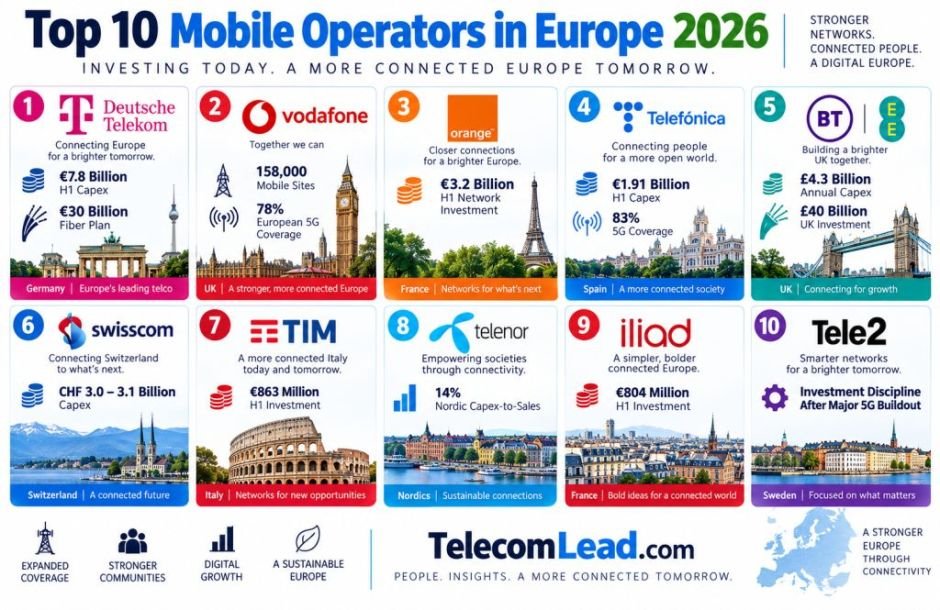
Deutsche Telekom, Vodafone and Orange have the greatest international scale, while Telefónica, BT/EE, Swisscom, TIM, Telenor, Iliad and Tele2 remain major investors in their core European markets.
The ranking considers revenue, mobile customers, Capex, 5G coverage and strategic network investments. Subscriber figures are not directly comparable because operators use different geographic and reporting definitions.
1. Deutsche Telekom: €7.8 Billion H1 Capex and €30 Billion Fiber Plan
Deutsche Telekom reported €29.9 billion of Q2 2026 revenue, while H1 cash Capex before spectrum reached €7.8 billion. Including spectrum, investment totaled €8.4 billion, of which approximately €500 million went into mobile spectrum licences.
Its 5G network covers around 99 percent of Germany’s population, while its European subsidiaries average 93.9 percent 5G population coverage. Deutsche Telekom’s German fiber footprint reached 13.6 million homes and businesses by June.
Deutsche Telekom H1 2026 network investment strategy shows that the company is investing €30 billion in German fiber through 2030, including an additional €800 million announced for the next three years.
2. Vodafone: 158,000 Mobile Sites and 78% European 5G Coverage
Vodafone operates one of Europe’s largest mobile infrastructures, with approximately 158,000 mobile sites across Europe and Africa and 78 percent 5G population coverage in Europe. It also markets gigabit broadband to 84 million European households.
A major investment focus is now the UK following the Vodafone-Three combination. The company is building a 5G Standalone network and expects more than £700 million of annual cost and Capex synergies by year five, approximately half from capital expenditure efficiencies.
Vodafone’s broader infrastructure includes about one million kilometres of terrestrial fiber and investments or ownership interests in 70 subsea cables.
3. Orange: €3.2 Billion H1 Network Investment
Orange reported €20.9 billion of H1 2026 revenue and 321.3 million mobile accesses globally.
More important from a network perspective, eCAPEX reached €3.2 billion during H1, equivalent to 15.2 percent of revenue and 2.7 percent higher year over year. Investment increased particularly in Africa and the Middle East, while France accounted for around €1.4 billion.
Orange H1 2026 results and eCapex strategy indicates that Orange is reshaping its European position following consolidation of MasOrange in Spain. The transaction contributed to a €13.2 billion increase in Orange’s net financial debt, taking it to €35.7 billion at June 2026.
4. Telefonica: €1.91 Billion H1 Capex and 83% 5G Coverage
Telefonica generated €16.39 billion of H1 revenue and reported approximately 299.8 million accesses.
Capital expenditure reached approximately €1.91 billion during H1 2026, supporting fiber, 5G, IT modernization and other infrastructure.
The operator’s 5G network covers around 83 percent of the population across its four core markets — Spain, Germany, the UK and Brazil.
Telefonica is increasingly concentrating capital on these strategic markets rather than maximizing geographic footprint. Its H1 adjusted operating cash flow after leases improved, allowing the company to raise its 2026 growth outlook for that metric to above 3 percent.
5. BT/EE: £4.3 Billion Annual Capex and £40 Billion UK Investment
BT Group is undertaking one of Europe’s largest integrated fixed-mobile infrastructure programs.
BT expects £4.2-£4.3 billion of FY2027 capital expenditure excluding spectrum.
More significantly, BT says it will have invested more than £40 billion in the UK between 2020 and 2030, encompassing full fiber, mobile and other digital infrastructure.
BT’s £40 billion UK network investment program shows that EE’s 5G+ network reached 77 percent of the UK population by June 2026, while Openreach’s full-fiber network is on track to pass 25 million premises by the end of December. The longer-term targets are 30 million fiber premises and 99 percent 5G+ population coverage.
6. Swisscom: CHF 3.0-3.1 Billion Capex
Swisscom has become a larger European operator following its expansion in Italy through Fastweb + Vodafone.
The group expects CHF14.7-14.9 billion of 2026 revenue and CHF3.0-3.1 billion of Capex. H1 capital expenditure was CHF1.355 billion.
Swisscom’s Swiss 5G+ network covers 90 percent of the population, while FTTH reaches about 58 percent of households and businesses.
In Italy, Fastweb + Vodafone has achieved 90 percent 5G population coverage and 61 percent fiber coverage. The company is also working with TIM on network sharing and potentially developing up to 6,000 new mobile sites.
7. TIM: €863 Million H1 Investment
TIM remains one of Italy’s most important telecom infrastructure investors.
Group industrial and mobile spectrum investment totaled €863 million during H1 2026, €29 million higher than a year earlier.
TIM’s 2026 plan targets Group Capex below 14 percent of revenue, with domestic Capex at around 12 percent. The company is separately planning approximately €500 million of investment between 2026 and 2028 in infrastructure supporting digital sovereignty, including cloud, networks and AI workloads.
TIM also continues to invest in 5G and mobile infrastructure while exploring network-sharing initiatives with Fastweb + Vodafone.
8. Telenor: 14% Nordic Capex-to-Sales
Telenor’s investment strategy has shifted toward disciplined Nordic infrastructure spending as its 5G rollout matures.
The operator expects Capex excluding leases at around 14 percent of Nordic sales in 2026, falling below 13 percent by 2028 and toward 11-12 percent by 2030.
Q1 Capex excluding leases reached NOK2.28 billion, including NOK1.81 billion in the Nordics, mainly for mobile modernization, fiber and IT transformation.
Telenor is also investing through acquisitions. It agreed to acquire GlobalConnect’s Norwegian consumer business for NOK6 billion, including around 140,000 fiber customers, while a Finnish all-fiber upgrade represents approximately NOK1.4 billion of investment.
9. Iliad: €804 Million H1 Investment
Iliad has emerged as one of Europe’s fastest-growing telecom challengers, operating across France, Italy and Poland.
The group reported approximately €5.24 billion of H1 2026 revenue and 52.5 million subscribers, including around 42.2 million mobile subscribers.
Iliad invested approximately €804 million during H1, supporting mobile and fixed-network expansion.
Its 5G population coverage has reached approximately 95 percent in France, 98 percent in Italy and 90 percent in Poland, giving Iliad an increasingly extensive European next-generation mobile footprint.
Its investment model is particularly important because Iliad has combined aggressive subscriber growth with continued network ownership rather than relying solely on wholesale access.
10. Tele2: Investment Discipline After Major 5G Buildout
Tele2 generated approximately SEK7.4 billion of Q2 revenue, up 2 percent organically, while end-user service revenue reached SEK5.6 billion.
The operator is increasingly emphasizing returns from infrastructure already deployed rather than accelerating capital intensity.
Tele2 says Capex intensity remains low as it maintains a disciplined investment strategy. The group continues investing in 5G across Sweden and the Baltics and strengthened its Lithuanian network with additional spectrum during 2026.
This represents a broader European trend: operators that have completed large parts of their initial 5G rollout are beginning to focus more closely on network utilization, customer monetization and cash generation.
Europe’s Telecom Investment Shifts From 5G Coverage to 5G Quality
Europe’s biggest operators are collectively spending tens of billions of euros annually on telecom infrastructure, but investment priorities are changing.
Deutsche Telekom is combining nearly €8 billion of H1 cash Capex with a €30 billion German fiber program. BT expects £4.2-£4.3 billion of annual Capex and more than £40 billion of UK investment during 2020-2030. Swisscom expects more than CHF3 billion of 2026 Capex, while Orange invested €3.2 billion in only six months.
The next stage is increasingly about 5G Standalone, densification, fiber backhaul, spectrum efficiency, AI-enabled networks and convergence rather than basic 5G coverage.
Network sharing is another major theme. Fastweb + Vodafone and TIM are cooperating in Italy, while Vodafone’s UK combination with Three is intended to create greater network scale.
For European telecom investors, the critical metric is therefore shifting from simply how much operators spend to how effectively Capex improves network quality, coverage, customer growth and returns. Deutsche Telekom’s 99 percent German 5G coverage, EE’s rapidly expanding 5G+ footprint and Swisscom’s 90 percent 5G+ coverage demonstrate how Europe’s network investment cycle is moving from initial deployment toward optimization and monetization.
FASNA SHABEER