The global telecom industry has moved into a decisive phase of 5G monetisation in 2026. Operators are no longer measuring 5G success mainly by population coverage, spectrum holdings or network launches. The stronger indicators are now ARPU growth, service revenue, subscriber upgrades, data consumption and the ability to bundle connectivity with broadband, digital services and enterprise solutions. The GSMA Intelligence analysis of 5G consumer trends and monetisation opportunities provides additional insight into how changing 5G user behaviour can create new revenue opportunities for telecom operators.
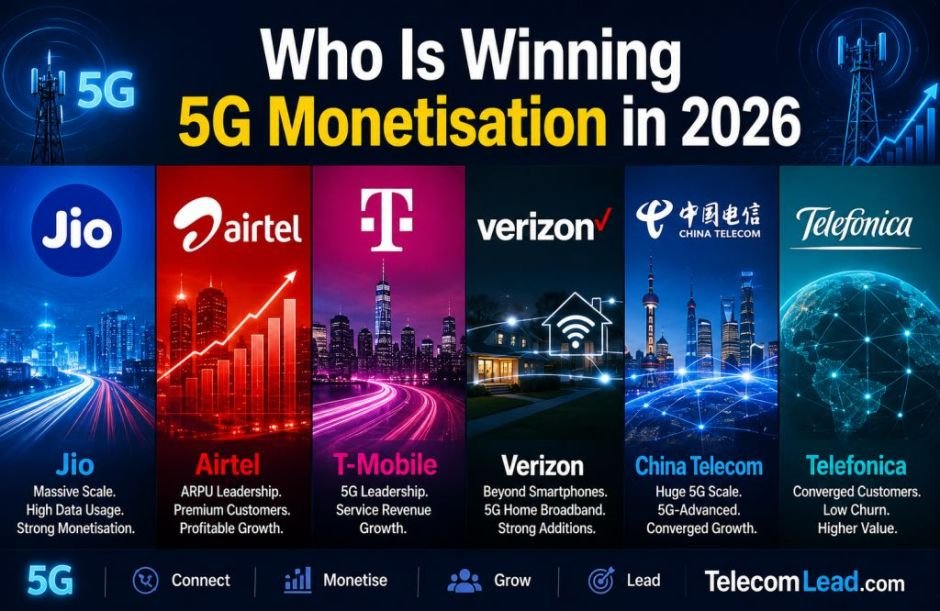
The results emerging in 2026 suggest there is no single winning model. Reliance Jio is demonstrating the economics of enormous 5G scale, Bharti Airtel is extracting higher ARPU from premium customers, T-Mobile US is converting network leadership into service revenue growth, while China Telecom is moving towards 5G-Advanced and converged services. Telefonica shows how 5G can support premium converged propositions rather than functioning as a standalone revenue product.
Reliance Jio: 285 Million 5G Users Create Unmatched Scale
Reliance Jio has emerged as one of the strongest examples of mass-market 5G monetisation. Jio had approximately 285 million 5G subscribers at the end of June 2026, up from 268.5 million at the end of March. Its overall subscriber base exceeded 533 million, giving the operator an enormous platform for selling higher-value connectivity and digital services.
Jio’s ARPU increased to ₹215.6 in the June quarter. More importantly for long-term monetisation, average monthly data consumption reached 43.7 GB per customer, the highest among India’s major operators. 5G traffic was around 1.5 times 4G traffic, indicating that migration to 5G is fundamentally changing network consumption.
The company entered FY2027 from a strong base. In FY2026, Jio generated ₹1.47 trillion in revenue from operations and ₹763 billion in EBITDA, while serving 524.4 million customers at March-end.
These figures suggest Jio’s monetisation strategy is primarily about scale: migrate hundreds of millions of users to 5G, increase data consumption and subsequently monetise the relationship through broadband, cloud, AI and digital platforms.
Bharti Airtel: ARPU Leadership Shows Premiumisation Is Working
If Jio leads on 5G subscriber scale, Bharti Airtel is particularly strong on revenue generated per customer.
Airtel’s India mobile ARPU increased 5.6 percent to ₹264 in the June 2026 quarter, comfortably above Jio’s ₹215.6 and Vodafone Idea’s customer ARPU of ₹195. Airtel’s revenue increased 18.4 percent to ₹585.39 billion, while its high-speed 4G and 5G customer base expanded 7.5 percent.
Mobile data consumption reached 34.4 GB per customer per month. Airtel’s monetisation approach therefore differs from Jio: instead of pursuing only subscriber volume, it is increasingly focused on premium customers, higher-value plans and stronger network experience.
The company’s scale also matters. Airtel crossed 650 million customers globally in April 2026 across its operations, reinforcing its ability to spread network and digital-service investments across a large subscriber base.
The broader transformation of mobile networks and services is also examined in the GSMA Mobile Economy 2026 report, which highlights the growing economic contribution of mobile connectivity as 5G, digital services and AI adoption expand.
Vodafone Idea: ARPU Growth Provides Early Monetisation Signal
Vodafone Idea offers another interesting example because its 5G network is much younger than those of Jio and Airtel.
Vi reported 193.1 million customers in Q1 FY2027, compared with 192.8 million in the previous quarter, recording its first quarter of positive net subscriber additions since the Vodafone India-Idea Cellular merger.
Its 4G/5G subscriber base increased to 130.1 million from 127.4 million a year earlier. Data usage jumped 27.9 percent, from 69.1 PB per day to 88.4 PB per day.
Most significant from a monetisation perspective was customer ARPU, which increased 10.2 percent to ₹195. Although the absolute ARPU remains below Airtel and Jio, the growth rate indicates that Vi’s combination of tariff changes, customer upgrades and 5G expansion is beginning to improve customer economics.
T-Mobile US: 5G Leadership Converts into $19 Billion Service Revenue
T-Mobile US provides one of the clearest examples of 5G translating into revenue growth in a mature telecom market.
The operator generated $19.0 billion in service revenue during Q2 2026, up 9 percent, while postpaid service revenue climbed 13 percent to $15.9 billion. Postpaid ARPA increased 2 percent to $152.91, according to T-Mobile US Q2 2026 service revenue performance.
T-Mobile added 277,000 postpaid accounts during the quarter and finished June with 34.7 million postpaid accounts. Deutsche Telekom reported that T-Mobile’s service revenue growth reflected both a larger postpaid base and higher postpaid average revenue per account.
This is an important distinction in the 5G monetisation debate. The technology does not necessarily need to appear as a separate “5G fee.” Network quality can instead support customer acquisition, retention, premium plans and additional services, ultimately increasing service revenue.
Verizon: Monetisation Expands Beyond Smartphones
Verizon’s strategy increasingly demonstrates how operators can monetise 5G infrastructure through both mobility and fixed wireless access.
Verizon generated $23.4 billion in mobility and broadband service revenue in Q2 2026, representing 2.8 percent growth. Verizon added 184,000 postpaid phone customers and 348,000 broadband customers during the quarter.
The broadband additions included 193,000 fixed wireless access customers and 155,000 fiber customers. Verizon consequently reached approximately 17.1 million combined fixed wireless and fiber broadband connections.
This demonstrates one of the industry’s most important 5G revenue opportunities: using mobile spectrum and network capacity to compete directly in the home broadband market.
China Telecom: 322.5 Million 5G Users and 5G-A Expansion
China represents the world’s largest 5G market. By July 2026, the country had reached 1.3 billion 5G mobile subscriptions, equivalent to 70.5 percent of its 1.85 billion mobile subscriptions. China had also deployed 5.15 million 5G base stations.
China Telecom alone had 442.43 million mobile subscribers at the end of Q2 2026, including 322.50 million 5G network subscribers. That represents 5G penetration of roughly 73 percent.
The operator is now pushing beyond basic 5G connectivity towards 5G-Advanced (5G-A). China Telecom reported 5G-A customers reaching 4.68 million, while mobile data usage per subscriber increased 10.6 percent year-on-year.
Its converged customer base exceeded 130 million, with converged ARPU reaching RMB128. Revenue from partnered customer benefits increased 75 percent, illustrating how operators can generate value by combining connectivity with applications and digital services.
For additional industry context, China Telecom 2026 subscriber and 5G operating data provides updates covering mobile, 5G and broadband customers.
China Mobile: 895 Million Mobile Internet Customers
China Mobile remains another enormous monetisation platform. In the first half of 2026, the operator reported 895 million mobile internet customers, adding 11.45 million during the period.
Mobile ARPU stood at RMB45.1, while the number of gigabit broadband customers reached 117 million, increasing by 8.41 million. Household integrated ARPU reached RMB46.8.
China Mobile’s numbers underline an important evolution of 5G economics in China: monetisation increasingly depends on combining mobile connectivity with broadband, cloud, computing, AI and enterprise services rather than expecting large consumer price premiums purely for 5G access.
Telefonica: 5G Supports Higher-Value Converged Customers
Telefonica’s results demonstrate another model built around convergence.
The operator’s total accesses reached 299.8 million in H1 2026, up 5.3 percent, while 5G coverage reached 83 percent of the population across its four core markets. Group revenue reached €16.392 billion, increasing 1.7 percent.
Spain provides a particularly interesting monetisation indicator. Telefonica Espana reported quarterly ARPU of €91.1, alongside a record-low churn rate of just 0.7 percent. Its mobile contract base remained above 16 million.
In Brazil, Telefonica’s Vivo Total converged proposition reached 3.8 million customers, representing 29 percent growth. Telefonica Brasil’s Q2 revenue increased 17.8 percent to €2.684 billion, or 7.6 percent in constant currencies.
The results reinforce the argument that the economic return from 5G increasingly comes through larger customer relationships involving mobile, fiber, entertainment, enterprise and digital services.
Who Is Winning 5G Monetisation in 2026?
There is no universal winner because operators are monetising 5G differently. Jio is arguably the global scale leader, with 285 million 5G customers and exceptionally high data consumption. Airtel stands out for ARPU expansion, reaching ₹264 while continuing to increase its premium 4G/5G base.
In the United States, T-Mobile US is demonstrating perhaps the clearest connection between network differentiation and service revenue, with Q2 service revenue rising 9 percent to $19 billion and postpaid service revenue increasing 13 percent.
Verizon’s 193,000 quarterly fixed-wireless additions illustrate another commercially important route: monetising 5G network capacity as home broadband.
China Telecom’s 322.5 million 5G customers, meanwhile, show the enormous scale reached by Chinese 5G networks, but its 5G-A services and RMB128 converged ARPU may be more important indicators of where China’s next phase of monetisation will come from.
The 2026 numbers increasingly show that 5G monetisation is not simply about charging customers more for 5G. Operators generating the strongest returns are using 5G to increase data consumption, move customers to premium plans, lower churn, sell fixed wireless broadband, expand converged packages and create new enterprise and digital-service revenue streams. In that sense, the winners are becoming the operators that can turn network investment into a broader and more valuable customer relationship.
FASNA SHABEER