Vodafone Idea (Vi) is showing signs of improving operating momentum in Q1 FY27, with revenue and EBITDA growth, higher ARPU, rising 4G/5G adoption, expanding network coverage and its first quarter of net subscriber additions since the merger.
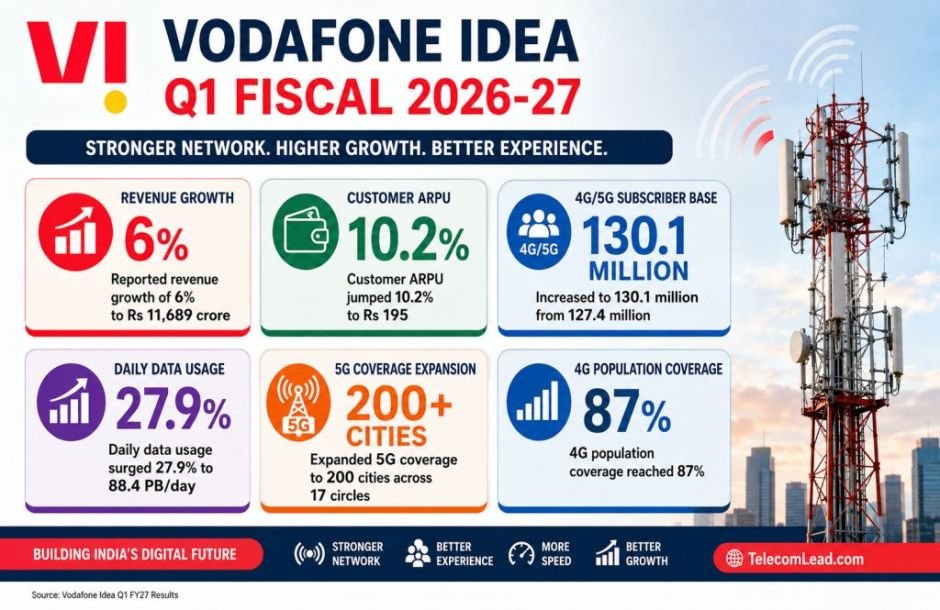
Vodafone Idea’s Q1 FY27 performance: revenue rose 6.0 percent to Rs 11,689 crore, customer ARPU jumped 10.2 percent to Rs 195, data traffic surged 27.9 percent to 88.4 PB per day, 4G/5G subscribers reached 130.1 million, and 5G coverage expanded to more than 200 cities.
The performance comes as Vodafone Idea steps up network investment to close its coverage gap with larger rivals and improve customer experience across India’s highly competitive telecom market.
Vodafone Idea Revenue Rises 6 Percent, EBITDA Grows 9.1 Percent
Vodafone Idea reported Q1 FY27 revenue of Rs 11,689 crore, an increase of 6.0 percent year on year and 3.2 percent quarter on quarter.
EBITDA increased 9.1 percent year on year to Rs 5,034 crore, outpacing revenue growth. Vodafone Idea’s capex was Rs 1,930 crore during the quarter as the operator continued investing in 4G expansion, 5G rollout and upgrades to its core and transmission networks.
Network investment is increasingly important for Vi as rising smartphone consumption pushes significantly more traffic onto its mobile broadband infrastructure.
Vodafone Idea ARPU Jumps 10.2 Percent to Rs 195
One of the strongest indicators in the quarter was improvement in customer monetisation.
Customer ARPU excluding M2M increased 10.2 percent to Rs 195 from Rs 177 in Q1 FY26, which Vodafone Idea said was the highest year-on-year ARPU growth in the industry. Customer upgrades were the primary driver.
Blended ARPU also improved to Rs 177 from Rs 165 a year earlier.
At the same time, blended churn improved to 3.8 percent from 4.4 percent, providing another positive signal for customer retention.
Vi Subscriber Base Returns to Sequential Growth
Vodafone Idea ended Q1 FY27 with 193.1 million subscribers, up from 192.8 million in Q4 FY26, marking the company’s first quarter of net subscriber additions since the merger.
The year-on-year picture remains more challenging, however. The subscriber base was 197.7 million in Q1 FY26, meaning Vi still had 4.6 million fewer customers than a year earlier.
The composition of the subscriber base improved. Postpaid subscribers jumped to 31.9 million from 26.6 million, an increase of 5.3 million.
Total data subscribers increased to 136.0 million from 134.8 million, while the 4G/5G subscriber base grew to 130.1 million from 127.4 million, adding 2.7 million customers year on year.
VLR subscribers declined to 167.0 million from 172.7 million.
These figures suggest Vodafone Idea is increasingly focused not simply on subscriber volume but on attracting and retaining customers who generate higher ARPU and consume more mobile data.
Vi Data Traffic Surges 27.9 Percent to 88.4 PB Per Day
Data consumption was another major growth indicator.
Vodafone Idea’s daily data usage surged 27.9 percent to 88.4 PB per day from 69.1 PB per day in Q1 FY26.
Average data consumption per 4G/5G subscriber increased sharply to 21.7 GB from 17.3 GB over the same period.
Voice usage was comparatively subdued. Total minutes of use decreased to 341 billion minutes from 350 billion minutes, while average minutes of use per user remained unchanged at 590 minutes.
The divergence between voice and data consumption highlights the growing importance of mobile broadband to Vi’s network strategy.
Vodafone Idea 5G Reaches More Than 200 Cities
Vodafone Idea has expanded its 5G network to more than 200 cities across the 17 key circles where it holds 5G spectrum.
The operator is simultaneously expanding 4G capacity by deploying additional sites and upgrading its core and transmission infrastructure.
The dual 4G and 5G strategy is important because a large portion of Vi’s customer base still depends on 4G, while growing 5G smartphone adoption is creating demand for higher network speeds and capacity.
Vi 4G Coverage Rises to 87 Percent
Vodafone Idea’s 4G population coverage increased to 87.0 percent in June 2026 from 84.1 percent in Q1 FY26.
The company said it has brought an incremental 39.4 million people under its 4G footprint since Q1 FY26.
The number of census towns and villages covered by Vi’s 4G network increased to 429,730 from 395,827.
Vodafone Idea expects planned investments to push 4G population coverage beyond 95 percent across its 17 circles.
Its 2G footprint remained stable, covering 487,173 census towns and villages, while 2G population coverage remained at 91.3 percent in both Q1 FY26 and Q1 FY27.
Vodafone Idea Broadband Sites Jump to 580,883
Vi’s infrastructure expansion provides another indication of the scale of its network investment.
Total unique towers increased to 209,269 from 197,139 between Q1 FY26 and Q1 FY27.
More importantly for mobile data capacity, unique broadband towers increased to 204,893 from 189,229. Vodafone Idea said it added more than 15,600 unique broadband towers during the last 12 months.
The operator’s total broadband sites expanded to 580,883 from 516,183, representing an addition of 64,700 sites in one year.
The expansion is aimed at increasing network capacity, extending geographic coverage and improving indoor mobile broadband experience.
Can Vodafone Idea Turn Network Expansion Into Subscriber Growth?
Vodafone Idea’s Q1 FY27 numbers show a notable contrast. Its 193.1 million subscriber base remains below the 197.7 million recorded a year earlier, and VLR subscribers have also fallen. However, the sequential return to subscriber growth, expansion of postpaid customers and increase in 4G/5G subscribers offer encouraging signals.
More importantly, customers are becoming more valuable and data intensive. Customer ARPU increased 10.2 percent, data traffic jumped 27.9 percent and average 4G/5G data consumption climbed from 17.3 GB to 21.7 GB.
With Rs 1,930 crore quarterly capex, more than 200 5G cities, 87.0 percent 4G population coverage, nearly 205,000 unique broadband towers and 580,883 broadband sites, Vodafone Idea is building additional network capacity to support that consumption.
The key test ahead will be whether this investment can help Vi sustain net subscriber additions, push 4G coverage beyond its 95 percent target, accelerate 5G adoption and translate rapidly growing data consumption into stronger revenue and ARPU growth.
BABURAJAN KIZHAKEDATH