Japan continues to set the global benchmark for high-speed broadband in 2026, making it one of the best countries for consumers seeking ultra-fast fiber internet. With 99.9 percent residential FTTH coverage, widespread 10 Gbps fiber services, and advanced optical infrastructure, Japanese internet providers are competing on speed, Wi-Fi performance, bundled services, and customer experience rather than network availability.
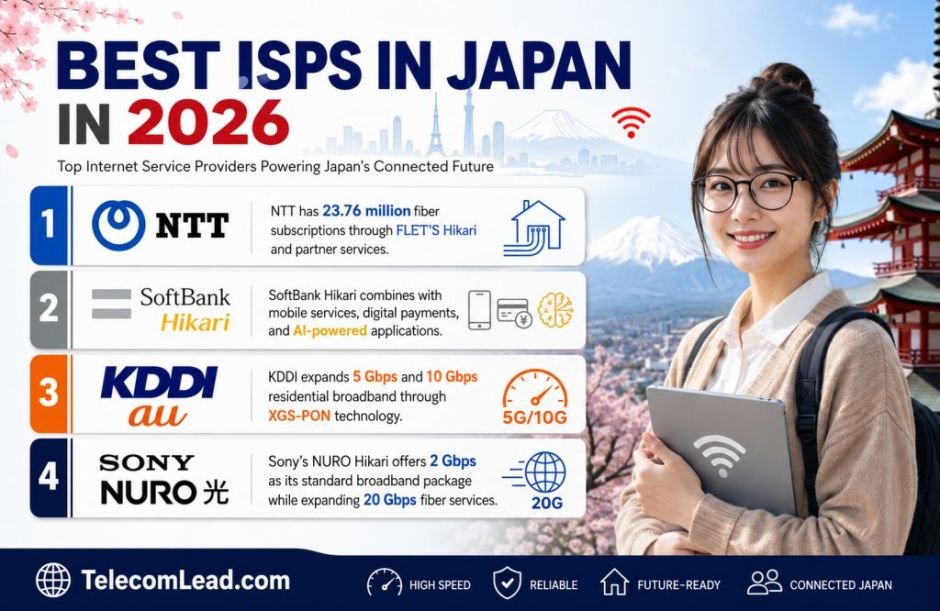
For customers looking for the best ISP in Japan, providers now differentiate themselves through multi-gigabit broadband, mobile bundles, AI-powered network management, and premium home Wi-Fi solutions.
Japan’s Fiber Broadband Market Reaches Near-Universal Coverage
Japan’s fixed broadband market has matured into one of the world’s most advanced digital infrastructures. National internet traffic continues growing by 14.6 percent annually, driven by 4K and 8K streaming, cloud gaming, remote work, and a smart home market valued at more than US$11 billion.
Nearly all major internet providers now deploy IPv6 IPoE technology, reducing network congestion and delivering more consistent broadband performance during peak hours.
NTT Group Leads Japan’s Broadband Market
The NTT Group remains Japan’s largest broadband provider with approximately 64 percent market share and supports more than 23.76 million active fiber subscriptions through FLET’S Hikari and partner services.
The company is investing heavily in its Innovative Optical and Wireless Network (IOWN), designed to reduce power consumption by 100 times while increasing transmission capacity by 125 times. The future network also targets sub-1 millisecond latency for AI applications, autonomous vehicles, and industrial automation.
SoftBank Strengthens Ecosystem Strategy
SoftBank holds approximately 20.7 percent of Japan’s FTTH market and serves around 7.7 million home broadband subscribers.
Its broadband strategy combines SoftBank Hikari with mobile services, digital payments, and AI-powered applications. The company is also integrating its 460-billion parameter large language model into future digital services while promoting fixed-mobile convergence.
KDDI Expands High-Speed Fiber
KDDI controls around 13.5 percent of the broadband market with approximately 5 million fiber subscriptions.
The operator continues expanding 5 Gbps and 10 Gbps residential broadband through XGS-PON technology while leveraging its independently owned fiber infrastructure to deliver consistent performance across major metropolitan markets.
NURO Hikari Delivers Premium Broadband Speeds
Sony’s NURO Hikari has become Japan’s fastest-growing premium fiber provider with approximately 1.5 million subscribers and around 4 percent national market share.
The service offers 2 Gbps as its standard broadband package while expanding 20 Gbps fiber services in Tokyo and Kanagawa. Customers also receive Wi-Fi 7 routers designed to maximize multi-gigabit wireless performance for gaming and remote work.
Other Broadband Providers
Beyond the market leaders, cable providers such as J:COM and smaller ISPs collectively account for the remaining 1.8 percent of Japan’s fiber broadband market.
Specialized providers including Sakura Fiber Internet and Asahi Net continue attracting international residents through English-language customer support and flexible contract options.
Japan’s Broadband Speeds Continue to Improve
Japan has entered the mainstream 10 Gbps broadband era.
Across all internet technologies, the national median download speed reaches approximately 280 Mbps, while households connected directly to fiber typically experience median download speeds of around 540 Mbps.
Real-world wired performance on 10 Gbps fiber connections commonly ranges between 6 Gbps and 8.5 Gbps.
To fully utilize multi-gigabit connections, providers increasingly bundle Wi-Fi 7 routers featuring 320 MHz wireless channels.
Broadband Pricing in Japan
Japanese broadband pricing remains highly competitive, particularly when combined with mobile subscriptions.
Typical monthly pricing includes:
1 Gbps fiber: 4,400-6,500 JPY
10 Gbps fiber: starting from 6,380 JPY
Most households use Set-Wari mobile discounts, reducing monthly mobile bills by 1,100 JPY per line.
For a family of four, savings can reach 4,400 JPY per month, effectively making home broadband nearly free through bundled discounts.
What Internet Customers Want in 2026
Consumers increasingly expect ISPs to deliver excellent in-home wireless performance rather than simply providing fast fiber connections.
Approximately 44 percent of customers are willing to pay between 500 JPY and 2,000 JPY per month for managed smart Wi-Fi services featuring AI optimization, automated bandwidth allocation, enhanced cybersecurity, and seamless coverage throughout the home.
Customer Challenges
Despite Japan’s advanced broadband infrastructure, customer satisfaction still has room for improvement.
Only 21 percent of broadband users describe themselves as very satisfied, while approximately 51 percent experience occasional connectivity issues.
The most common complaints include home Wi-Fi coverage problems, video buffering during busy hours, reliance on AI chatbots instead of human support, complex contracts, high exit fees, and confusion surrounding the new Universal Service Charge for Broadband.
Investment Continues Across Fiber Networks
Investment in Japan’s broadband industry is projected to reach US$26.4 billion during 2026.
Operators continue shifting investment away from legacy copper infrastructure toward photonic networking, edge computing, and next-generation optical technologies.
Meanwhile, 5G Fixed Wireless Access (FWA) has become the fastest-growing broadband segment, accounting for 5.7 percent of the market by providing plug-and-play internet for renters and temporary residents.
Outlook for Japan’s Broadband Market
Japan remains one of the world’s most attractive broadband markets for internet customers seeking reliable, high-speed connectivity.
With 99.9 percent FTTH coverage, widespread 10 Gbps services, growing adoption of Wi-Fi 7, and increasing investment in optical infrastructure, providers including NTT Group, SoftBank, KDDI, NURO Hikari, J:COM, Sakura Fiber Internet, and Asahi Net continue raising the standard for broadband performance. For consumers, the best ISP depends on location, desired speed, mobile bundle savings, customer support, and demand for premium home Wi-Fi experiences.
FASNA SHABEER