Enterprise demand for next-generation Wi-Fi infrastructure is accelerating rapidly as businesses increase investments in AI workloads, industrial automation, IoT, healthcare connectivity, education technology, and smart venue experiences, according to a new report from ABI Research.
ABI Resesarch
The report highlights explosive growth in 6 GHz-enabled Wi-Fi devices and argues that governments and regulators must preserve full access to unlicensed 6 GHz spectrum while identifying additional spectrum resources to support future enterprise demand.
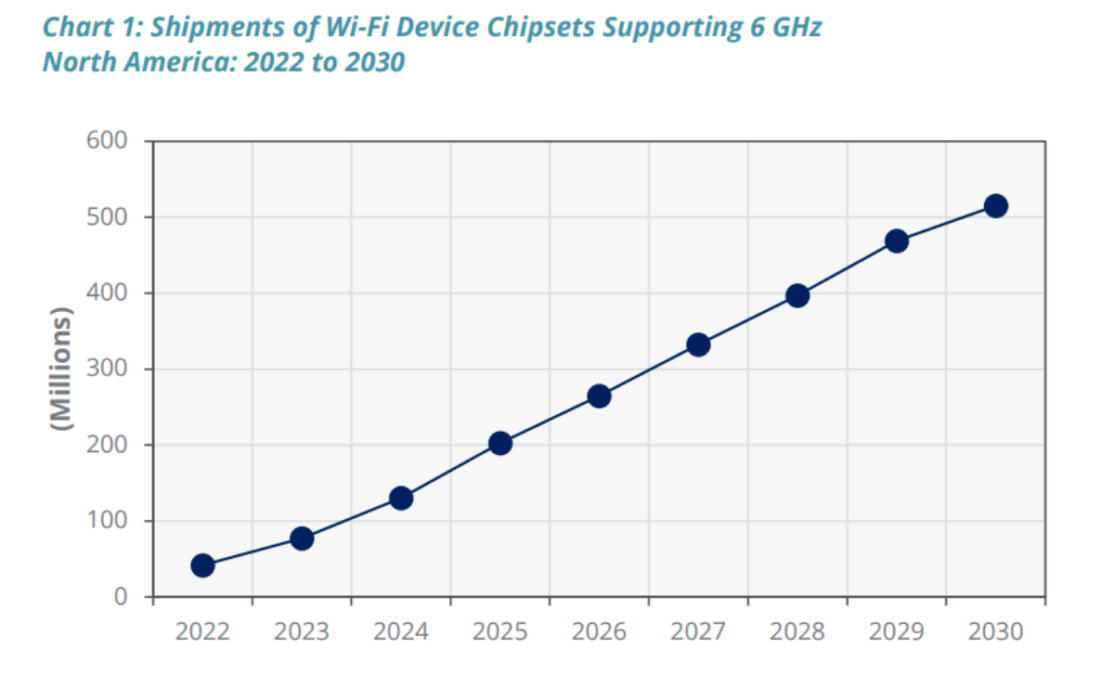
ABI Research said annual global shipments of 6 GHz-enabled Wi-Fi chipsets surged from 200 million in 2022 to 1.1 billion in 2025 and are projected to reach 2.6 billion by 2030. In North America alone, shipments of 6 GHz Wi-Fi chipsets are forecast to climb from 41.8 million in 2022 to 515.2 million in 2030.
The report noted that enterprise adoption of the full 6 GHz band has accelerated because businesses increasingly depend on Wi-Fi for AI applications, Industrial IoT, automation, robotics, digital collaboration, and mission-critical operations. Wi-Fi networks are also becoming essential for AI inferencing, continuous model training, connected sensors, and real-time data collection across enterprise environments.
ABI Research emphasized that the 6 GHz band has become strategically important for enabling Wi-Fi 7 and the upcoming Wi-Fi 8 standard, which is designed to deliver ultra-high reliability, lower latency, and deterministic connectivity for enterprise applications. The report said Wi-Fi 8 chipset shipments are expected to jump from 15.5 million units in 2027 to nearly 600 million by 2030. Wi-Fi 8 networking chipset shipments are projected to increase from 12.6 million in 2028 to 85.6 million in 2030.
ABI Research said the introduction of the full 1200 MHz 6 GHz spectrum band by the U.S. Federal Communications Commission in 2020 enabled wider 320 MHz channels, significantly improving throughput, latency, and network capacity for enterprise deployments.
The study highlighted that the United States has emerged as the global leader in enterprise Wi-Fi innovation because regulators allowed full access to the 6 GHz band. In comparison, Europe allocated only the lower portion of the band, limiting enterprise performance and reducing adoption of advanced Wi-Fi infrastructure. ABI Research estimates that 98.7 percent of Wi-Fi access points shipped in the United States in 2026 will support 6 GHz, compared with 67.3 percent in Europe.
Education has emerged as one of the largest enterprise Wi-Fi growth sectors. ABI Research said 96 percent of students surveyed across 71 U.S. universities identified Wi-Fi as the most important technology feature for learning. Four out of five students connect at least two devices daily to campus networks, driving demand for higher-capacity infrastructure.
The report forecasts that 73.9 percent of all Wi-Fi access points shipped to the global education sector by 2030 will support 6 GHz, while North America will reach 98.1 percent adoption. Global shipments of 6 GHz-enabled access points to educational campuses reached nearly 1 million units in 2025.
Sports stadiums and entertainment venues are also rapidly increasing Wi-Fi investments. ABI Research said data traffic at major events continues to rise sharply as fans stream content, upload videos, access digital ticketing systems, and use interactive applications.
At a U.S. NCAA Division 1 football stadium, peak Wi-Fi bandwidth increased from 9.8 Gbps in 2023 to 16.9 Gbps in 2024 after enabling 6 GHz networking, while total traffic volumes rose from 9.4 TB to 13.4 TB. By 2025, total traffic reached 17 TB.
ABI Research projects that shipments of 6 GHz Wi-Fi access points to stadiums worldwide will grow at a 40.8 percent CAGR between 2024 and 2030, with 97.4 percent of all stadium Wi-Fi access points in North America expected to support 6 GHz by 2030.
Healthcare is another major growth area as hospitals increasingly rely on Wi-Fi for patient monitoring, virtual care, IoT medical devices, RTLS systems, and secure data management. ABI Research expects annual Wi-Fi access point shipments to healthcare facilities to rise from 2.1 million in 2025 to 3.3 million in 2030.
The report said 6 GHz-compatible Wi-Fi access points in healthcare will increase from 21.8 percent of shipments in 2025 to 70.4 percent globally by 2030, while North America will reach 97.9 percent penetration.
Manufacturing and industrial sectors are also driving demand for advanced Wi-Fi. ABI Research forecasts the installed base of autonomous warehouse robotics in North America will nearly double from 13,648 deployments in 2025 to 26,982 by 2032, supported by 6 GHz-enabled wireless networking.
The report projects that the percentage of ruggedized industrial Wi-Fi access points supporting 6 GHz will increase globally from 6.9 percent in 2024 to 74.8 percent by 2030. In North America, adoption is forecast to rise from 18.4 percent to 88.9 percent during the same period.
ABI Research concluded that enterprise demand for Wi-Fi networking, AI-enabled connectivity, and next-generation wireless applications will continue to accelerate sharply throughout the decade, making additional unlicensed spectrum increasingly critical for future digital infrastructure growth.
BABURAJAN KIZHAKEDATH