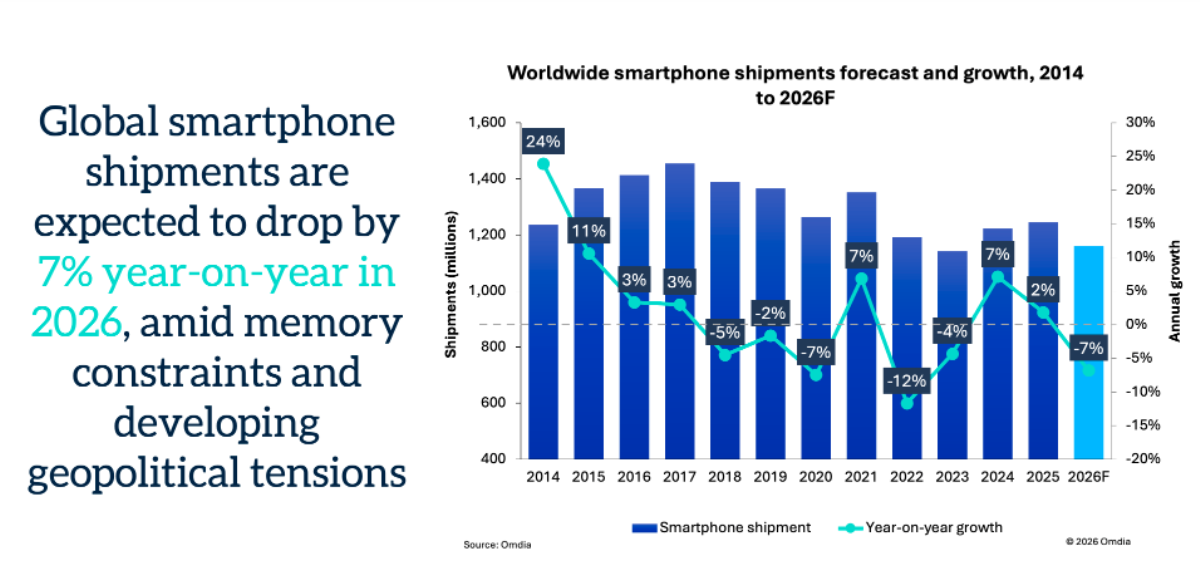
The global smartphone market is projected to face another challenging year in 2026, with shipments forecast to decline by around 7 percent, according to insights from Omdia. Rising memory prices, supply constraints, and geopolitical volatility are expected to reshape demand patterns across price segments and pressure vendor profitability, Omdia report said.
Here are 10 key facts defining the smartphone market outlook for 2026:
Global shipments to drop 7 percent in 2026
Worldwide smartphone volumes are expected to contract due to sustained cost pressures and weaker consumer demand, particularly in price-sensitive regions.
Risk of deeper 15 percent decline under downside scenario
If memory supply remains tight and AI server demand absorbs production capacity, shipment declines could exceed 15 percent, surpassing the 12 percent contraction recorded in 2022.
Memory costs drive bill of materials higher
Memory now accounts for a significantly larger share of the smartphone bill of materials, eroding margins, especially in entry-level devices.
Retail price increases already underway
Since Q4 2025, smartphone brands have started raising retail prices to protect profitability, which may further dampen demand in emerging markets.
Ultra-low-cost segment below $100 to plunge 31 percent
Devices priced under $100 are forecast to see the sharpest decline, reflecting extreme margin pressure and high sensitivity to macroeconomic shifts, Zaker Li, Principal Analyst at Omdia, said.
Core $100 to $399 segment also under pressure
The mass-market price bands, which account for the bulk of global shipments, are expected to contract as higher component costs push up retail prices.
Entry-focused vendors face supply disadvantages
Brands relying heavily on LPDDR4X memory and operating on thin margins may encounter production constraints and double-digit shipment declines.
Premium smartphones above $800 to grow 4 percent
The high-end segment is forecast to remain resilient, supported by stronger pricing power and brand loyalty.
Apple and Samsung gain structural advantages
Apple continues to dominate the premium tier with strong supply chain leverage and higher margins, while Samsung benefits from vertical integration and in-house semiconductor capabilities.
Supply chain consolidation likely to accelerate
Slowing entry-level demand is expected to pressure mid- and low-end component suppliers, increasing consolidation risks among smaller ODMs and specialized vendors.
2026 is shaping up as a year of structural adjustment for the global smartphone industry. Vendors are expected to prioritize higher-value product innovation, stricter cost control, and disciplined production planning, while channel partners focus on tighter inventory management to navigate slower upgrade cycles and ongoing macroeconomic uncertainty.
BABURAJAN KIZHAKEDATH