
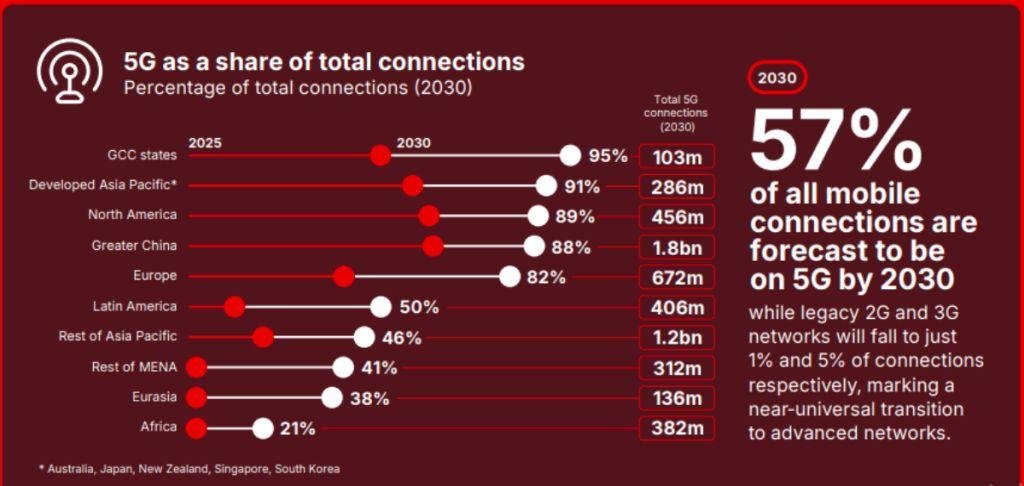
The GSMA report unveiled at Mobile World Congress 2026 projects that 57 percent of global mobile connections will operate on 5G networks by 2030, marking a decisive shift toward next-generation connectivity. As 5G adoption accelerates worldwide, legacy technologies are set to fade rapidly, with 2G and 3G expected to account for just 1 percent and 5 percent of total connections, respectively, by the end of the decade.
Regional 5G Adoption Trends
5G penetration will vary significantly across regions. The GCC States are forecast to lead globally with 95 percent of mobile connections on 5G by 2030. Developed Asia Pacific will follow at 91 percent, while North America is projected to reach 89 percent adoption, GSMA report said.
Greater China will achieve 88 percent 5G penetration but remain the largest 5G market globally in terms of scale, with 1.8 billion connections. Europe is expected to record 82 percent adoption, and Latin America will reach 50 percent.
Emerging markets will experience slower penetration but strong volume growth. Rest of Asia Pacific is forecast at 46 percent, Rest of MENA at 41 percent, Eurasia at 38 percent, and Africa at 21 percent. Notably, Africa alone is projected to have 382 million 5G connections by 2030, underlining significant long-term growth opportunities.
Telecom Revenue Growth and Capex Outlook
The telecom industry outlook points to steady financial expansion. Global operator revenues are projected to rise from $1.19 trillion in 2025 to $1.36 trillion by 2030. Between 2025 and 2030, operators are expected to invest $1.2 trillion in capital expenditure to expand networks and upgrade technology infrastructure, reinforcing the 5G rollout and digital transformation initiatives.
Mobile Industry Economic Contribution
In 2025, mobile technologies and services generated $7.6 trillion in economic value, accounting for 6.4 percent of global GDP. Productivity gains contributed the largest share at $4.8 trillion, while the direct contribution of the mobile ecosystem reached nearly $2 trillion.
The mobile ecosystem spans three primary segments: mobile operators; infrastructure and equipment providers including tower companies, network vendors, device manufacturers and IoT suppliers; and content and services providers such as app developers, distributors, retailers and mobile cloud companies.
By 2030, mobile’s contribution to the global economy is expected to grow to $11.3 trillion, representing 8.4 percent of global GDP. This growth will be driven by expanding mobile connectivity and accelerating enterprise adoption of advanced technologies such as 5G, IoT and AI. Mobile’s economic contribution is forecast to grow at a CAGR of 8.4 percent toward the end of the decade, significantly outpacing projected global GDP growth of 2.6 percent between 2026 and 2030.
Employment Impact
The mobile ecosystem directly supported 31 million jobs worldwide in 2025 and indirectly generated an additional 19 million jobs across other sectors. In total, the industry supported 50 million jobs globally, highlighting its expanding role in driving economic development and digital transformation.
BABURAJAN KIZHAKEDATH

