Global telecom capital expenditure is entering a new phase in 2026 as operators shift investment from large-scale 5G coverage rollouts toward fiber, 5G-Advanced, AI infrastructure, cloud platforms, data centers, computing capacity and network automation.
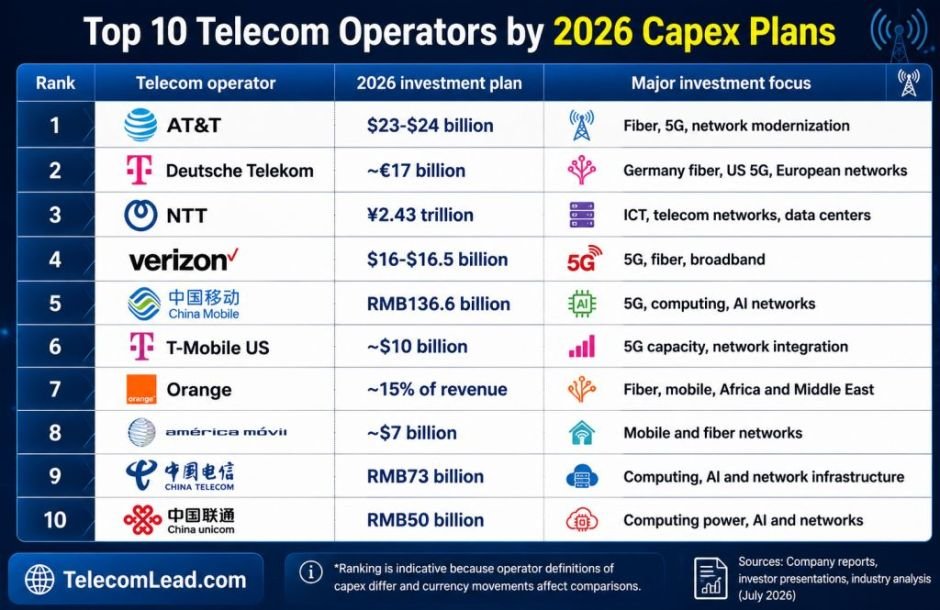
Based on announced company guidance and investment plans, AT&T is positioned among the world’s biggest telecom investors in 2026 with annual capital investment of $23 billion-$24 billion, while Deutsche Telekom expects cash capex of around €17 billion. China Mobile plans RMB136.6 billion of capital expenditure as it sharply increases investment in computing and AI networks.
The comparison requires some caution because telecom groups use different definitions. AT&T reports “capital investment”, Deutsche Telekom reports cash capex before spectrum, Orange uses eCAPEX, and several Asian operators report consolidated capital investment covering businesses beyond traditional telecom networks. Currency movements also affect rankings when figures are converted into dollars.
Industry-wide investment is nevertheless expected to soften. The Dell’Oro Group global telecom capex outlook points to continued pressure on operator investment as major 5G and fiber deployment cycles mature. The composition of spending, however, is changing rapidly toward AI, computing, fiber and network capacity.
1. AT&T: $23-$24 Billion Annual Capital Investment
AT&T stands at the top of the 2026 telecom investment ranking based on its current guidance. According to the AT&T 2026-2028 capital investment outlook, the US operator expects capital investment of $23 billion-$24 billion annually between 2026 and 2028.
AT&T’s spending strategy is particularly significant because the company is simultaneously investing heavily in fiber and wireless infrastructure. Its acquisition of Lumen’s mass-market fiber business for $5.75 billion further expands the company’s fiber footprint.
The network strategy is part of a much larger AT&T $250 billion US connectivity investment commitment through 2030, covering infrastructure and technologies required to address expanding connectivity and network demand.
The strategy contrasts with the broader telecom capex slowdown. Omdia notes that while Verizon intends to reduce capex and T-Mobile expects spending to remain flat or decline, AT&T is increasing investment, particularly around FTTP and 5G network modernisation. US telecom capital intensity was only 13.6 percent in 2025, compared with a global average of 15.9 percent.
AT&T therefore represents one of the strongest exceptions to the global trend of moderating telecom network investment.
2. Deutsche Telekom: Around €17 Billion
Deutsche Telekom expects cash capex before spectrum investment of around €17 billion in 2026, placing the European telecom giant among the world’s biggest network investors.
Investment will continue across Germany, the United States and other European markets. The group’s spending is particularly significant because Deutsche Telekom consolidates T-Mobile US, meaning its global investment footprint spans Europe’s largest economy and one of the world’s most competitive 5G markets.
The company expects capital expenditure to decline in 2027 as the heightened investment associated with the integration of UScellular starts winding down.
Analyst consensus in June placed Deutsche Telekom’s FY2026 cash capex at approximately €16.79 billion, followed by €16.63 billion in 2027 and €17 billion in 2028.
Deutsche Telekom’s investment strategy increasingly combines conventional mobile and fiber expansion with cloud, digital infrastructure, automation and network modernisation.
3. NTT: ¥2.43 Trillion Capital Investment
Japan’s NTT plans consolidated capital investment of approximately ¥2.43 trillion in FY2026, compared with ¥2.326 trillion in FY2025.
NTT’s investment profile is broader than that of a conventional mobile operator because the group operates telecom networks, enterprise ICT infrastructure, data centers and global technology businesses.
During Q1 FY2026 alone, capital investment reached ¥511.8 billion, up from ¥456.5 billion in the corresponding period.
Of that quarterly investment, the Integrated ICT Business accounted for ¥197 billion, Global Solutions for ¥168 billion, Regional Communications for ¥96.6 billion and other operations, including real estate and energy, for ¥50.1 billion.
NTT therefore illustrates how the definition of telecom capex is expanding beyond radio and fiber networks into data centers, enterprise infrastructure and other forms of digital infrastructure.
4. Verizon: $16-$16.5 Billion
Verizon expects capital expenditure of $16 billion-$16.5 billion in 2026.
The spending supports Verizon’s mobile network, 5G capacity, fiber expansion and broadband strategy. The operator is increasingly using its network investments to compete across both mobile and fixed broadband markets.
Verizon’s capex strategy is more disciplined than during the peak phase of its nationwide 5G rollout. This illustrates a wider trend among mature 5G operators: spending is moving away from basic geographic coverage and toward capacity, fiber backhaul, network efficiency and monetisation.
Fixed wireless access is particularly important because it allows Verizon to generate additional revenue from spectrum and 5G infrastructure originally deployed primarily for mobile customers.
5. China Mobile: RMB136.6 Billion
China Mobile plans RMB136.6 billion of capex in 2026, approximately 9.5 percent below its RMB150.9 billion investment in 2025.
The reduction, however, hides a major change in investment priorities.
China Mobile plans to increase investment in computing networks by 62.4 percent and AI networks by 19.8 percent. Computing and AI networks together will account for more than 37 percent of investment across its three principal network categories.
China Mobile’s intelligent computing capacity had already reached 92.5 EFLOPS, while computing service revenue approached RMB90 billion in 2025, increasing more than 11 percent. Intelligent computing service revenue surged 279 percent.
China Mobile’s strategy is consequently one of the clearest demonstrations of the telecom industry’s capex transition: total investment is declining while AI-related infrastructure investment is accelerating dramatically.
6. T-Mobile US: Around $10 Billion
T-Mobile US expects approximately $10 billion in cash purchases of property and equipment in 2026, including capitalised interest.
Its investment profile differs from AT&T because much of T-Mobile’s nationwide 5G coverage build has already been completed. The emphasis is increasingly on adding network capacity, integrating acquired assets and maintaining its 5G performance advantage.
The company raised several elements of its financial guidance following Q1 2026 but retained its approximately $10 billion capital expenditure expectation.
T-Mobile expects 950,000-1.05 million postpaid net account additions in 2026 and Core Adjusted EBITDA of $37.1 billion-$37.5 billion, highlighting the increasing emphasis on generating returns from the network investment already made.
7. Orange: Capex Target Around 15 Percent of Revenue
Orange has set its 2026 eCAPEX target at approximately 15 percent of revenue. The company spent €3.2 billion during the first half of 2026, representing 15.2 percent of revenue.
First-half eCAPEX increased 2.7 percent, driven primarily by higher investment in Africa and the Middle East. Excluding those markets, Orange’s eCAPEX declined 2.4 percent and represented approximately 14 percent of revenue.
Orange’s investment strategy covers fiber, mobile capacity, 5G, enterprise infrastructure and rapidly expanding networks in Africa and the Middle East.
The company had spent €1.542 billion in Q1 2026, equivalent to 15.3 percent of revenue, showing that investment remained closely aligned with its full-year target.
The geographic difference is significant because it demonstrates that telecom investment cycles are increasingly diverging. Mature European networks can reduce some infrastructure spending while markets with stronger subscriber and data growth continue to require network expansion.
8. America Movil: Around $7 Billion Annually
America Movil is targeting approximately $7 billion of annual capital expenditure through 2028, according to its investor outlook reported in May 2026.
Earlier guidance indicated that the Latin American telecom giant expected capital expenditure to remain around 14-15 percent of revenue in 2026 and subsequent years.
The investment will support mobile networks, 5G expansion, fiber and broadband infrastructure across America Movil’s extensive Latin American operations.
The company expects service revenue to grow at an average 4-5 percent annually between 2026 and 2028, according to its longer-term investor targets.
For America Movil, maintaining investment across multiple Latin American markets remains important as rising mobile data consumption, fiber adoption and 5G expansion create additional network capacity requirements.
9. China Telecom: RMB73 Billion
China Telecom expects to invest approximately RMB73 billion in 2026, down 9.2 percent from RMB80.4 billion in 2025.
Like China Mobile, China Telecom is cutting conventional telecom investment while directing substantially more capital toward computing infrastructure.
Computing infrastructure is expected to account for approximately 35 percent of total capex in 2026, with investment in computing capacity rising 26 percent .
Network infrastructure investment, meanwhile, is expected to decline 26 percent and represent around 41 percent of total capital spending. Another 24 percent will be directed toward integrated information services and supporting infrastructure.
This makes China Telecom another important example of telecom capex shifting from traditional connectivity toward AI, cloud and computing infrastructure.
The numbers also show why headline capex declines can provide an incomplete picture of the telecom equipment market. China Telecom may be spending less overall, but a significantly larger proportion of investment is moving toward computing-intensive infrastructure.
10. China Unicom: RMB50 Billion
China Unicom expects approximately RMB50 billion of capex in 2026, down from RMB54.2 billion in 2025.
The reduction continues a multi-year trend. China Unicom’s capital expenditure declined from RMB74.2 billion in 2022 to RMB73.9 billion in 2023, RMB61.4 billion in 2024 and RMB54.2 billion in 2025.
The composition of investment is changing sharply, however. More than 35 percent of China Unicom’s 2026 capex will be allocated to computing power, demonstrating the strategic importance of AI infrastructure.
In 2025, capex represented approximately 16 percent of service revenue, down from 23 percent in 2022.
The trajectory shows how network maturity can release capital for new infrastructure priorities. Instead of maintaining the investment levels required during the peak 5G construction period, China Unicom can increasingly direct resources toward computing and AI platforms.
AI and Computing Replace 5G as the Next Telecom Capex Engine
The 2026 ranking reveals an important change in global telecom investment.
The industry is no longer engaged in a uniform race to build nationwide 5G networks. Operators in mature 5G markets are increasingly reducing conventional wireless spending while reallocating capital toward fiber, AI computing, cloud infrastructure, data centers, 5G-Advanced and network automation.
The transformation is occurring alongside a much broader acceleration in AI infrastructure and data center capital expenditure, as hyperscalers and technology companies expand computing infrastructure to support rapidly growing AI workloads.
China provides perhaps the clearest evidence of this transition. China Mobile is cutting overall capex 9.5 percent while increasing computing-network investment 62.4 percent. China Telecom is reducing total investment 9.2 percent while boosting computing infrastructure investment 26 percent. China Unicom is cutting overall capex but directing more than 35 percent toward computing power.
These figures indicate that falling telecom capex does not necessarily translate into uniformly weaker demand for technology suppliers. The addressable opportunity is changing from conventional radio-access expansion toward servers, accelerators, optical networking, routers, data-center infrastructure, cloud platforms and AI-enabled network systems.
AT&T Takes a Different Capex Route
The United States presents a different picture. AT&T plans $23 billion-$24 billion of annual capital investment, significantly above T-Mobile US at approximately $10 billion, because AT&T is pursuing an aggressive combination of fiber expansion and mobile network modernisation.
Verizon sits between them with $16 billion-$16.5 billion of planned 2026 capex.
The difference highlights how operators at different stages of their infrastructure cycles can follow dramatically different spending strategies even within the same telecom market.
T-Mobile has already established extensive nationwide 5G coverage and is increasingly focused on extracting returns from that infrastructure. AT&T, by comparison, sees an opportunity to expand fiber aggressively while simultaneously modernising its wireless network.
What the 2026 Telecom Capex Shift Means for Equipment Vendors
The central message for telecom equipment suppliers is therefore mixed. Global telecom capex may decline in 2026, but the investment opportunity is not disappearing. Instead, billions of dollars are moving from conventional radio coverage toward fiber, high-capacity transport, routers, cloud infrastructure, data centers, AI computing and intelligent networks.
This transition potentially broadens the competitive landscape. Traditional telecom network suppliers are increasingly competing or partnering with cloud, semiconductor, server, optical networking and data-center technology companies as operator infrastructure becomes more computing-intensive.
For Ericsson, Nokia, Huawei and ZTE, conventional RAN investment remains important, particularly in developing 5G markets and as 5G-Advanced deployments expand. However, operators’ changing spending priorities increase the importance of automation, core networks, private networks, cloud-native platforms and AI-enabled network management.
Cisco and Ciena can benefit from greater demand for IP routing and optical capacity as AI and data-center traffic increases network requirements. Meanwhile, the expansion of telecom computing infrastructure potentially creates additional opportunities for semiconductor, server and accelerated-computing suppliers.
The biggest lesson from the 2026 capex plans is therefore not simply that telecom spending is slowing. It is that the definition of telecom infrastructure investment is changing.
The first phase of 5G was dominated by spectrum, radios, antennas and coverage. The next investment phase is increasingly about connecting those networks to fiber, cloud, data centers and enormous pools of computing capacity.
For telecom technology suppliers, where operators spend their capex in 2026 may ultimately matter far more than whether headline global telecom capex rises or falls.
FASNA SHABEER