
Central America’s smartphone market is facing one of its sharpest corrections in years as rising memory costs push up handset prices and weaken demand for affordable devices. Smartphone shipments across the subregion fell 22 percent in 2Q26, according to Omdia, reflecting Central America’s heavy dependence on entry-level and mass-market smartphones.
Devices priced below US$300 accounted for 84 percent of Central American smartphone shipments in 2025, leaving the market particularly exposed to increases in DRAM and NAND costs. Across Latin America, smartphone shipments dropped 12 percent to 30.3 million units in 2Q26, while the regional average selling price increased 25 percent .
The Omdia Latin America smartphone market analysis shows why affordability is becoming critical. Buyers want better cameras, storage, batteries, AI features and 5G, but many are unwilling or unable to accept substantially higher prices.
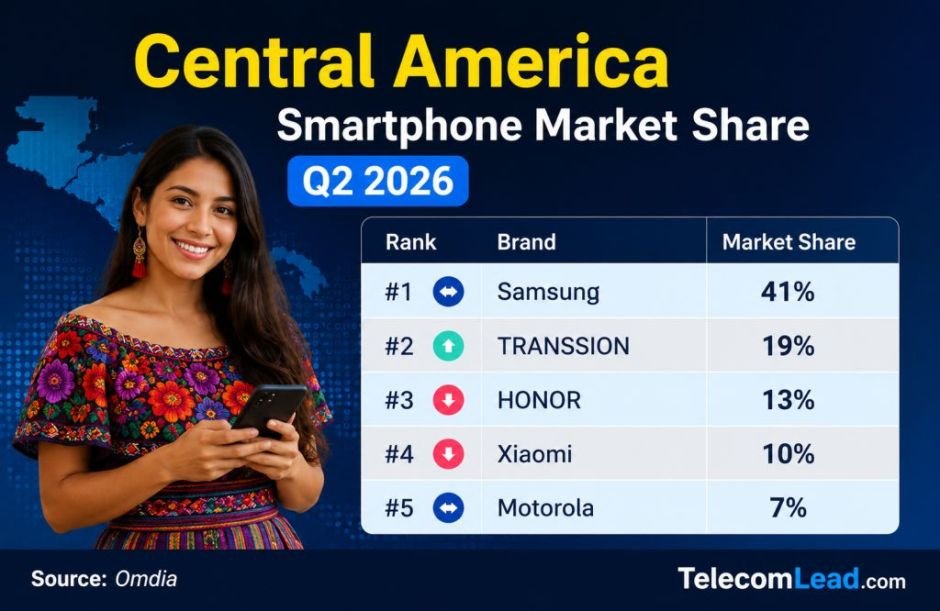
Samsung led Central America in 2Q26 with a 41 percent shipment share, followed by TRANSSION at 19 percent, HONOR at 13 percent, Xiaomi at 10 percent and Motorola at 7 percent.
Samsung Leads Central America Smartphone Market with 41% Share
Samsung’s commanding 41 percent share reflects the importance of its Galaxy A portfolio in a region dominated by smartphones below US$300.
The company has been using discounts and instalment plans to protect demand. In Guatemala, the Galaxy A17 LTE 4GB+128GB has been offered at Q1,599, compared with Q2,299 previously, while the Galaxy A07 4GB+128GB has been priced at Q1,099, down from Q1,199.
The Galaxy A17 8GB+256GB has also been available at approximately Q2,099, with payment options extending to 24 months on eligible purchases.
Samsung’s strategy addresses the central issue facing Central American consumers: whether improvements in cameras, storage and performance are sufficient to justify replacing an existing smartphone.
The company’s Galaxy A smartphone offers in Guatemala demonstrate how discounts and financing are increasingly being used to protect demand.
Samsung also benefits from its scale. Across Latin America, the company shipped 12 million smartphones in 2Q26, increasing shipments 9 percent and raising its regional market share to 39 percent.
TRANSSION Captures 19% with Affordable TECNO, Infinix and itel Phones
TRANSSION ranked second with 19 percent of Central America smartphone shipments, highlighting strong demand for its TECNO, Infinix and itel brands.
Its positioning is particularly suited to a market where buyers increasingly expect high specifications even from relatively inexpensive smartphones.
The TECNO Spark 50, for example, combines a 7000mAh battery, 50MP camera and 120Hz display, giving budget-conscious customers features previously associated with more expensive devices.
In Costa Rica, the Spark 50 has been listed at around ₡89,900, while Guatemala retailers have offered the Infinix Note 50 Pro 8GB+256GB for approximately Q2,249.
TRANSSION’s challenge is maintaining this price-to-specification advantage as memory becomes more expensive. Across Latin America, TRANSSION shipments fell 19 percent in 2Q26 despite returning to fifth position regionally with 2 million units and a 6.4 percent share.
Its Central American performance nevertheless demonstrates the continuing appeal of large batteries, storage and displays at lower prices.
HONOR Takes 13% as AI Moves into the Mid-Range
HONOR captured 13 percent of Central America smartphone shipments, positioning it well ahead of Xiaomi and Motorola during the quarter.
Rather than competing exclusively at the lowest price points, HONOR is trying to persuade consumers to move into higher-value mid-range devices through cameras, displays, batteries and AI.
The HONOR 400 Lite has been listed in Guatemala at around Q2,299, compared with approximately Q2,595 previously.
HONOR is also moving higher with the HONOR 600 family. Retail listings have put the HONOR 600e at about Q4,999, reduced from Q5,999, while the HONOR 600 and 600 Pro address progressively higher price bands.
The strategy matters because premium and upper-mid-range smartphones have proved more resilient to the memory-driven market slowdown. Across Latin America, high-end smartphones represented 12 percent of HONOR’s sales mix in 2Q26.
Xiaomi Holds 10% as Redmi Focuses on Price and Storage
Xiaomi accounted for 10 percent of Central America smartphone shipments in 2Q26.
The company continues to rely heavily on Redmi smartphones that combine aggressive prices with large storage configurations.
The Redmi Note 15 4G 6GB+128GB has been offered in Guatemala for around Q1,599, down from Q1,899. The 8GB+256GB version has been available for approximately Q1,799, while the 8GB+512GB version has been around Q1,999.
Selected purchases can also be financed over periods extending to 36 months.
Xiaomi is therefore targeting customers who evaluate smartphones primarily by how much RAM, storage, battery capacity and camera capability they receive for their budget.
However, the company is exposed to the pressure on affordable devices. Xiaomi’s Latin American shipments fell 27 percent to 4.9 million units in 2Q26, although it remained the region’s second-largest smartphone vendor with a 16 percent share.
Motorola Takes 7% as Claro Financing Reduces Upfront Cost
Motorola captured 7 percent of Central America smartphone shipments.
Operator distribution is an important part of its strategy. Motorola and Claro introduced the motorola signature, Edge 70 Fusion and Moto G17 in Guatemala during 2026.
Under selected 24-month plans, launch pricing included Q950 or Q900 for motorola signature, Q550 for Edge 70 Fusion and Q295 for Moto G17, substantially reducing the upfront cost compared with outright purchases.
The Motorola and Claro 2026 smartphone launch in Guatemala demonstrates the increasingly important role operators play in making more expensive smartphones accessible through monthly payments.
Motorola’s wider Latin American shipments reached 4.4 million units in 2Q26, giving it a 14 percent regional share despite a 15 percent decline. Its high-end and premium smartphone portfolio grew 46 percent, helped by the Edge 70 and Razr 70 series.
Claro Has 26.4 Million Mobile Subscribers Across Central America and Caribbean
The scale of the telecom operators serving Central America is important to smartphone vendors because operators remain major handset distribution, financing and upgrade channels.
América Móvil, which operates primarily through the Claro brand in Central America, reported 26.4 million wireless subscribers across its Central America and Caribbean reporting segment at the end of June 2026, an increase of 5.2 percent .
The company added a net 360,000 mobile subscribers during 2Q26, including 126,000 postpaid customers.
Revenue from América Móvil’s Central America and Caribbean operations increased 7.6 percent to US$1.3 billion in 2Q26. Service revenue rose 7.9 percent and mobile service revenue increased 9.3 percent, accelerating from 8.4 percent growth in the previous quarter.
The postpaid expansion is particularly significant for smartphone makers because consumers on monthly contracts are generally easier to reach with handset financing, upgrades and bundled device offers.
Claro also operates fixed networks in these markets. Its Central America and Caribbean fixed-line base reached 8.6 million revenue-generating units, increasing 6.9 percent after the addition of 121,000 RGUs during the quarter.
Tigo Guatemala Revenue Reaches $440 Million
Millicom’s Tigo is the other major telecom group shaping smartphone distribution across Central America, with operations including Guatemala, Honduras, El Salvador, Nicaragua, Costa Rica and Panama.
Guatemala is one of Millicom’s largest markets. Tigo Guatemala generated US$440 million in revenue during 2Q26, compared with US$417 million a year earlier. Service revenue increased 5.9 percent to US$382 million.
Postpaid customers in Guatemala increased 19 percent , while mobile ARPU grew at a mid-single-digit rate.
The rapid postpaid expansion is particularly relevant to Samsung, HONOR, Xiaomi and Motorola because operator instalment plans can make mid-range and premium smartphones affordable without customers paying the entire device price upfront.
Tigo Panama Generates $182 Million Revenue
Millicom’s Panama operation generated US$182 million in total revenue during 2Q26, while service revenue reached US$175 million.
That compares with revenue of US$177 million and service revenue of US$170 million in 2Q25.
Tigo’s Honduras joint venture generated US$160 million in revenue during the quarter, including US$152 million of service revenue, compared with US$153 million and US$145 million respectively a year earlier.
Millicom does not break out every Central American country’s mobile subscriber count in the same way that América Móvil reports its regional base, so directly comparable country subscriber rankings cannot reliably be constructed from the latest company results.
At group level, however, Millicom ended 2Q26 with 55.8 million mobile customers, including 16.8 million postpaid subscribers. These totals include its broader Latin American portfolio and should not be interpreted as Central America-only figures.
Liberty Latin America Adds Mobile Customers
Liberty Latin America is another important telecom player in Central America, particularly through businesses in Costa Rica and Panama.
The group reported 6.8 million mobile subscribers as of June 30, 2026, alongside 3.9 million fixed revenue-generating units and 4.8 million homes passed. Its annualized first-half revenue was approximately US$4.4 billion. These figures cover Liberty Latin America’s wider Latin American and Caribbean portfolio rather than Central America alone.
Liberty Latin America recorded 45,000 combined postpaid mobile and broadband net additions in 2Q26, following 50,000 postpaid mobile additions across its segments in the first quarter.
For smartphone manufacturers, Claro, Tigo and Liberty provide valuable retail and financing channels that can offset some of the affordability pressure created by higher device prices.
Central America Smartphone Market Is Becoming a Value Battle
Central America’s 22 percent shipment contraction demonstrates how quickly rising smartphone prices can affect a market dominated by affordable devices.
Samsung is currently best positioned, controlling 41 percent of shipments through a broad Galaxy portfolio, extensive operator relationships and aggressive promotions. TRANSSION’s 19 percent share shows that consumers still respond strongly to specifications and low prices, while HONOR’s 13 percent demonstrates growing demand for feature-rich mid-range devices.
Xiaomi, with 10 percent, is using Redmi pricing, storage options and financing to defend its position, while Motorola’s 7 percent share is supported by Moto G affordability and operator financing for more expensive Edge and Signature smartphones.
The telecom market could help support the next upgrade cycle. Claro’s Central America and Caribbean mobile base has reached 26.4 million customers and its mobile service revenue is growing 9.3 percent, while Tigo continues to expand postpaid adoption in markets such as Guatemala. Liberty Latin America is also adding postpaid customers across its footprint.
For smartphone vendors, the message is increasingly clear: Central America is not simply a competition over who launches the newest device. It is a competition over who can deliver the most meaningful upgrade at a price consumers can still afford. Financing, discounts, storage, batteries, cameras, AI and affordable 5G will determine which brands gain share as the market adjusts to higher component costs.
FASNA SHABEER