
Deutsche Telekom has reported strong operating momentum in the first half of 2026, with revenue increasing 2.4 percent year over year to €59.8 billion and service revenue rising 2.8 percent to €50.4 billion.
The growth in revenue at Deutsche Telekom was driven by continued customer additions, expanding broadband and fiber adoption, higher mobile revenues, and sustained investments in digital infrastructure across Germany, the United States and Europe.
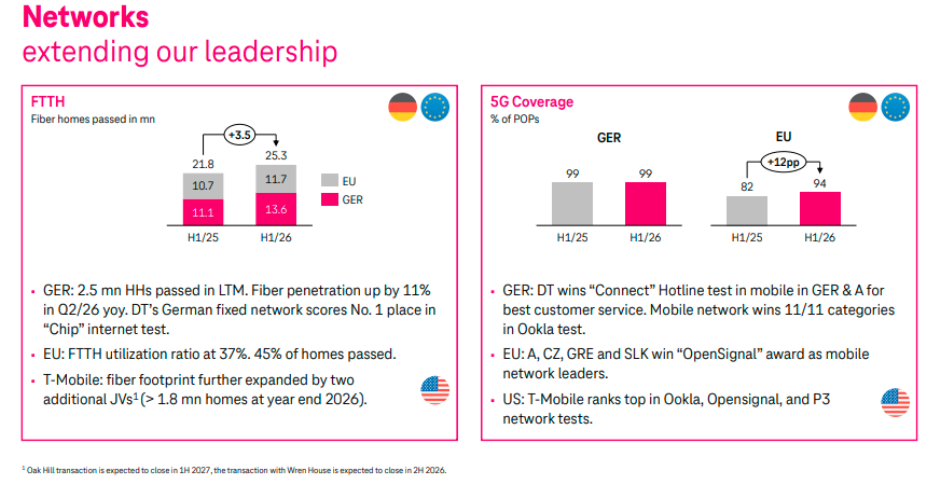
The Germany business generated €12.8 billion in revenue, up 2.7 percent, supported by growth in mobile services, broadband and TV. Mobile customers reached 76.7 million, including 419,000 net additions under the Telekom and congstar contract brands since the end of 2025. The prepaid base increased 3.9 percent, driven by automotive M2M SIM demand. Fiber-based connections reached 21.0 million, retail broadband customers remained stable at 15.1 million, while 58 percent of broadband customers subscribed to plans offering 100 Mbps or higher. TV customers increased by 53,000, or 1.1 percent, and fixed-network lines declined 1.1 percent to 16.6 million. Deutsche Telekom expanded its German fiber footprint to 13.6 million homes and businesses, while its 5G network covered around 99 percent of the population.
Capital expenditure in Germany declined significantly as fiber investments were rescheduled. Cash capex before spectrum fell 21.7 percent, or €490 million, to €1.8 billion, although the company expects full-year investment to increase slightly as fiber deployment accelerates.
The United States remained Deutsche Telekom’s largest growth engine. Revenue increased 2.4 percent to €39.3 billion, while service revenue rose 3.1 percent to €32.4 billion. In U.S. dollar terms, total revenue increased 9.4 percent and service revenue grew 10.2 percent. T-Mobile US ended June with 34.7 million postpaid accounts, compared with 34.2 million at the end of 2025. Postpaid net account additions totaled 494,000, compared with 523,000 a year earlier. Growth was supported by acquisitions including UScellular Wireless Business, Metronet and Lumos, which also contributed to higher Average Revenue per Account (ARPA). Cash capex before spectrum increased 3.1 percent to €4.6 billion, reflecting continued nationwide 5G network expansion and acquisition-related investments. Total cash capex including spectrum declined 4.0 percent to €5.0 billion because spectrum purchases were lower than a year earlier. T-Mobile US also secured 102 AWS-3 spectrum licenses for approximately €0.2 billion (US$0.3 billion).
Across Europe, revenue increased 1.3 percent to €6.3 billion, while service revenue climbed 5.1 percent. Mobile contract customers increased 1.2 percent excluding classification changes, broadband customers grew 1.4 percent, and fixed-mobile convergence (FMC) customers rose 2.5 percent to 9.1 million. The region ended June with 47.0 million mobile customers, 7.8 million broadband customers, 9.1 million fixed-network lines, and 4.5 million TV customers. Deutsche Telekom expanded 5G coverage to an average of 93.9 percent of the population across its European footprint and increased fiber availability to 11.7 million households, representing 44.5 percent coverage, with 391,000 additional homes passed during the first half.
Country performance across Europe remained positive. Greece recorded 2.5 percent revenue growth to €1.7 billion, supported by IT, mobile, broadband and TV services. Hungary posted the strongest growth, with revenue increasing 8.9 percent to €1.2 billion, driven by higher mobile revenue per customer, fiber expansion and TV growth. Poland generated €871 million in revenue, up 1.7 percent, supported by higher contract subscribers, broadband, TV and ARPU growth. Revenue in the Czech Republic increased 6.6 percent to €663 million, with adjusted EBITDA AL rising 12.4 percent to €308 million. Austria reported revenue of €726 million, down 1.5 percent due to lower non-service revenue despite stable service revenue and growing FMC adoption.
At Group level, Deutsche Telekom reduced investment while continuing network expansion. Cash capex before spectrum declined €0.4 billion to €7.8 billion, while cash capex including spectrum decreased €0.8 billion to €8.4 billion. Spectrum investment totaled €0.5 billion, compared with €1.0 billion in the first half of 2025. Investment priorities remained focused on fiber rollout, nationwide 5G deployment, broadband infrastructure and network modernization.
Digital services also contributed to growth. As Germany’s official media rights partner for the 2026 FIFA World Cup, MagentaTV attracted more than 200 million viewers, compared with 70 million during UEFA EURO 2024, setting new records for streaming, social media engagement and marketing. Deutsche Telekom has also secured the German media rights for the 2030 FIFA World Cup, strengthening its digital entertainment strategy.
BABURAJAN KIZHAKEDATH

