
Telecom operators are expanding network design beyond smartphone traffic to address the different requirements of industrial sensors, robots, cameras and connected equipment. These applications place greater emphasis on predictable performance, uplink capacity, device power consumption and dependable coverage.
The transition is visible in 5G RedCap, private mobile networks, edge computing and satellite IoT. By September 2026, 43 operators across 28 countries and territories were investing in RedCap, according to the Global mobile Suppliers Association.
Operators are combining connectivity with device management and computing services. For enterprise customers, the value lies in keeping equipment connected, detecting faults earlier and supporting automation — not simply achieving a higher download speed.
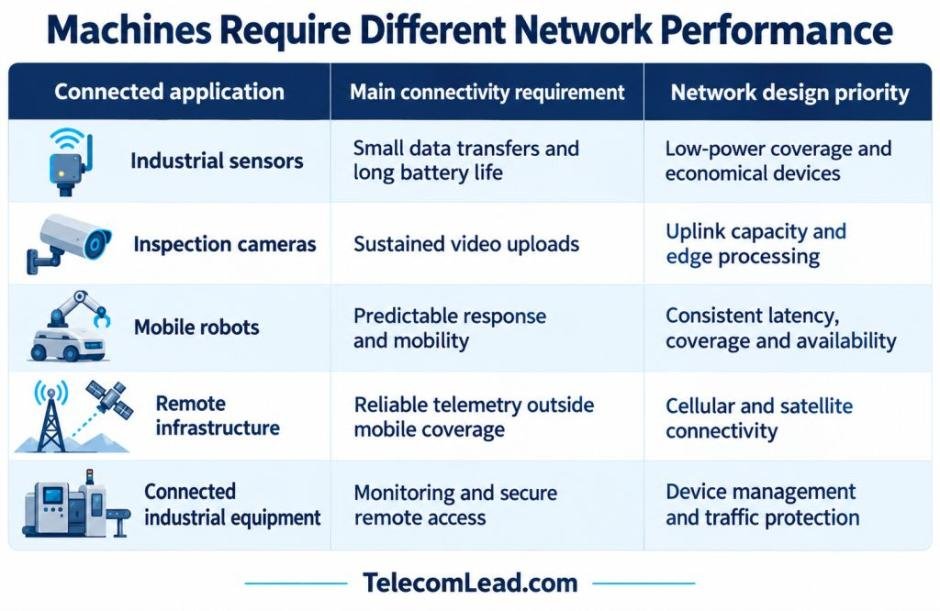
Machines Require Different Network Performance
Machine connectivity covers several distinct traffic patterns. A battery-powered sensor may transmit occasional measurements, while an inspection camera continuously uploads video. A mobile robot may require consistent communications as it moves across a factory. These differences make a single connectivity specification unsuitable for every machine. Operators must match the network service to the application’s actual requirements.
43 Operators Invest in 5G RedCap
RedCap, short for reduced capability, provides a streamlined form of 5G for devices that do not require the full performance of conventional 5G equipment.
The GSA September 2026 RedCap report identifies an ecosystem comprising nine chipsets, 34 modules, 46 customer premises equipment devices, four wearables and four industrial devices.
Recent commercial launches include Rogers Wireless in Canada, Com4 in Norway and Zain in Saudi Arabia. GSA expects enhanced RedCap, or eRedCap, chipsets and devices to become commercially available in early 2027.
RedCap can bridge the gap between lower-capability cellular IoT and full 5G. However, it does not replace every IoT technology. Low-data sensors may remain suited to NB-IoT or LTE-M, while demanding industrial applications may need higher-performance connections.
Investment counts also differ from commercial availability: the 43 operators include companies at different stages of technology adoption.
Private Networks Bring Connectivity Closer to Production
Factories need coverage and service controls tailored to production environments.
GSA’s April 2026 market report identified 374 manufacturing customer deployments of mobile private networks, making manufacturing the largest identified vertical. These are customer deployments, rather than 374 nationwide operator networks.
The same report recorded 95 operators with launched 5G Standalone services and 35 operators investing in 5G-Advanced, including 11 with launched services, using data through March 2026.
Standalone architecture supports capabilities such as network slicing and RedCap, while private networks can provide local coverage, traffic controls and integration with factory systems.
Successful deployment still depends on indoor radio planning, compatible devices and integration with operational technology. A private network’s business case must be tied to measurable production requirements.
AT&T Combines Industrial Connectivity With Edge AI
AT&T introduced Connected AI for Manufacturing in March 2026, working with MicroAI, NVIDIA and Microsoft.
The platform combines 5G, IoT, generative AI and edge processing to connect industrial assets and analyze near-real-time data. Applications include predictive maintenance, equipment-effectiveness monitoring, fault detection and cybersecurity.
AT&T reported that controlled pilots under test operating conditions achieved up to 70 percent less waste on injection-molding lines, 2.5–4 hours of advance warning for pre-failure faults, and a 35 percent improvement in fulfillment-center efficiency. Results varied with the deployment environment, integration and operating practices.
These are pilot outcomes, not guaranteed results for every factory.
The initiative demonstrates a broader commercial opportunity: operators can combine communications with analytics that help manufacturers interpret equipment data and act sooner.
Edge Computing Changes What Machines Transmit
Industrial AI does not always require sending every measurement or video frame to a distant cloud.
Processing data near equipment can reduce transport requirements and shorten the path between observation and action. An inspection camera, for example, can analyze images locally and transmit selected alerts or results.
This changes network planning. Operators must consider where workloads run, how much data crosses the network and what happens if connectivity is interrupted.
Edge computing can support faster decisions, but predictable application performance depends on the complete system, including software, computing capacity and machine interfaces.
Deutsche Telekom Extends IoT Beyond Terrestrial Coverage
Deutsche Telekom’s multi-orbit IoT roaming initiative connects its NB-IoT and LTE-M network with satellite services.
Its February 2026 announcement described GEO connectivity through Skylo and LEO connectivity involving Sateliot and OQ Technology. Multi-orbit operation had been demonstrated using commercially available NB-IoT hardware.
At that point, Skylo connectivity was already used operationally by customers, while other integrations were at validation or development stages.
Applications include remote infrastructure monitoring, maritime tracking and transmitting alerts from edge-AI sensors.
Satellite IoT extends coverage options, but narrowband services should not be treated as substitutes for high-throughput terrestrial connections. They are particularly useful when reliable status messages matter more than large data transfers.
Managed IoT Makes Device Control a Core Service
Connecting machines at scale also requires centralized management of subscriptions, connectivity policies and service issues.
Telefonica reported recognition as a Leader in the 2026 Gartner Magic Quadrant for Managed IoT Connectivity Services Worldwide for the 12th consecutive year.
Its managed IoT connectivity portfolio includes technologies such as 5G and NB-IoT, with the Kite platform providing centralized connectivity management.
For enterprises, managing thousands of devices across locations can be as important as the underlying radio technology. Operators can differentiate through provisioning, troubleshooting, coverage and lifecycle support.
What Will Determine Operator Success?
Machine connectivity creates opportunities across manufacturing, logistics, utilities and remote infrastructure. Capturing them requires services built around application performance and operating economics.
Operators need to demonstrate dependable coverage, suitable latency, efficient device connectivity and manageable integration costs. Enterprise customers will assess outcomes such as reduced downtime, faster fault detection and more reliable asset monitoring.
The network-design shift is toward greater specialization. RedCap addresses mid-tier devices, private networks support local industrial requirements, edge AI processes machine data, and satellite IoT reaches assets outside terrestrial coverage.
Operators that coordinate these capabilities can turn connectivity into a more useful component of industrial operations.
FASNA SHABEER


