
Reliance Jio delivered the fastest mobile download speeds on both the Delhi–Agra highway and Agra–Delhi railway routes in TRAI’s July 2026 network tests, reaching 213.68 Mbps on the highway and 82.68 Mbps on the railway. Vodafone Idea recorded the lowest proportion of poor-signal samples on the highway, while Airtel achieved zero dropped calls on the railway route.
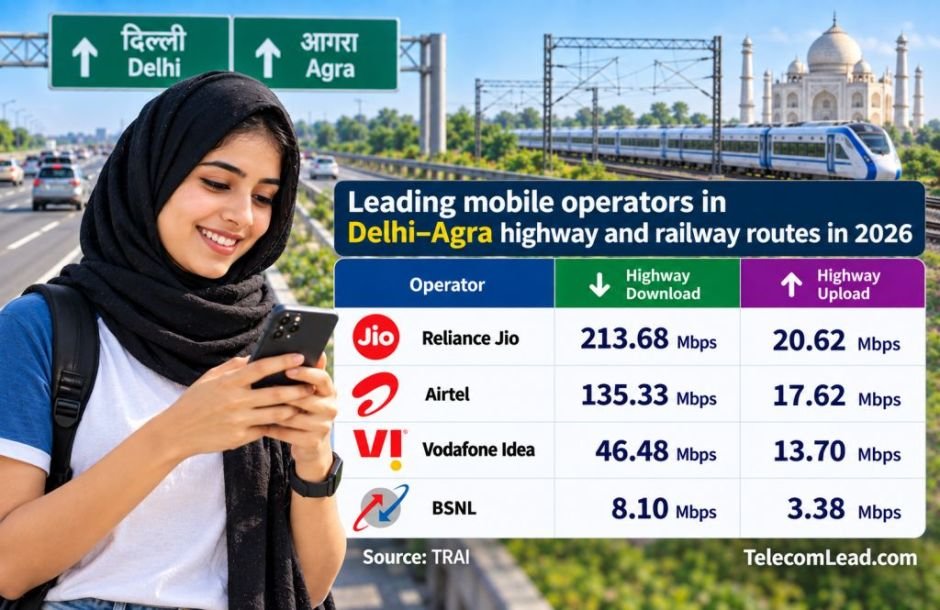
The Telecom Regulatory Authority of India (TRAI) has released its drive test results assessing real-world mobile network performance across the Delhi–Agra Yamuna Expressway and Agra–Delhi railway corridor.
TRAI tested Airtel, BSNL, Reliance Jio and Vodafone Idea for network coverage, download and upload speeds, dropped calls and voice quality during July 16-17, 2026.
The assessment covered 183.4 km of highway and 188 km of railway, making the results particularly useful for comparing how mobile networks perform when subscribers are travelling at speed rather than remaining in a fixed urban location.
Jio Delivers 213.68 Mbps on Delhi–Agra Highway
Jio emerged as the clear leader in mobile download performance on the Delhi–Agra highway, recording speed of 213.68 Mbps.
Airtel ranked second at 135.33 Mbps, while Vodafone Idea achieved 46.48 Mbps. BSNL, tested on its 4G network, delivered 8.10 Mbps.
Jio’s highway download speed was approximately 58 percent higher than Airtel’s and about 4.6 times Vi’s measured speed.
Jio also led highway upload performance with 20.62 Mbps, followed by Airtel at 17.62 Mbps, Vi at 13.70 Mbps and BSNL at 3.38 Mbps.
The results give Jio a clear advantage in overall data throughput along the tested highway corridor.
Vi Records Best Highway Coverage
Download speed, however, tells only part of the network-performance story.
Vodafone Idea produced the strongest result for signal consistency along the Delhi–Agra highway route.
TRAI found only 44 poor-signal samples among 13,327 samples collected for Vi. This translates into a poor-signal ratio of approximately 0.33 percent.
Jio recorded 145 poor-signal samples from 13,268, or around 1.09 percent, while Airtel recorded 180 from 13,960, equivalent to about 1.29 percent.
BSNL’s result was significantly weaker, with 4,876 poor-signal samples among 12,619, equivalent to approximately 38.6 percent.
| Operator | Samples | Poor Signal | Poor-Signal Share |
| Vodafone Idea | 13,327 | 44 | 0.33% |
| Reliance Jio | 13,268 | 145 | 1.09% |
| Airtel | 13,960 | 180 | 1.29% |
| BSNL | 12,619 | 4,876 | 38.64% |
TRAI also detected 206 BSNL samples with limited service or no coverage. Airtel, Jio and Vi recorded zero no-coverage samples in this measurement.
The figures highlight an important distinction: Jio provided the fastest highway data connection, while Vi delivered the most consistent measured signal coverage along the tested route.
Vi Records Zero Dropped Calls on Highway
Vi also produced the best call-drop result on the highway.
The operator recorded zero dropped calls from 66 successfully established calls.
Jio experienced one dropped call from 66 calls, giving it an approximate drop rate of 1.52 percent.
Airtel recorded two dropped calls from 65 established calls, equivalent to approximately 3.08 percent.
BSNL experienced 16 dropped calls from 68 successfully established calls, translating into a much higher drop rate of approximately 23.5 percent.
| Operator | Successful Calls | Dropped Calls | Drop Rate |
| Vodafone Idea | 66 | 0 | 0% |
| Reliance Jio | 66 | 1 | 1.52% |
| Airtel | 65 | 2 | 3.08% |
| BSNL | 68 | 16 | 23.53% |
The combination of zero dropped calls and the lowest poor-signal ratio gives Vi a strong showing for basic mobile connectivity on the Delhi–Agra highway, despite its lower data speeds compared with Jio and Airtel.
Jio Also Leads Mobile Speed on Agra–Delhi Railway
Mobile network performance declined considerably when TRAI moved from the highway to the railway environment.
Jio remained the fastest network, but its download speed fell from 213.68 Mbps on the highway to 82.68 Mbps on the railway.
Vi moved into second place on the railway with 47.48 Mbps, narrowly ahead of Airtel’s 44.23 Mbps.
BSNL recorded 9.99 Mbps.
| Operator | Railway Download | Railway Upload |
| Reliance Jio | 82.68 Mbps | 10.14 Mbps |
| Vodafone Idea | 47.48 Mbps | 12.31 Mbps |
| Airtel | 44.23 Mbps | 13.32 Mbps |
| BSNL | 9.99 Mbps | 5.07 Mbps |
Jio therefore maintained a substantial download-speed advantage, delivering approximately 74 percent faster downloads than Vi, its nearest rival on the railway route.
However, Jio did not lead railway upload performance.
Airtel ranked first with 13.32 Mbps, followed closely by Vi at 12.31 Mbps. Jio recorded 10.14 Mbps, while BSNL reached 5.07 Mbps.
Railway Performance Shows Different Operator Strengths
The railway test produced a notably different competitive picture from the highway.
On the highway, Jio’s 213.68 Mbps was substantially ahead of Airtel’s 135.33 Mbps. On the railway, Jio’s speed dropped to 82.68 Mbps, while Airtel fell more sharply to 44.23 Mbps.
Vi was comparatively stable: its download performance actually increased slightly from 46.48 Mbps on the highway to 47.48 Mbps on the railway.
BSNL also increased from 8.10 Mbps to 9.99 Mbps, although it remained far behind the private operators.
This comparison illustrates the challenges operators face in maintaining high mobile data throughput along railway corridors, where users move rapidly through changing radio environments and between cell sites.
Airtel Records Zero Dropped Calls on Railway Route
Airtel delivered the best call-drop performance during TRAI’s railway test.
The operator recorded zero dropped calls from 60 successfully established calls.
Vi experienced two drops from 62 calls, equivalent to approximately 3.23 percent, while Jio recorded three dropped calls from 63, or approximately 4.76 percent.
BSNL again lagged its private-sector rivals, with 12 dropped calls from 60 successfully established calls, representing a 20 percent call-drop rate.
This means the operator ranking changed significantly between the highway and railway environments: Vi had zero call drops on the highway, while Airtel achieved zero call drops on the railway.
Vi Leads Railway Coverage Among Private Operators
Vi also performed strongly in railway coverage.
TRAI recorded 224 poor-signal samples from 11,728 samples on Vi’s network, equivalent to approximately 1.91 percent.
Jio recorded 286 poor-signal samples from 11,697, or around 2.45 percent, while Airtel had 326 poor-signal samples from 11,709, approximately 2.78 percent.
BSNL recorded 5,264 poor-signal samples from 10,895, meaning roughly 48.3 percent of its samples fell below the specified minimum signal-strength level.
The figures indicate that Vi recorded the lowest poor-signal ratio among the four operators on both the highway and railway routes.
Jio Highway Speed Far Exceeds Declared Typical Throughput
TRAI also compared actual highway performance with the typical throughput declared by operators.
Jio declared typical download throughput of 15 Mbps, compared with the 213.68 Mbps recorded during the test. Its measured performance was therefore more than 14 times the declared typical throughput.
Airtel’s 135.33 Mbps result was around 7.5 times its declared typical download throughput of 18 Mbps.
Vi achieved 46.48 Mbps, more than three times its declared typical download throughput of 15 Mbps.
BSNL recorded 8.10 Mbps, broadly in line with its declared typical speed of 8 Mbps.
These measurements should not be interpreted as guaranteed subscriber speeds. Actual mobile performance can vary according to network congestion, spectrum availability, handset capability, distance from cell sites and whether a device is connected to 4G or 5G.
TRAI Test Covers More Than 370 Km
The July test covered a combined 371.4 km across highway and railway routes.
The 183.4 km highway test ran from Delhi towards Agra via the Yamuna Expressway, covering locations including Dankaur, Jewar, Tappal, Surir, Javara, Baldeo, Khandauli and Kuberpur.
TRAI also tested stationary network performance at The Food Street – Food Court at the Yamuna Expressway Vrindavan Cut.
The 188 km railway test covered the Agra-to-Delhi corridor through Raja Ki Mandi Junction, Mathura Junction, Chata, Kosi Kalan, Palwal, Ballabhgarh and Faridabad.
TRAI cautions that its drive-test findings represent network performance along the routes at the specific dates and times of testing. They should therefore be viewed as a snapshot of real-world network quality rather than a comprehensive ranking of each operator’s entire network.
Jio Wins on Speed, Vi on Coverage
TRAI’s Delhi–Agra tests reveal different strengths among India’s private telecom operators.
Reliance Jio was the clear data-speed leader, recording 213.68 Mbps on the highway and 82.68 Mbps on the railway.
Vodafone Idea delivered the strongest measured signal consistency, with poor-signal ratios of just 0.33 percent on the highway and 1.91 percent on the railway. Vi also recorded zero dropped calls during the highway test.
Airtel ranked second in highway download speed at 135.33 Mbps and delivered the fastest railway upload speed at 13.32 Mbps. It also recorded zero dropped calls on the railway route.
BSNL remained substantially behind its private-sector rivals, particularly in coverage and call reliability, despite delivering download speeds of 8.10 Mbps on the highway and 9.99 Mbps on the railway.
For subscribers travelling between Delhi and Agra, the TRAI findings show why mobile network performance needs to be assessed across several metrics. Jio provides the strongest download-speed performance, Vi stands out for signal coverage, and Airtel shows strengths in upload speed and railway call reliability.
BABURAJAN KIZHAKEDATH


