
Travel eSIM adoption is accelerating as international travelers seek flexible and affordable mobile connectivity, but network routing, wholesale partners, internet exit points, speed restrictions and 5G agreements can significantly affect performance.
Ookla’s Q2 2026 Speedtest data shows that branded travel eSIM activity achieved double-digit growth during the 12 months to June 2026, compared with 12 percent growth in overall international roaming. Travel eSIMs’ measured share of roaming increased from 2.7 percent to 3.4 percent.
The analysis, based on Android Speedtest data from 190 countries and a 24-month market-evolution series, highlights an opportunity for mobile network operators and MVNOs to reclaim roaming revenue and customer ownership.
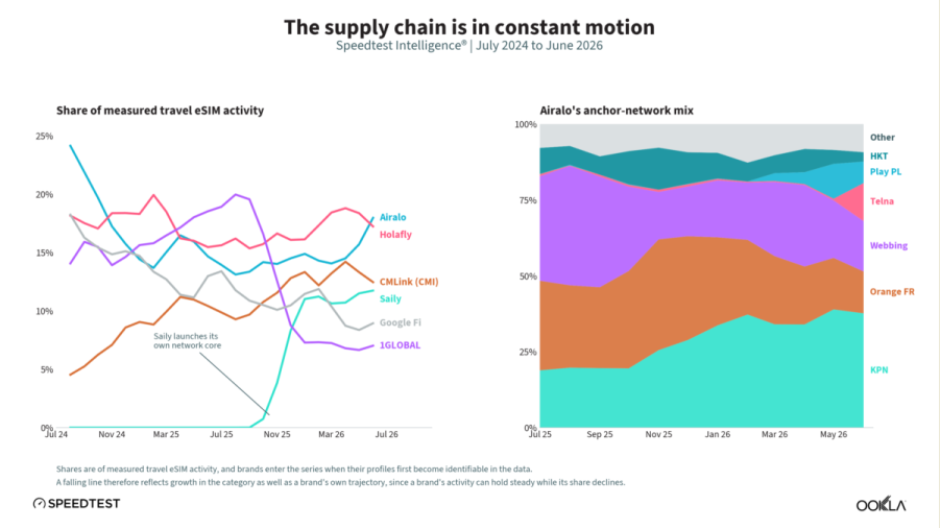
Travel eSIM Market Relies on Concentrated Wholesale Networks
Although travelers can choose from numerous eSIM brands, the underlying connectivity market is concentrated among a relatively small group of wholesale providers.
Key suppliers include Hutchison Austria, Hutchison Hong Kong, China Mobile Hong Kong, KPN, Orange, Singtel, Telna, Webbing, Transatel, Proximus, BICS, Plus Poland and Sky UK.
Hutchison Austria accounts for approximately two-thirds of Holafly’s measured samples, while China Mobile Hong Kong represents about one-third. KPN supplies more than one-third of Airalo’s samples. Airalo also relies on Webbing Hong Kong, Orange France, Play Poland and Telna in the United States.
Singtel supports Nomad, Eskimo and Trip.com, while Proximus and BICS provide connectivity to Roamless and Firsty. Sky UK anchors eSIM Go, Transatel supports Ubigi, and Vodafone UK provides the wholesale network behind Revolut’s travel eSIM service.
The commercial potential is considerable. Airalo became the first travel eSIM unicorn in July 2025 after raising $220 million and says it serves more than 20 million travelers. Holafly says its cumulative revenue has exceeded $500 million.
Internet Exit Points Can Create Severe Latency
A travel eSIM may connect to a local mobile network, but the data can travel thousands of kilometres before reaching the public internet. This routing model can dramatically increase latency and affect applications such as cloud platforms, video calls, gaming and enterprise collaboration tools.
Holafly’s Madrid internet hub produced global median multi-server latency of 320 milliseconds. Saily, which used exit points in Germany, the Netherlands, the United States, Singapore and Japan, achieved 117 milliseconds.
1GLOBAL recorded 121 milliseconds by using a hub in the United States and four European hubs. Webbing operated 10 facilities stretching from Tokyo to Dallas and kept nearly three-quarters of measured traffic inside the country where the Speedtest was conducted.
Airalo’s country-specific profiles in Japan recorded latency of 54 milliseconds on the au network, compared with 36 milliseconds for local users.
Across the travel eSIM brand and destination combinations studied by Ookla, median latency ranged from 1.5 times to 30 times local-network levels. Profiles routed through Amsterdam generated latency 30 times higher than local services in Australia.
Madrid-based routing produced latency penalties of 25 times in Singapore, 18 times in Thailand and 15 times in Japan. Profiles routed through Singapore delivered latency 17 times higher than local connections in the United States.
On Japan’s au network alone, travel eSIM latency varied from 54 milliseconds to 543 milliseconds, demonstrating how two eSIM services using the same radio network can deliver sharply different customer experiences.
Remote Speedtest Servers Distort Travel eSIM Performance
Two in five tests conducted on brands using centralized hubs selected Speedtest servers outside the traveler’s destination country.
Travel eSIM profiles in Thailand that routed traffic through Amsterdam selected servers in the Netherlands, located more than 9,000 kilometres away. These connections produced median latency of 434 milliseconds.
United States profiles routed through Madrid selected Spanish servers and recorded latency of 361 milliseconds. In China, travel eSIM profiles selected servers located in Hong Kong, Taiwan, Singapore and Vietnam.
Network congestion further increased delays. Loaded latency exceeded 1.2 seconds on Holafly’s Madrid hub and 1GLOBAL’s London platform. Even distributed-core networks approached 900 milliseconds under loaded conditions.
These findings indicate that the local mobile network displayed on a smartphone is only one part of travel eSIM performance. Wholesale architecture, international transit and the location of the internet breakout point can be equally important.
Travel eSIM Speeds Range from 0.21 Mbps to More Than 80 Mbps
Download speeds varied substantially among travel eSIM providers, partly because of wholesale speed restrictions and different service-tier policies.
Yesim delivered download speed of 6.03 Mbps, while Instabridge recorded 10.23 Mbps. Firsty’s advertising-supported free tier was restricted to only 0.21 Mbps.
Airalo achieved speed of 30.11 Mbps, although Speedtest results showed performance plateaus of approximately 20 Mbps in several Asian markets. Holafly reached 56.87 Mbps, while Ubigi recorded 75.89 Mbps.
1GLOBAL delivered 80.21 Mbps, narrowly behind Nomad at 80.26 Mbps. The difference between Firsty’s free tier and the fastest measured provider illustrates how commercial speed policies can be as influential as radio-network quality.
5G Access Becomes a Key eSIM Differentiator
Access to 5G networks also varied widely. Ubigi led the measured brands with a 5G access rate of 62 percent, while some competitors achieved only 20 percent to 36 percent.
Operators and travel eSIM providers that secure stronger 5G wholesale agreements can differentiate their services through faster downloads, better video performance and improved support for business applications.
For enterprise travelers, however, a 5G logo does not guarantee strong performance. A connection can use a high-speed local 5G network but still suffer from poor latency if traffic is routed through a distant international hub.
Orange Targets Travel eSIM Users in More Than 200 Destinations
Telecom operators are increasingly launching their own travel eSIM products to compete with digital-first brands.
Orange Travel provides connectivity across more than 200 destinations through 700 carrier networks. Its partnership with Trip.com, announced in June 2026, covers France, Italy, Spain, the United Kingdom and Switzerland.
Customers can purchase 20 GB, 50 GB or 100 GB plans with validity of up to 30 days. Prices start at €8.99.
The partnership allows Orange to combine its wholesale relationships and network expertise with Trip.com’s digital travel distribution platform.
Vodafone Travel eSIM Covers 206 Destinations
Vodafone’s travel eSIM service covers 206 destinations and provides access to 700 networks. The service includes 5G connectivity in 98 countries.
Vodafone offers plans ranging from 1 GB to 150 GB, with validity periods extending to 90 days. Regional packages start at €4 for Europe, €5 for Oceania and €6 for North America.
Packages for Asia, the Caribbean, Latin America and the Middle East start at €7.
The broad range of allowances and validity periods enables Vodafone to address short trips, extended holidays, remote working and frequent international travel.
Verizon Visible Launches FIFA World Cup 2026 eSIM Pass
Verizon’s Visible brand introduced an eSIM Travel Pass for the FIFA World Cup 2026, using Verizon 5G and 5G Ultra Wideband connectivity.
Regular pricing is $25 for 7 days, $35 for 14 days and $45 for 30 days. The pre-order prices were $15, $25 and $35, respectively.
The three packages include 90, 180 and 300 calling minutes to more than 85 countries. The offer demonstrates how operators can use major sporting events to attract international visitors directly instead of surrendering the customer relationship to third-party eSIM providers.
Wholesale Network Changes Can Cut Latency by 100 Milliseconds
Travel eSIM performance can improve quickly when providers change their wholesale suppliers or routing architecture.
Airalo approximately doubled KPN’s contribution to its measured traffic, reduced the share supplied by Orange France by half and added Telna. Holafly consolidated more of its connectivity around Hutchison Austria.
Saily established its own network during late 2025 and routed 95 percent of its measured samples through a distributed core. This architecture allows internet traffic to exit closer to the user instead of passing through a single distant hub.
Ookla found that the most extensive supplier change reduced global median latency by approximately 100 milliseconds between April and June 2026.
Telecom Operators Can Reclaim Roaming Customers
Under the current travel eSIM model, travelers may use the radio infrastructure of a local mobile network while purchasing data from Airalo, Holafly, Saily, Nomad or Ubigi. The eSIM provider retains the digital purchase, billing information and customer relationship, while the operator primarily earns wholesale revenue.
Telefónica has identified travel eSIMs as a potential growth opportunity for both MNOs and MVNOs. Operators already possess local network assets, 5G coverage, internet interconnection capabilities, roaming agreements and customer-service infrastructure.
Combining those assets with competitive digital distribution, transparent pricing and instant eSIM activation could help operators recover some of the roaming value moving to specialist platforms.
Local internet breakout can be particularly important for enterprise customers because it delivers more predictable routing for cloud applications, video conferencing and other latency-sensitive workloads. Guaranteed quality of service and clear information about 5G availability could also support premium business travel plans.
The Q2 2026 Speedtest findings show that travelers should assess more than price, data allowance and destination coverage when selecting an eSIM. The location of the internet exit point, the quality of the wholesale partner, speed restrictions, 5G access and network routing can ultimately determine whether the service delivers a fast local experience or a connection slowed by an international detour.
FASNA SHABEER


