Telecom Regulatory Authority of India (TRAI) has released recommendations on establishing a regulatory framework for the sale of foreign telecom service providers’ SIM and eSIM cards used in machine-to-machine (M2M) and Internet of Things (IoT) devices meant exclusively for export. The move is aimed at unlocking India’s export potential in connected devices while ensuring regulatory clarity, national security, and ease of doing business.
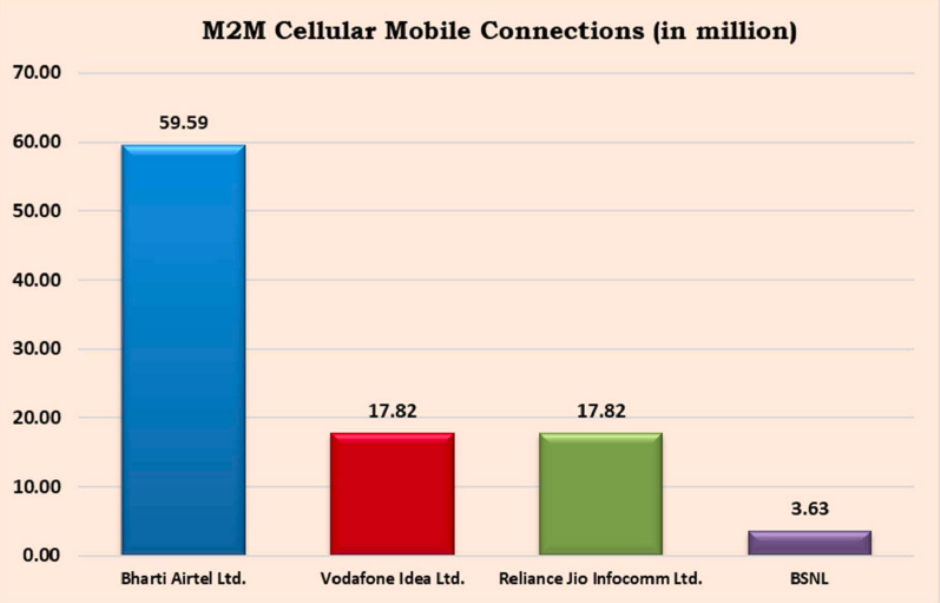
Leading M2M service providers in India are Bharti Airtel (59.59 million connections), Vodafone Idea (17.82 million), Reliance Jio (17.82 million), and BSNL (3.63 million) at the end of October 2025.
New International M2M SIM Service Authorisation
At the core of TRAI’s recommendations is the creation of a new, light-touch service authorisation under the Telecommunications Act, 2023. The proposed framework introduces a dedicated category called the International M2M SIM Service Authorisation, designed specifically to regulate the sale of foreign telecom service providers’ SIM and eSIM cards for export-oriented M2M and IoT devices.
TRAI has recommended that this authorisation be included under auxiliary service authorisations in its earlier framework dated September 18, 2024, and under miscellaneous service authorisations in the Department of Telecommunications’ draft rules under Section 3(1)(a) of the Act.
Simple Eligibility and Low-Cost Entry
To encourage participation and innovation, TRAI has proposed highly simplified eligibility and financial conditions. Any company registered under the Indian Companies Act would be eligible to apply for the International M2M SIM Service Authorisation.
Key financial terms include:
Application processing fee of Rs. 5,000
Entry fee of nil
Minimum equity of nil
Minimum net worth of nil
Bank guarantee of nil
Authorisation fee of nil
The authorisation would be valid for ten years and renewable for another ten-year period, provided the renewal request is submitted at least one year before expiry. The service area would be national in scope.
Online, Digital-First Approval Process
In line with the government’s digital governance push, TRAI has recommended that the International M2M SIM Service Authorisation be granted entirely online, with digitally signed, auto-generated approvals. This approach is expected to significantly reduce approval timelines and administrative burden for applicants.
Scope Limited to Export-Oriented Use
The scope of the authorisation would be strictly limited to selling foreign telecom service providers’ SIM and eSIM cards to Indian enterprise entities that intend to export M2M and IoT devices fitted with such connectivity. The authorised entity must ensure that these SIMs and eSIMs are used solely outside India.
However, for development and validation purposes, TRAI has allowed temporary activation of foreign SIM and eSIM cards within India for testing, subject to strict conditions.
Testing Allowed for Up to Six Months
For testing and quality assurance, foreign telecom service providers’ SIM and eSIM cards may be activated in India for a maximum period of six months after successful completion of know-your-customer procedures. TRAI has noted that the government may extend this testing period beyond six months on a case-by-case basis, if required.
After testing or upon completion of six months, whichever is earlier, the services must be suspended. TRAI has also mandated that:
Foreign SIM and eSIM cards must not be pre-activated
SIMs and eSIMs used for testing must be suspended after the permitted period
SIMs and eSIMs must not be in an activated state at the time of export
Strict KYC and Physical Verification Requirements
To address security and traceability concerns, TRAI has laid out detailed compliance obligations for authorised entities. These include maintaining comprehensive KYC records of Indian enterprise customers.
Mandatory documents and information include:
Corporate Identity Number, LLP Identification Number, or equivalent business registration proof
GST registration certificate, if available
Address of the place of business or working location
In addition, authorised entities must carry out physical verification of the enterprise customer’s premises before selling foreign SIM or eSIM cards for export-oriented M2M and IoT devices.
Device-Level Information and Government Access
For each SIM or eSIM card sold, the authorised entity must collect detailed information while the SIM or eSIM remains within India. This includes device identifiers such as IMEI or ESN, along with the make and model of the machine, such as vehicles, utility meters, or point-of-sale terminals.
This information must be made available to the government on demand, ensuring transparency and regulatory oversight.
Monthly Reporting and Annual Returns
TRAI has proposed a robust reporting mechanism to monitor compliance. Authorised entities would be required to submit monthly reports to relevant authorised agencies, detailing:
Name and address of the Indian enterprise customer and authorised representative
Name and country of the foreign telecom service provider
MSISDN and IMSI of the SIM or eSIM
Date of activation for testing, if applicable
Date of service suspension after testing, if applicable
To streamline compliance, TRAI has recommended that the DoT develop a secure online portal with restricted access for authorised entities and government agencies. Annual returns would also need to be submitted within one month of the end of each financial year through the same portal.
Flexible Commercial Terms
For ease of doing business, TRAI has clarified that commercial terms, including tariffs under the International M2M SIM Service Authorisation, should be governed by mutual agreement between the authorised entity and the Indian enterprise customer, without regulatory price controls.
Coordination for Imports and Exports of SIMs and Devices
Beyond authorisation, TRAI has urged the DoT to coordinate with other central ministries, including the Ministry of Finance and the Ministry of Commerce, to establish a clear regulatory framework for:
Import of foreign SIM and eSIM profiles for export-oriented M2M and IoT devices
Import of foreign SIM and eSIM cards, including those fitted in devices meant for export
Export of Indian telecom service providers’ SIM and eSIM cards for devices meant for import into India
This coordinated approach is expected to remove bottlenecks across customs, trade, and telecom regulations.
Boost to Make in India and Global Competitiveness
TRAI has emphasized that these recommendations strongly support the government’s Make in India initiative. By enabling Indian manufacturers to integrate globally compatible M2M and IoT connectivity at the production stage, the proposed framework would make Indian products more attractive in international markets.
The regulator believes the International M2M SIM Service Authorisation will help Indian enterprises compete more effectively with established global players in IoT and M2M markets, positioning India as a preferred manufacturing and export hub for connected devices.
If implemented, the recommendations could play a critical role in accelerating India’s role in global IoT supply chains while maintaining regulatory oversight and national security safeguards, TRAI Secretary Atul Kumar Chaudhury said.
BABURAJAN KIZHAKEDATH