
Telekom Malaysia reported capital expenditure (Capex) of RM212 million in Q1 2026, driven primarily by fibre expansion initiatives and 5G mobile backhaul deployment under access network investments.
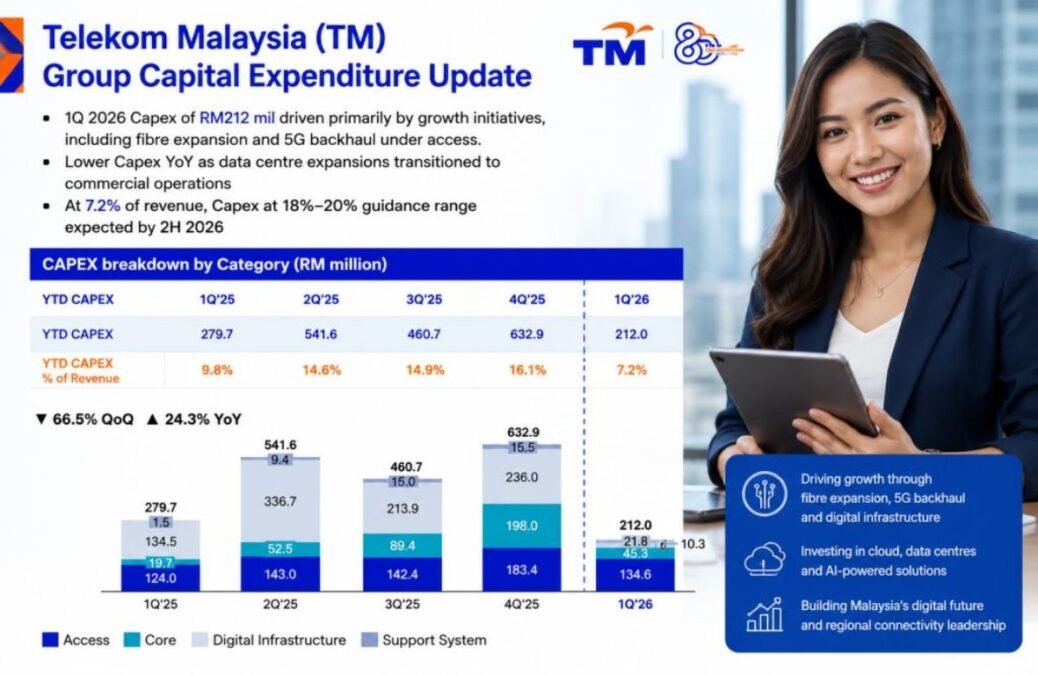
Telekom Malaysia said Q1 2026 Capex represented 7.2 percent of revenue, lower than previous quarters due to the transition of data centre expansion projects into commercial operations. Despite the lower quarterly spending, the company maintained its full-year Capex guidance range of 18 percent to 20 percent of revenue, with spending expected to accelerate by the second half of 2026.
The company’s total Capex declined 66.5 percent quarter-over-quarter from RM632.9 million in Q4 2025 and decreased 24.3 percent year-over-year from RM279.7 million in Q1 2025.
Telekom Malaysia’s Capex allocation in Q1 2026 showed continued focus on network access infrastructure and digital platform expansion.
Access infrastructure investments accounted for RM134.6 million in Q1 2026, remaining the largest Capex category as Telekom Malaysia continued investing in fibre broadband rollout and 5G backhaul connectivity.
Core network investments totaled RM45.3 million during the quarter, supporting digital network modernization and connectivity upgrades.
Digital infrastructure spending reached RM21.8 million, reflecting continued investment in cloud infrastructure, digital platforms and data centre-related capabilities.
Support system investments stood at RM10.3 million, covering operational systems and enterprise support infrastructure.
In comparison, Telekom Malaysia’s total Capex spending reached RM632.9 million in Q4 2025, including RM183.4 million for access infrastructure, RM198 million for core systems, RM236 million for digital infrastructure and RM15.5 million for support systems.
During Q3 2025, total Capex stood at RM460.7 million, comprising RM142.4 million for access, RM89.4 million for core infrastructure, RM213.9 million for digital infrastructure and RM15 million for support systems.
Telekom Malaysia reported Q2 2025 Capex of RM541.6 million, including RM143 million for access, RM52.5 million for core infrastructure, RM336.7 million for digital infrastructure and RM9.4 million for support systems.
In Q1 2025, Group Capex totaled RM279.7 million, with RM124 million invested in access infrastructure, RM19.7 million in core systems, RM134.5 million in digital infrastructure and RM1.5 million in support systems.
The company indicated that future Capex priorities will continue focusing on fibre broadband expansion, AI-enabled digital infrastructure, hyperscaler connectivity, cloud services, mobile backhaul and data centre ecosystem growth as part of its broader digital transformation strategy.
Q1 revenue
Telekom Malaysia started 2026 with stronger revenue growth, rising profitability and expanding digital business momentum, driven by broadband adoption, enterprise digital transformation demand, AI solutions and hyperscaler connectivity services.
Telekom Malaysia, which is executing PWR 2030 strategy, has reported Q1 2026 operating revenue of RM2.93 billion, increasing 2.9 percent year-over-year, supported by growth across all major business divisions including consumer broadband, enterprise digital services and carrier-to-carrier operations.
EBIT grew 6.3 percent to RM593.3 million, while Profit After Tax and Non-Controlling Interests (PATAMI) rose 9.3 percent to RM436.3 million after excluding one-off items. The company said operational resilience, automation initiatives and a leaner cost structure contributed to stronger profitability.
Reported PATAMI stood at RM425.3 million, while EBITDA reached RM1.1 billion with EBITDA margin remaining stable at 34.9 percent during the quarter.
Amar Huzaimi Md Deris, TM Group Chief Executive Officer said, “We entered 2026 with encouraging growth momentum, backed by a proactive move to boost the competitiveness of our quad play offerings, anchored by mobile, TV and smart home.”
“This is further complemented by encouraging growth in both our B2B and C2C digital offerings, such as cloud, cybersecurity, smart services, AI and data centre. All of these contributed to 9.3 percent increase in underlying PATAMI, a testament to our core operational resilience,” Ahmad Fairus Rahim, TM Group Chief Financial Officer, said.
The company’s consumer broadband and convergence business under the Unifi brand generated RM1.46 billion in revenue, rising 5.1 percent year-over-year. Telekom Malaysia said stronger convergence adoption and higher bundled device sales supported performance across broadband, mobile, TV and smart home services.
Telekom Malaysia’s broadband subscriber base expanded to 3.2 million customers as demand increased for higher-speed fiber broadband and converged digital connectivity solutions.
The enterprise-focused B2B division comprising TM One and Credence reported RM671.5 million in revenue, supported by growing adoption of cloud computing, ICT, cybersecurity and AI-driven digital transformation solutions from enterprises and government customers.
Management highlighted increasing demand for smart services, cloud infrastructure, AI platforms and data center capabilities as businesses accelerate digitalization initiatives.
Telekom Malaysia’s carrier-to-carrier business under TM Global delivered RM776.6 million in revenue, increasing 2.1 percent year-over-year. Growth was driven by rising international hyperscaler demand, wholesale connectivity expansion and domestic mobile backhaul infrastructure deployment.
Executives identified AI, cloud, cybersecurity and digital infrastructure as core long-term growth pillars under the company’s PWR 2030 transformation strategy. Telekom Malaysia said it continues expanding AI-enabled digital services, cloud platforms, GPU-as-a-Service capabilities and wholesale connectivity offerings.
On operational expenditure, Telekom Malaysia maintained disciplined cost management despite ongoing investments in technology modernization, network resilience and enterprise digital capabilities. Management said automation, digitalization and process optimization initiatives helped improve productivity and operational efficiency during the quarter.
BABURAJAN KIZHAKEDATH

