The shift toward AI monetisation is visible among major telecom operators. GSMA Intelligence identifies a growing number of operators deploying AI factories, sovereign cloud infrastructure, agentic AI and AI-enabled networks rather than limiting AI to internal automation.
The GSMA report on AI investment by telecom operators highlights initiatives involving Orange, Deutsche Telekom, Iliad, Bell Canada, Telus, e&, China Telecom, Grameenphone, Robi Axiata and Batelco, among others.
This operator activity is significant because 35 percent of new telco AI deployments have a revenue objective, while network and data-centre solutions have expanded to 29 percent of deployments announced during the latest six months, compared with 30 percent for customer care. GSMA Intelligence estimates AI factories could increase operator revenues by more than 5 percent.
Nvidia Leads Telco AI GPU Ecosystem
AI infrastructure partnerships are becoming another competitive battleground.
Among the world’s top 250 operators, Nvidia ranks first among GPU providers, followed by AMD and Intel. Google ranks first among hyperscalers, ahead of Microsoft and AWS. Perplexity leads the foundation-model category, followed by OpenAI and DeepSeek.
Among small and medium-sized operators, Nvidia also ranks first in GPUs, followed by Intel and AMD. AWS leads hyperscalers ahead of Microsoft and Google, while Perplexity leads foundation-model partners ahead of OpenAI and Snowflake.

Deutsche Telekom Targets Sovereign AI Infrastructure
Deutsche Telekom is among the European operators moving deeper into AI infrastructure. GSMA Intelligence highlights its planned AI Gigafactory with Schwarz Group in Germany, designed to provide sovereign AI compute infrastructure.
The strategy fits the broader European requirement for locally controlled compute, data residency and trusted infrastructure. Across Europe, 61 percent of cumulative telco AI deployments focus on cost savings and efficiency, while 39 percent have a revenue objective. Among new deployments during the six months to June 2026, however, the revenue share was only 22 percent, against 78 percent targeting internal efficiencies.
Orange Builds Sovereign AI Position in Europe and Africa
Orange provides one of the clearest examples of a multi-market sovereign AI strategy. In France, GSMA Intelligence identifies Google Distributed Cloud and OpenAI deployments on sovereign infrastructure, enabling in-country AI processing.
In West Africa, Orange’s local cloud platform, Door, is positioned as an alternative to foreign cloud providers. In Côte d’Ivoire, Orange is also targeting local enterprises with AI and cybersecurity solutions.
These investments illustrate why sovereignty is becoming commercially important. 34 percent of operators identify demand from regulated industries such as finance, healthcare and defence as the principal driver for sovereign AI, while 30 percent cite national regulation and data-residency requirements. Enterprise demand for sovereignty contributes another 17 percent.
Iliad Combines Nvidia GPUs with French Data Centres
Iliad is taking a more infrastructure-intensive approach. GSMA Intelligence highlights an Nvidia DGX SuperPOD hosted in Iliad’s own French data centre, combining locally controlled data-centre capacity with Nvidia computing infrastructure.
The partnership reflects the wider vendor hierarchy emerging in telecom AI. Among the top 250 operators, Nvidia ranks No. 1 among GPU partners, followed by AMD and Intel. Google leads hyperscaler partnerships among these large operators, followed by Microsoft and AWS, while Perplexity ranks first among foundation-model partners, ahead of OpenAI and DeepSeek.
Bell Canada and Telus Target Canadian Sovereign AI
Canadian operators are also turning sovereignty into an AI infrastructure opportunity. Bell Canada has established a sovereign AI partnership with Cohere designed to keep Canadian data under Canadian jurisdiction, while Telus is developing a sovereign AI factory and Canadian sovereign data centres.
North America is particularly advanced in this area. Around 40 percent of operators in the US and Canada have commercially launched sovereign AI products, compared with roughly 25–30 percent in other regions.
North American operators are also more commercially oriented in their broader AI strategies. 47 percent of cumulative AI deployments target revenue, compared with 53 percent focused on cost savings. For new deployments during the six months to June 2026, the split reached 50 percent revenue and 50 percent internal efficiency.
e& Combines Nvidia GPUs with Operator Data Centres
In Egypt, e& has deployed Nvidia H100 GPUs in an Oracle Cloud Infrastructure region hosted inside operator data centres, according to the GSMA Intelligence examples.
The model illustrates the partnership approach available to telecom companies: operators provide local infrastructure, connectivity and sovereign positioning while technology companies supply cloud platforms, GPUs and AI capabilities.
Across MENA, 43 percent of new AI deployments in the six months to June 2026 targeted external product revenue, compared with 57 percent focused on costs and efficiencies.
Grameenphone and Robi Axiata Build Local AI Infrastructure
Bangladesh offers two different operator approaches. GSMA Intelligence identifies Grameenphone’s national AI factory using Nvidia GPUs, while Robi Axiata operates a locally hosted Tier-4 cloud supporting AI and machine-learning workloads and sovereignty requirements.
The developments fit Asia-Pacific’s comparatively strong commercial AI orientation. 43 percent of cumulative AI deployments in Asia-Pacific target revenues, while 57 percent focus on costs and efficiencies. Among new deployments, the revenue proportion is 42 percent, versus 58 percent for internal objectives.
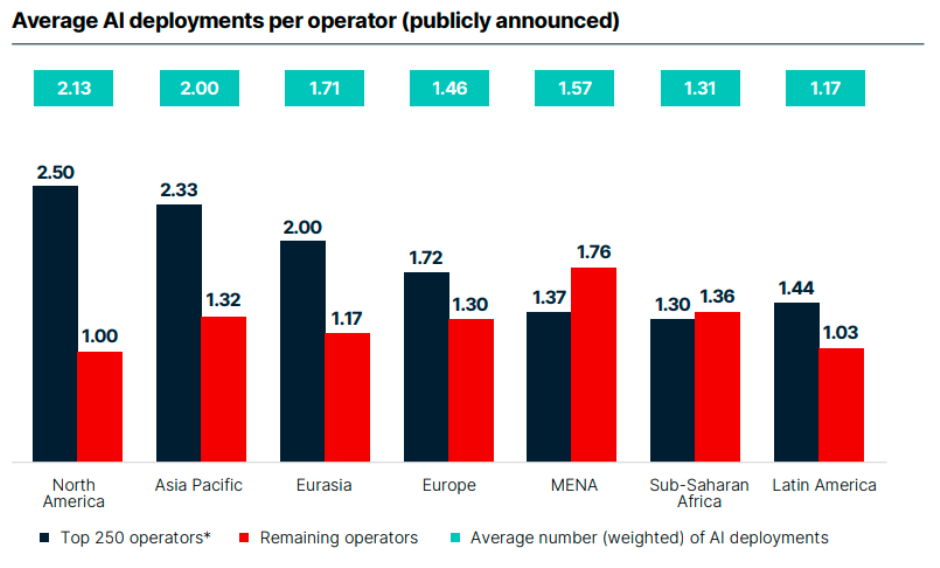
Asia-Pacific also has one of the highest AI deployment intensities. Large operators average 2.3 deployments per operator, compared with 1.3 for small and medium-sized operators, producing an overall regional average of 2.0.
Batelco Pushes AI to the Network Edge
Batelco’s approach in Bahrain demonstrates another potential telecom advantage: edge infrastructure. GSMA Intelligence identifies an AI-ready edge data centre providing sovereign, low-latency infrastructure.
Edge computing could differentiate operators from centralised cloud providers because telcos already possess distributed network sites and connectivity. GSMA Intelligence therefore sees connectivity, data centres, edge infrastructure and sovereign AI as areas where operators should prioritise capital rather than attempting to replicate the hyperscaler model.
Telkom, O2, PLDT and Grameenphone Push Agentic AI into Operations
AI investment is also moving into autonomous telecom operations. GSMA Intelligence highlights Telkom’s Agentic AI by BigBox, designed to support industrial transformation; O2 Telefónica’s Network Operations Agent for AI-powered network operations; PLDT Group’s agentic AI deployment for enterprise risk management; and a Grameenphone-ZTE agreement targeting autonomous network development through agentic AI.
KDDI has launched its au Support AI Advisor digital human, while Optus and Ericsson have trialled AI to improve 5G downlink performance. Zong and ZTE have also achieved an AI-based FDD Massive MIMO commercial deployment in Pakistan.
These projects reinforce a wider transition from chatbots toward network intelligence, autonomous operations and revenue-producing infrastructure.
Operator AI Spending Faces a Hyperscaler Capex Challenge
The biggest constraint is capital intensity. The report’s page 24 chart shows Amazon spending $92.3 billion in capex in 2025, followed by Google at $54.4 billion, Microsoft at $53.1 billion and Meta at $48.2 billion. US telecom operators collectively were at $29.9 billion, Chinese telcos at $19.6 billion, German telcos at $3.6 billion, UK telcos at $3.6 billion and French telcos at $3.1 billion. Hyperscaler capex increased 50 percent in 2025.
The gap explains why operators are unlikely to win by simply matching hyperscalers on compute investment. Their opportunity lies in combining 5G connectivity, edge infrastructure, existing data centres, local customer relationships and data sovereignty with technology supplied by Nvidia, hyperscalers and AI-model companies.
That strategy also connects directly with the economics identified by GSMA Intelligence: converting 5 percent of the addressable cloud revenue opportunity could add 1.4 percentage points to mobile service revenue growth; 10 percent could add 2.9 points, 15 percent could deliver 4.3 points, and 20 percent could produce a 5.7-point uplift.
BABURAJAN KIZHAKEDATH