

AT&T, NTT, Deutsche Telekom, Verizon and T-Mobile continue to invest billions of dollars in telecom infrastructure in 2026, but the biggest change is not how much operators are spending. It is where the money is going.

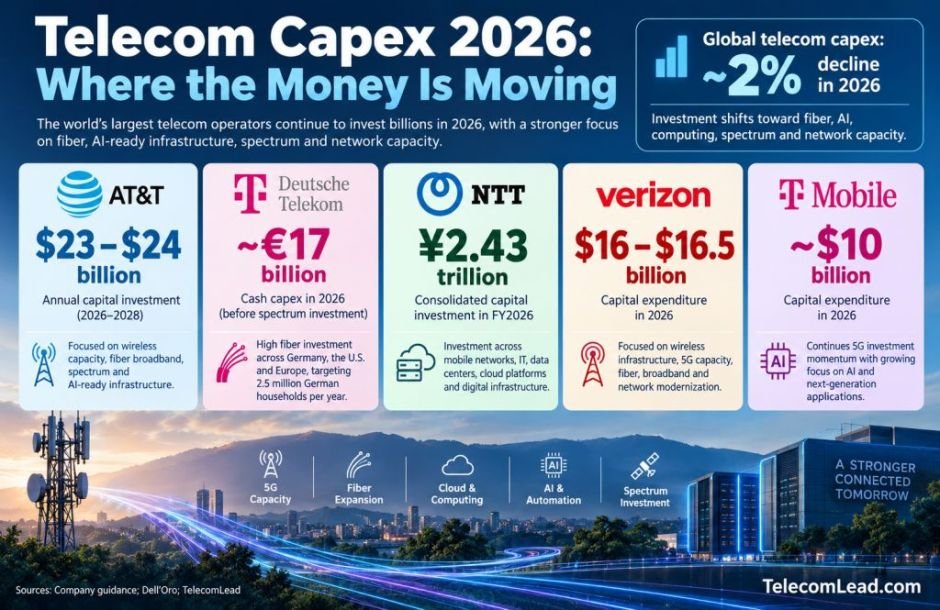
Global telecom capital expenditure is becoming more selective in 2026 as operators move away from the coverage-led investment cycle that defined the early years of 5G.
Dell’Oro forecasts worldwide telecom capex will decline around 2 percent in 2026 after broadly flat investment in 2025. That does not mean operators are abandoning network investment. Instead, spending is shifting toward infrastructure that can improve capacity, lower operating costs and generate new revenue.
Spectrum, fiber, AI-powered network automation, 5G Standalone, cloud infrastructure, enterprise connectivity and data-center-related investments are becoming increasingly important.
AT&T, NTT, Deutsche Telekom, Verizon and T-Mobile remain among the industry’s biggest investors, while Orange and Vodafone Idea demonstrate how capex priorities vary dramatically between mature and growth markets.
The new telecom investment cycle is therefore becoming less about building more network everywhere and more about extracting greater economic value from each dollar of capex.
Spectrum Becomes a Strategic Investment
One of the clearest changes in telecom spending is the growing importance of spectrum.
AT&T expects annual capital investment of approximately $23 billion-$24 billion during 2026-2028, keeping the U.S. operator among the world’s largest telecom infrastructure investors.
Its conventional network investment is focused on wireless capacity, fiber broadband and supporting infrastructure.
But AT&T’s July 2026 acquisition of approximately $23 billion of EchoStar spectrum licenses shows how spectrum transactions can now rival annual network capex in financial importance.
The portfolio includes around 30 MHz of nationwide 3.45 GHz spectrum and 20 MHz of nationwide 600 MHz spectrum.
The additional frequencies can increase network capacity without requiring AT&T to depend entirely on new physical sites.
This makes spectrum efficiency increasingly central to telecom economics. Operators can combine new frequencies with Massive MIMO, carrier aggregation, AI-powered scheduling and software upgrades to generate significantly more capacity from existing infrastructure.
AT&T’s AI-driven 5G and fiber network investment strategy illustrates how mobile operators are combining spectrum, fiber, Open RAN, Cloud RAN and automation rather than treating individual network technologies as separate investment programs.
NTT Shows Telecom Capex Is Moving Beyond the RAN
Japan’s NTT provides another indication of how the definition of telecom capital expenditure is changing.
NTT plans approximately ¥2.43 trillion of consolidated capital investment in FY2026, compared with ¥2.326 trillion in FY2025.
Q1 FY2026 investment reached ¥511.8 billion versus ¥456.5 billion a year earlier.
Importantly, the spending is spread well beyond conventional mobile infrastructure.
Integrated ICT accounted for approximately ¥197 billion of first-quarter investment, Global Solutions represented ¥168 billion and Regional Communications contributed approximately ¥96.6 billion.
The figures highlight an important structural change.
Large telecom groups increasingly operate at the intersection of communications networks, cloud infrastructure, enterprise IT and data centers.
AI is accelerating that convergence because operators already own many of the assets needed to deliver distributed computing: fiber networks, central offices, data centers, edge locations and nationwide connectivity.
This creates the possibility that future telecom capex will increasingly support both connectivity and computing.
Operators including Deutsche Telekom, Orange, Bell, Telus and others are already exploring telecom AI infrastructure and new AI revenue opportunities, including AI factories, sovereign cloud platforms and distributed computing.
Fiber Becomes the Foundation for Mobile, Broadband and AI
Deutsche Telekom expects approximately €17 billion in 2026 cash capex before spectrum investment, keeping it among Europe’s largest network investors.
The company’s investment program spans Germany, the United States and other European markets.
Fiber remains one of its most important priorities.
Deutsche Telekom aims to reach approximately 2.5 million additional German households with fiber each year and around 17.5 million homes by 2027.
Fiber investment was traditionally justified mainly by fixed broadband.
That argument is changing.
The same fiber infrastructure can increasingly support consumer broadband, mobile backhaul, enterprise connectivity, cloud services, data centers, edge computing and eventually 6G transport.
Deutsche Telekom’s strategy therefore illustrates why fiber is becoming one of the most versatile telecom infrastructure assets.
The operator is combining fiber, 5G, cloud and AI investment as it shifts from traditional network expansion toward a broader digital-infrastructure strategy.
The economics are particularly important because a single fiber network can support several revenue streams over many years.
Verizon and T-Mobile Move from Coverage to Capacity
The U.S. wireless investment cycle provides another example of changing capex priorities.
Verizon expects capital expenditure of approximately $16 billion-$16.5 billion in 2026.
T-Mobile expects around $10 billion.
Both operators already have extensive 5G coverage, meaning the next phase is increasingly about improving capacity, performance and monetization.
For Verizon, spending supports wireless infrastructure, broadband, fiber and network modernization.
For T-Mobile, the investment continues to strengthen 5G capacity while expanding the operator’s fixed broadband opportunity.
T-Mobile spent around $2.6 billion during Q1 2026, an increase of approximately 7 percent year on year.
Its network strategy increasingly connects 5G infrastructure with emerging applications, including artificial intelligence and physical AI.
Figure AI’s F03 humanoid robot, for example, is designed to use T-Mobile’s 5G Advanced connectivity.
That points toward an important shift in the network investment case.
Consumer smartphone traffic will remain critical, but future returns from 5G infrastructure could increasingly depend on machines, industrial automation, robots, vehicles and enterprise applications.
T-Mobile’s $10 billion network investment and fiber strategy demonstrates how telecom operators are broadening their infrastructure portfolios beyond traditional mobile connectivity.
AI-RAN Changes the Capacity Equation
Artificial intelligence may become one of the most important factors affecting telecom capex allocation.
Traditionally, operators needing additional mobile capacity had several major options: buy spectrum, deploy additional radio sites, install more radios or upgrade existing equipment.
AI introduces another possibility — extracting more performance from existing infrastructure.
SoftBank and Ericsson demonstrated this potential in a commercial Japanese 5G network, achieving up to approximately 25 percent improvement in spectral efficiency and up to 50 percent higher downlink user throughput using an AI-native scheduler.
Across all evaluated locations, both throughput and spectral efficiency improved by approximately 10 percent.
That matters because spectrum and physical infrastructure are among the largest costs faced by mobile operators.
If AI software can increase the output from those assets, network economics could improve without a proportionate increase in conventional capex.
Dell’Oro forecasts cumulative AI-RAN revenue of approximately $35 billion between 2026 and 2030.
However, the research firm does not expect AI-RAN to dramatically expand the overall RAN market.
That suggests much of the opportunity could involve operators reallocating existing network budgets rather than creating entirely new spending.
The emerging AI-RAN business case will therefore depend heavily on whether AI can deliver measurable improvements in capacity, automation, energy efficiency and operating costs.
Orange Shows Why Capex Geography Matters
Orange recorded €3.2 billion of eCapex during the first half of 2026, equivalent to 15.2 percent of revenue.
Investment increased around 2.7 percent year on year, largely because of higher spending in Africa and the Middle East.
Excluding those regions, eCapex declined 2.4 percent and represented approximately 14 percent of revenue.
The difference illustrates why a single global telecom capex number can hide major regional variations.
Mature European markets are increasingly directing investment toward fiber migration, automation, network simplification and efficiency.
Africa and the Middle East still require substantial investment in coverage, capacity and infrastructure expansion.
Operators with businesses across both mature and emerging markets must therefore manage two different capex cycles at the same time.
Vodafone Idea Uses Capex to Close the Network Gap
Vodafone Idea provides an even clearer contrast.
The Indian operator plans approximately ₹450 billion, or about $4.72 billion, of investment over three years.
It has already placed roughly ₹90 billion of network equipment orders.
The spending is focused on strengthening 4G coverage, adding capacity and accelerating 5G deployment.
Unlike AT&T, Verizon or Deutsche Telekom, Vodafone Idea is still addressing fundamental network expansion requirements.
Its investment program must improve coverage and network quality while competing against Reliance Jio and Bharti Airtel, which have already built extensive 5G networks.
India’s rapid mobile-data growth makes the challenge more urgent.
As traffic increases, Vodafone Idea must invest sufficiently to prevent capacity limitations while simultaneously expanding 5G.
The contrast with mature markets demonstrates that telecom capex is fragmenting into different regional investment models.
Five Areas Absorbing Telecom Investment
The 2026 capex cycle points toward five major areas of spending.
Spectrum is becoming increasingly valuable because additional low- and mid-band frequencies can raise network capacity without requiring equivalent increases in physical infrastructure.
Fiber is evolving into common infrastructure for broadband, mobile backhaul, enterprise networks, cloud connectivity and future 6G.
AI and automation can help operators improve spectrum efficiency, predict network problems, reduce energy consumption and optimize capacity.
Cloud and digital infrastructure are expanding telecom capex beyond traditional mobile networks into data centers, edge platforms and enterprise ICT.
5G Standalone and 5G-Advanced are moving network spending toward programmable infrastructure capable of supporting slicing, enterprise applications and new machine-based services.
Capital Efficiency Becomes the New Telecom Metric
Dell’Oro’s forecast for a roughly 2 percent decline in worldwide telecom capex in 2026 does not necessarily signal weakening network investment.
Instead, it reinforces a more important development: operators are becoming more demanding about returns.
The early 5G investment cycle required operators to acquire spectrum, upgrade thousands of sites and rapidly expand coverage.
The next phase requires a different financial discipline.
Operators increasingly need to demonstrate that network spending can increase capacity, reduce energy consumption, lower operating costs or create additional revenue.
That changes the opportunity for Ericsson, Nokia, Samsung, Huawei and other telecom equipment suppliers as well.
Selling more hardware will not be enough.
Vendors will increasingly need to demonstrate measurable improvements in network economics through AI, software, automation, cloud-native platforms and energy-efficient equipment.
Telecom Capex Is Becoming Digital Infrastructure Capex
The most important development in telecom investment during 2026 may therefore be the gradual disappearance of the boundary between telecom networks and wider digital infrastructure.
NTT is investing heavily in ICT and global solutions.
Deutsche Telekom is combining fiber, cloud and AI.
AT&T is combining spectrum, fiber, Open RAN and automation.
T-Mobile is connecting 5G investment with fiber and emerging AI applications.
Meanwhile, operators are examining data centers, sovereign AI, distributed computing and edge infrastructure as potential sources of additional revenue.
Telecom capex is not disappearing.
It is becoming broader, more software-driven and more closely connected with the AI and cloud infrastructure markets.
For operators, the critical question is no longer simply how much should we spend on the network?
The more important question is which infrastructure investments can generate the greatest capacity, efficiency and revenue from every dollar of capital?
That change could define the telecom investment cycle through the rest of the decade.
FASNA SHABEER