
The Philippines smartphone market in 2025 and early 2026 is defined by aggressive pricing, budget-driven demand and rising consumer concerns around online fraud. Shipment volumes are heavily concentrated among Chinese vendors, with Transsion emerging as the clear market leader in one of Southeast Asia’s most price-sensitive markets.
Smartphone market share: Budget brands take the lead
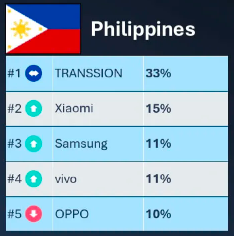
Recent industry data shows a highly concentrated vendor landscape:
Transsion – 33 percent
Transsion commands a dominant position, driven by its multi-brand strategy through Tecno, Infinix and itel, all targeting entry-level and gaming-focused buyers.
Xiaomi – 15 percent
Xiaomi holds second place, benefiting from strong demand for value-packed mid-range and affordable 5G devices.
Samsung – 11 percent
Samsung maintains steady share, supported by its Galaxy A series and brand recognition.
vivo – 11 percent
vivo competes through extensive offline distribution and youth-centric marketing.
OPPO – 10 percent
OPPO rounds out the top five, focusing on mid-tier devices and camera innovation.
Chinese vendors collectively account for more than 75 percent of shipment volumes, underscoring the Philippines’ strong preference for affordable smartphones, according to the latest Omdia report.
Transsion’s budget dominance and pricing strategy
Transsion’s 33 percent market share reflects its deep penetration of the sub-11,500 PHP segment, which represents the majority of national smartphone sales. By offering devices priced as low as 4,500 PHP, the company has captured first-time buyers and mobile gamers seeking high RAM and large battery capacity at entry-level prices.
Gaming-ready positioning, aggressive provincial retail expansion and social media marketing have enabled Transsion brands to dominate quarterly shipment cycles, especially during major online sale events.
Xiaomi’s 5G push and online strength
Xiaomi’s strategy centers on delivering high specifications at competitive prices. Affordable 5G models in the 10,000 PHP to 12,000 PHP range are driving upgrades as local carriers expand network coverage. The brand maintains a strong presence on Shopee, Lazada and TikTok Shop, combining flash sales with influencer-driven campaigns to boost volume.
By democratizing 5G access, Xiaomi is targeting tech-savvy millennials transitioning from 4G devices.
Samsung’s mid-range resilience and localization
Samsung continues to defend its 11 percent share through the Galaxy A series, targeting replacement buyers seeking reliability and long-term software support. Entry-level 5G models priced around 6,000 PHP serve as stepping stones for digital inclusion.
Local manufacturing initiatives are aimed at improving supply efficiency and pricing stability, helping Samsung respond more quickly to regional demand shifts while protecting margins.
vivo’s retail execution and youth marketing
vivo’s strength lies in its offline retail relationships and youth-oriented branding. Budget Y series models drive volume, while higher-end V series smartphones lift average selling prices. Marketing campaigns heavily emphasize AI-enhanced photography and lifestyle positioning to appeal to social media-active users.
OPPO’s cultural partnerships and premium positioning
OPPO is building brand equity through partnerships with local creative institutions and positioning its Reno series as a tool for content creators. Mid-tier pricing between 18,999 PHP and 24,999 PHP targets aspirational buyers seeking premium features without flagship pricing.
Buying patterns: E-commerce spikes and installment culture
The Philippine market is highly event-driven, with sales peaks during 3.3, 4.4 and other double-digit e-commerce campaigns. Flash sales, platform vouchers and bundled accessories significantly influence purchasing decisions.
Key buying trends include:
Strong demand for devices under 12,000 PHP
Preference for at least 8GB RAM for gaming and multitasking
Heavy reliance on installment plans and digital wallets
Rapid adoption of affordable 5G smartphones
Offline retail remains critical in provincial areas where e-commerce penetration is still developing.
Pricing pressures and ASP growth
Rising global memory and chipset costs are pushing average selling prices upward. While vendors attempt to keep entry-level models stable, analysts expect a 3 to 5 percent increase in ASP as brands promote higher-memory and 5G variants to protect profitability.
The market is gradually shifting from ultra-low-cost devices toward “value-plus” smartphones that balance affordability with gaming performance and battery endurance.
Customer complaints: Online fraud and delivery issues surge
As smartphone purchases increasingly move online, consumer complaints have intensified. Authorities report rising cases of:
Fake online stores and counterfeit products
Non-delivery and delayed delivery complaints
Misleading promotional offers
Phishing and smishing scams linked to holiday sales
Cybercrime reports show phishing-related incidents surging sharply in 2025, with fraudulent links spread via SMS and social media. Consumers have suffered significant financial losses, increasing demand for built-in anti-scam protection, stronger authentication tools and verified seller programs.
Outlook: From price war to trust economy
The Philippine smartphone market remains volume-driven, but competitive advantage is shifting beyond pricing. Vendors must now balance affordability with security, logistics reliability and after-sales service.
While Transsion dominates in unit shipments, Xiaomi accelerates 5G adoption and Samsung leverages brand trust, the next phase of competition will hinge on ecosystem integration, digital payment partnerships and enhanced consumer protection features.
FASNA SHABEER

