
Indonesia’s smartphone market remained highly competitive in Q1 2026 as smartphone vendors prioritized profitability, pricing discipline, and sustainable growth amid weakening demand across Southeast Asia. Chinese smartphone brands continued dominating Indonesia’s smartphone industry, while Samsung Electronics remained the only major non-Chinese smartphone vendor among the country’s top five smartphone brands.
According to Omdia, Southeast Asia smartphone shipments declined 9 percent year-on-year in Q1 2026 as smartphone vendors reduced aggressive discounting and focused more heavily on margin protection instead of shipment-led market share expansion. Average smartphone selling prices in Southeast Asia increased 19 percent to $349 because of rising memory and component costs combined with stronger demand for higher-value smartphones.
Indonesia remained Southeast Asia’s largest smartphone market with shipments reaching 7.2 million units in Q1 2026 despite a 17 percent year-on-year decline.
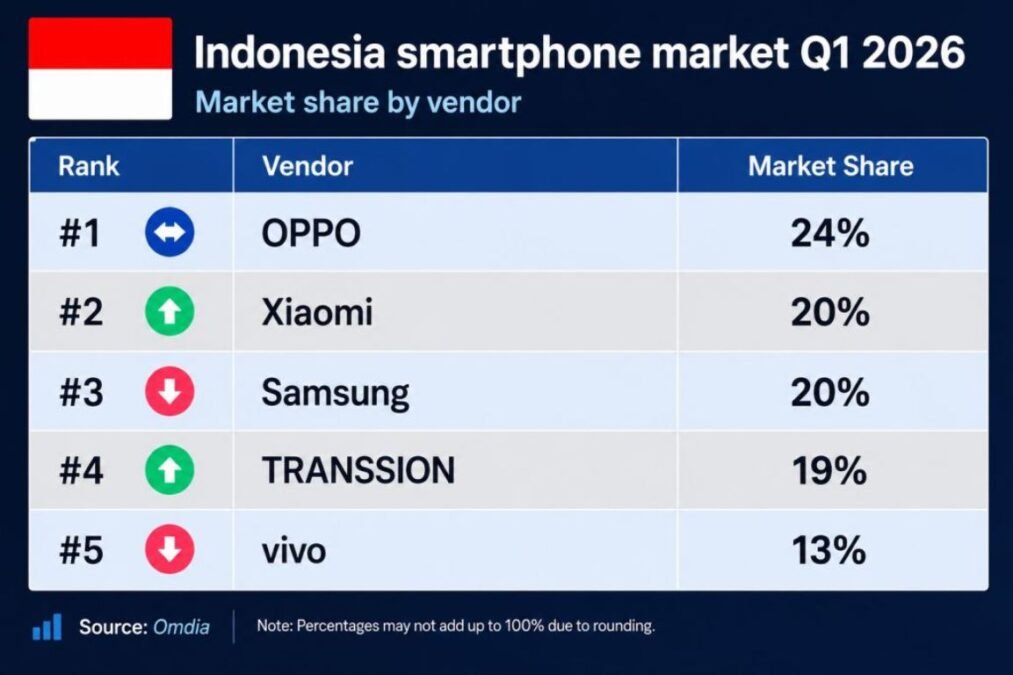
OPPO secures leadership in Indonesia smartphone market
OPPO secured the leading position in Indonesia’s smartphone market with a 24 percent market share, supported by its strong offline retail network, localized marketing strategy, and demand for affordable mid-range smartphones.
Xiaomi captured a 20 percent market share as its aggressive pricing strategy and feature-rich entry-level and mid-range smartphones continued attracting price-sensitive Indonesian consumers.
Samsung Electronics also secured a 20 percent market share, maintaining its position as Indonesia’s leading non-Chinese smartphone vendor despite intensifying pressure from Chinese competitors in affordable 5G categories.
TRANSSION reached a 19 percent market share through rapid growth of Infinix, Tecno, and itel smartphones in Indonesia’s affordable smartphone segment.
vivo accounted for a 13 percent market share while maintaining strong retail visibility and camera-focused smartphone positioning.
Indonesia’s smartphone market remained tightly contested, with only an 11 percentage point gap separating the number one and number five smartphone vendors.
Smartphone vendors focus on affordability and profitability
Smartphone brands in Indonesia increasingly focused on balancing affordability and profitability as rising component and memory prices reduced flexibility for aggressive pricing campaigns.
OPPO continued strengthening its retail-led strategy through offline distribution expansion and installment-based financing programs targeting mass-market smartphone buyers.
Xiaomi maintained strong momentum by offering feature-rich smartphones with high-refresh-rate displays, affordable 5G connectivity, large batteries, and gaming-oriented performance in the IDR 2 million to IDR 5 million category.
Samsung Electronics focused on protecting profitability through its Galaxy ecosystem strategy while expanding affordable Galaxy A-series smartphone offerings.
TRANSSION strengthened its market position through gaming-focused smartphones, aggressive pricing, and youth-oriented branding under its Infinix and Tecno smartphone portfolios.
vivo continued emphasizing camera optimization, stylish smartphone designs, and offline retail partnerships to defend market share.
Affordable 5G smartphones dominate Indonesian demand
Indonesia’s smartphone market in 2026 continued witnessing intense pricing competition in affordable 5G smartphones as vendors focused on balancing shipment growth with sustainable profitability.
Samsung Galaxy A16 5G smartphones retailed in Indonesia between IDR 3.2 million and IDR 3.8 million depending on storage configurations and sales channels, while Galaxy A55 5G devices were available between IDR 5.5 million and IDR 6.5 million across major retail outlets.
Xiaomi Redmi Note 15 5G smartphones generally retailed between IDR 3 million and IDR 4 million, while Poco X-series gaming smartphones ranged from IDR 3.5 million to IDR 5.5 million depending on specifications and promotional campaigns.
Budget 5G smartphones from Infinix, Tecno, vivo, and itel increasingly entered the IDR 1.5 million to IDR 3 million segment, intensifying competition in Indonesia’s entry-level smartphone market.
Consumers increasingly preferred smartphones offering 120Hz displays, gaming optimization, AI-based photography, fast charging capabilities, and large battery capacity instead of premium flagship devices as economic pressure continued influencing spending behavior.
Mobile gaming, affordability and bundled data plans shape buying behavior
Indonesian smartphone consumers in Q1 2026 remained highly price-sensitive, with buying decisions strongly influenced by financing availability, bundled operator data plans, gaming performance, and battery endurance.
Affordable mobile internet packages and installment-based purchasing programs continued driving smartphone adoption across lower-income and rural consumer segments.
Consumers increasingly favored smartphones optimized for TikTok usage, mobile gaming, social media content creation, and video streaming. Devices featuring 90Hz and 120Hz displays, fast charging technology, and larger batteries gained stronger traction among younger users.
Offline retail stores remained highly important because bundled operator offers, cashback promotions, and financing programs significantly influenced purchasing decisions.
Expanding mobile internet subscriber base supports smartphone growth
Indonesia’s expanding mobile internet subscriber base continued supporting smartphone demand as telecom operators accelerated 4G and 5G rollout nationwide.
Telkomsel remained Indonesia’s largest mobile operator with coverage exceeding 97 percent of the population and more than 159 million subscribers. The operator continued expanding 5G services across Jakarta, Surabaya, Bali, and other major cities.
Indosat Ooredoo Hutchison accelerated 5G rollout and focused on AI-driven digital services and competitive data packages targeting younger mobile internet users.
XL Axiata and Smartfren also intensified competition through high-volume data plans, gaming-focused subscriptions, and bundled streaming services.
Affordable mobile internet packages remained one of the strongest drivers of smartphone adoption across Indonesia’s mass-market segments.
Consumers report overheating, software ads and battery issues
Consumer discussions across e-commerce platforms, Reddit, smartphone forums, and online reviews increasingly highlighted concerns related to software advertisements, overheating, battery optimization, and long-term device performance in affordable Android smartphones.
Several Xiaomi and Redmi users complained about advertisements appearing inside system applications and pre-installed software affecting user experience. Online discussions also highlighted occasional overheating during gaming and heavy multitasking sessions, particularly in entry-level gaming-oriented smartphones.
Some Samsung Galaxy A-series users discussed battery drain concerns following software updates and occasional lag during prolonged multitasking usage. Consumers also raised concerns regarding charging speed consistency and thermal performance during gaming sessions.
Infinix and Tecno users frequently discussed software optimization limitations, delayed Android updates, and camera processing inconsistencies in lower-priced smartphones. However, many consumers continued positively rating these devices for battery life, gaming performance, and aggressive pricing.
Consumers across multiple online platforms also expressed frustration regarding rising mobile data costs, expiring internet quotas, and shorter validity cycles for prepaid plans as Indonesian telecom operators increasingly focused on profitability and ARPU growth strategies.
Longer smartphone replacement cycles also increased consumer focus on software stability, battery endurance, long-term update support, and after-sales service quality during purchasing decisions.
Outlook: AI-ready smartphones and profitability to shape market competition
Indonesia is expected to remain one of Southeast Asia’s most important smartphone markets because of its large digital consumer base, growing mobile internet penetration, and increasing demand for affordable AI-ready 5G smartphones.
Smartphone vendors are increasingly expected to compete through AI-enabled features, localized software experiences, ecosystem integration, financing-led affordability, and offline retail expansion instead of aggressive shipment-led strategies.
Indonesia’s smartphone market is also expected to witness stronger focus on local manufacturing, pricing discipline, operator partnerships, and sustainable profitability throughout the remainder of 2026, Omdia report said.
FASNA SHABEER

