
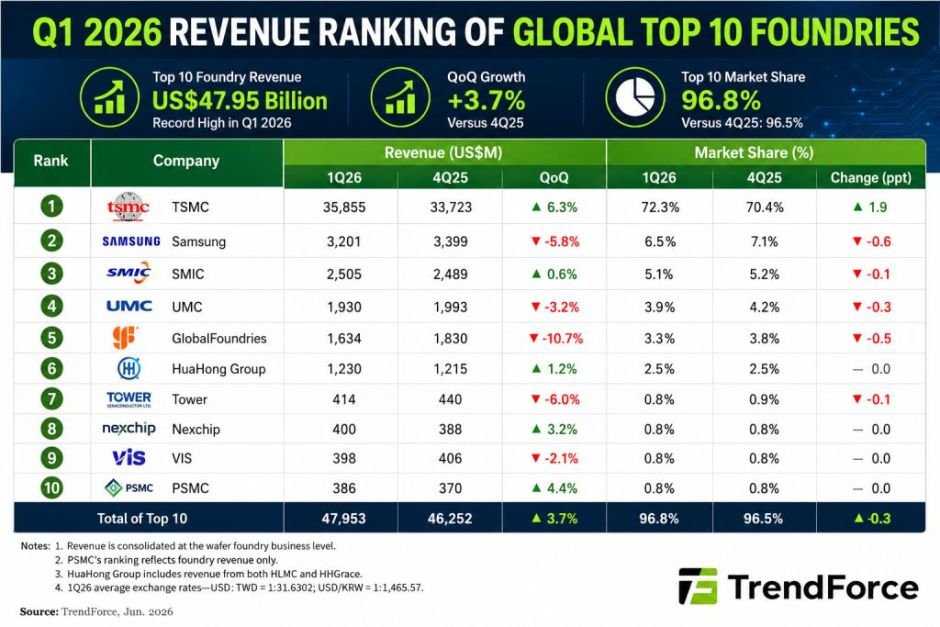
The global semiconductor foundry industry achieved another record quarter in Q1 2026, fueled by strong demand for AI high-performance computing (HPC) chips, accelerated inventory building across TV and PC supply chains, and growing orders for advanced semiconductor technologies. According to TrendForce, combined revenue of the world’s top 10 foundries rose 3.7 percent quarter-on-quarter to a record US$47.95 billion despite the traditional seasonal slowdown in smartphone demand.
The strong performance was largely driven by sustained shipments of AI server GPUs, xPUs, server CPUs, and power management chips. TV brands and PC/notebook manufacturers also increased inventories and accelerated production schedules, creating additional pull-in orders for foundries throughout the quarter.
TrendForce expects the momentum to continue into Q2 2026. Inventory replenishment by TV and PC/notebook brands is likely to last for another quarter, while smartphone makers are entering new product production cycles. Foundries are also signaling potential wafer price increases during the second half of 2026 as utilization rates improve and pricing bottoms out across several process technologies, encouraging customers to secure capacity early.
AI-related demand remains a major growth catalyst, with advanced-node production and power management semiconductor demand exceeding expectations. TrendForce forecasts another record quarter for the world’s top foundries in Q2 2026, with growth expected to accelerate sequentially.
TSMC remained the dominant player in the market, benefiting from strong AI server GPU and xPU demand as well as rising deployment of Agentic AI infrastructure and general-purpose servers. Revenue increased 6.3 percent quarter-on-quarter to nearly US$35.86 billion, while its market share expanded to 72 percent, reinforcing its leadership position even during a seasonally weaker period.
Samsung Foundry, excluding its System LSI business, retained its position as the second-largest foundry globally. While it received some support from TV and PC-related pull-in orders, smartphone seasonality weighed on performance. Revenue declined 5.8 percent quarter-on-quarter to slightly above US$3.2 billion, reducing market share to 6.5 percent.
China-based SMIC maintained third place after benefiting from orders from TV brands and notebook manufacturers. The company also gained from wafer price increases negotiated with certain 8-inch customers in the second half of 2025. Revenue rose 0.6 percent sequentially to US$2.51 billion, while market share remained stable at 5.1 percent.
UMC continued to benefit from inventory-building activities among TV and PC supply chains. Additional demand for both 8-inch and 12-inch peripheral IC production improved capacity utilization and shipments. However, a larger mix of lower-priced 8-inch wafers reduced average selling prices by around 5 percent, leading to a 3.2 percent revenue decline to US$1.93 billion. UMC maintained fourth position with a 3.9 percent market share.
GlobalFoundries experienced one of the sharpest declines among leading foundries. Limited exposure to consumer electronics inventory replenishment and weaker smartphone-related demand caused both shipments and average selling prices to fall. Revenue dropped approximately 11 percent quarter-on-quarter to just over US$1.63 billion, while market share slipped to 3.3 percent. Despite the decline, the company retained fifth place globally.
HuaHong Group held sixth position after consolidated revenue, including HLMC operations, increased 1.2 percent quarter-on-quarter to US$1.23 billion. Market share remained unchanged at 2.5 percent. Stable wafer shipments at HHGrace helped offset pricing pressure during the quarter.
Tower Semiconductor ranked seventh, reporting revenue of US$414 million, down 6 percent quarter-on-quarter due to seasonal weakness in consumer electronics peripheral IC demand. The company maintained a market share of 0.8 percent.
The most notable ranking change occurred among the smaller foundries. Nexchip emerged as the biggest beneficiary of TV and PC inventory replenishment because of its strong exposure to peripheral IC markets. Revenue increased 3.2 percent quarter-on-quarter to US$400 million, enabling the company to climb from ninth to eighth place, the highest ranking in its history.
VIS secured ninth position with a market share of 0.8 percent. Strong pull-in orders for notebook, TV large-display driver ICs, smartphone chips, and AI-related power management ICs supported demand. However, a higher mix of display driver IC shipments reduced average selling prices, resulting in a 2.1 percent revenue decline to nearly US$400 million.
PSMC completed the top 10 ranking. Excluding memory operations and focusing on foundry-related revenue, the company posted 4.4 percent quarter-on-quarter growth to US$386 million. Rising memory prices also supported its overall business performance, allowing PSMC to maintain a 0.8 percent market share.
With AI infrastructure spending accelerating globally and foundries preparing for potential wafer price hikes later in 2026, the semiconductor manufacturing sector is entering a new growth phase. Demand for AI processors, advanced packaging, power management solutions, and high-performance computing chips is expected to keep capacity utilization elevated and push foundry revenues to fresh record levels in the coming quarters.
BABURAJAN KIZHAKEDATH

