The global smartphone industry is entering its steepest annual contraction as soaring memory costs force Apple, Samsung, Xiaomi, Huawei and other device makers to increase prices, reduce entry-level models and concentrate on premium smartphones.
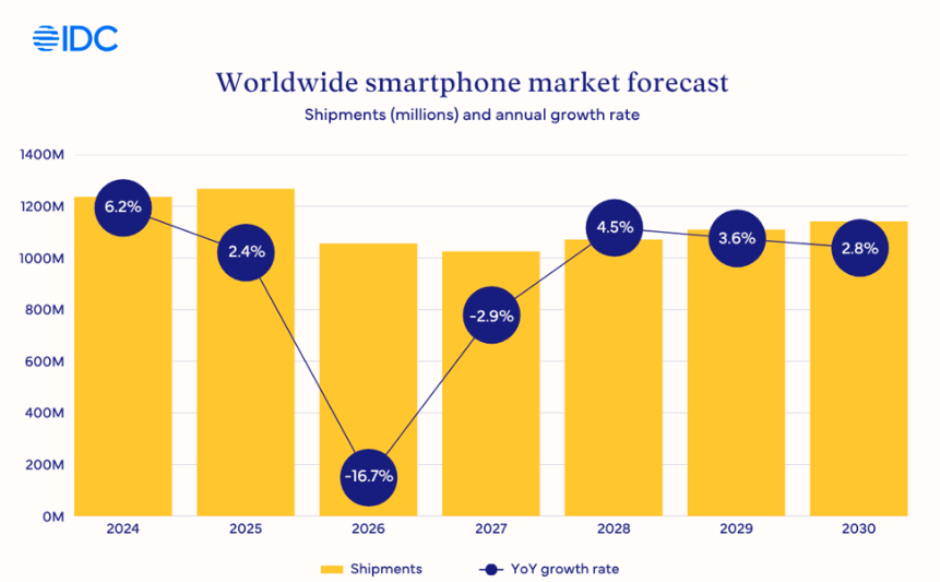
Nabila Popal – Senior Director, Data & Analytics at IDC, expects smartphone shipments to decline 16.7 percent in 2026 to slightly more than 1 billion units. IDC has earlier projected 13.9 percent decline in smartphone shipments. A drop of 16.7 percent in smartphone shipments represents the largest annual shipment contraction recorded by the industry.
IDC smartphone market forecast 2026 indicated the smartphone market is shrinking in volume while expanding in value. IDC forecasts global smartphone sales value will rise 6.3 percent to $613 billion because manufacturers are charging significantly more for each device.
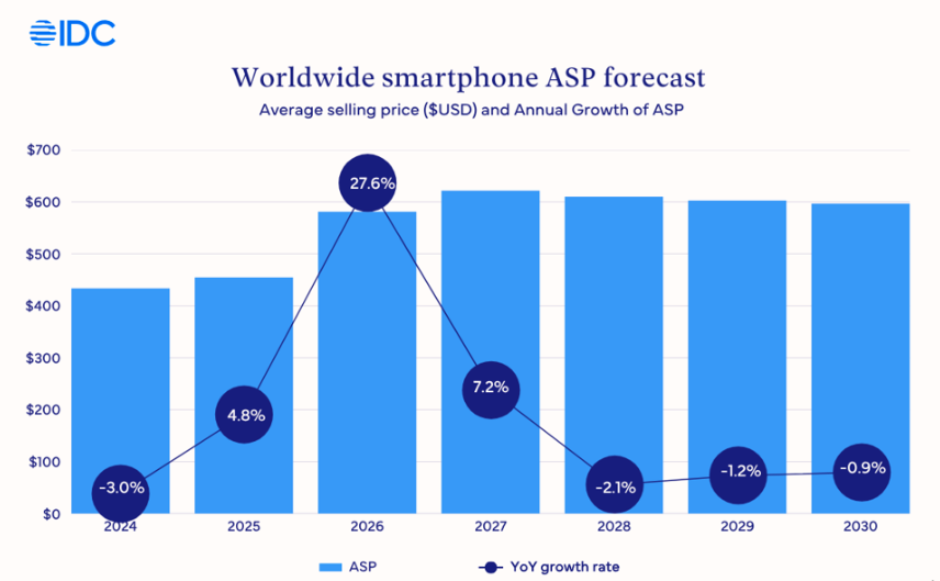
The average smartphone selling price is expected to reach a record $581 in 2026, increasing 27.6 percent in one year. IDC had projected an average price of $550 in the previous quarter, but manufacturers are passing memory and other component costs to consumers faster than anticipated.
Memory Prices Rise More Than 300%
The principal cause of the smartphone downturn is the memory shortage that began in late 2025 and intensified during the second half of 2026.
NAND flash and DRAM prices have increased by more than 300 percent year over year, dramatically raising the cost of manufacturing smartphones. Memory prices are expected to continue increasing until at least 2028, forcing vendors to redesign product portfolios around a permanently higher cost structure.
The effect will become more severe during the second half of 2026, when IDC expects smartphone shipments to fall 27.2 percent year over year.
Samsung Q2 2026 mobile business results support IDC’s assessment. Samsung said its Memory Business recorded an all-time quarterly revenue high during the second quarter of 2026 as supply remained limited and prices continued rising. The company expects demand for server DRAM, enterprise SSDs and high-bandwidth memory to keep the market undersupplied, despite weaker smartphone and PC demand.
The shortage illustrates the effect of AI infrastructure spending on the consumer-electronics supply chain. Memory suppliers are prioritising higher-value products for AI servers and data centres, reducing the capacity available for smartphones—particularly inexpensive Android devices.
Sub-$100 Smartphone Market Faces 60% Decline
The industry shipped approximately 173 million smartphones priced below $100 last year, but this category now faces an existential challenge.
Manufacturers of entry-level Android phones traditionally operated with limited ability to absorb higher component costs. With memory prices rising more than threefold, many of these models are becoming commercially unviable.
Shipments in the sub-$100 segment dropped by almost 60 percent in the second quarter of 2026. IDC expects the decline to accelerate during the second half.
Consumers in Africa, Latin America, Southeast Asia and other price-sensitive regions will experience the greatest impact because smartphone vendors are cutting the least expensive models and directing production towards mid-range and premium devices.
Emerging-market smartphone shipments are expected to fall by more than 20 percent in 2026. Buyers who cannot afford higher prices are likely to postpone upgrades, purchase refurbished devices or continue using existing handsets for longer.
The average smartphone now costs approximately $147 more than it did two years ago, fundamentally altering upgrade economics for consumers.
Xiaomi Shipments Drop 26.5% as ASP Jumps 25.9%
Xiaomi Q2 2026 smartphone business results provide some of the clearest evidence that rising prices cannot fully compensate for falling smartphone volumes.
Xiaomi shipped 31.2 million smartphones during the second quarter of 2026, a decline of approximately 26.5 percent. Smartphone revenue fell 7.5 percent to RMB42.1 billion. Xiaomi’s average smartphone selling price jumped 25.9 percent to a record RMB1,351.
Premiumisation is changing Xiaomi’s position in China. Smartphones priced at RMB3,000 or more represented 32.1 percent of Xiaomi’s mainland China sales during the second quarter, increasing 4.5 percentage points to a record level.
Xiaomi captured 16.2 percent of China’s RMB3,000–RMB4,000 smartphone category, an improvement of 3.3 percentage points.
The company shipped approximately 65 million smartphones during the first half of 2026. Its earlier full-year shipment target for 2025 was 180 million units, but actual shipments reached 165.2 million.
These figures show why Xiaomi is moving beyond the sub-$200 market. More than half of its smartphones have traditionally been priced below $200, making the company particularly exposed to memory inflation.
Samsung Mobile Revenue Reaches KRW33.2 Trillion
Samsung’s Mobile eXperience and Networks businesses generated KRW33.2 trillion in second-quarter 2026 revenue. Sales increased, supported by the Galaxy S26 series and Galaxy A devices.
Samsung said elevated industry-wide component costs affected the mobile business. Its response will be a flagship-led strategy built around the Galaxy S26 and Galaxy Z8 series, a higher premium-device mix and expanded AI experiences.
Samsung’s results reinforce IDC’s expectation that manufacturers with broad supply-chain relationships and strong premium brands will be better positioned to navigate the shortage.
Samsung reported quarterly revenue of KRW171.5 trillion, up 28 percent sequentially. The Device eXperience division, which contains Samsung’s mobile and consumer-electronics operations, recorded a 9 percent sequential revenue decline.
Apple iPhone Revenue Jumps 21.7% to $54.25 Billion
Apple fiscal Q3 2026 financial results indicated that the iPhone maker is benefiting from the industry’s move towards higher prices because its customers are already concentrated in the premium segment.
Apple generated $54.25 billion in iPhone revenue during its fiscal third quarter ended June 27, 2026, up from $44.58 billion in the corresponding period — a rise of 21.7 percent.
For the first nine months of fiscal 2026, iPhone revenue reached $196.52 billion, compared with $160.56 billion a year earlier, representing growth of 22.4 percent.
Apple’s quarterly revenue increased 16 percent to $109.4 billion, with iPhone revenue reaching a June-quarter record.
Apple had already reported record iPhone demand in the previous two quarters. Fiscal first-quarter revenue reached $143.8 billion, up 16 percent, while fiscal second-quarter revenue increased 17 percent to $111.2 billion.
Apple’s installed base also surpassed 2.5 billion active devices.
The performance supports IDC’s view that premium manufacturers are more resilient because consumers in markets such as the United States and United Kingdom can use trade-in programmes and long-term interest-free financing to manage higher device prices.
Android Shipments to Fall 24.3%
Android will absorb almost the entire 2026 smartphone market contraction. IDC expects Android shipments to decline 24.3 percent, causing the operating system’s market share to fall by seven percentage points in a single year.
Android is more exposed because it dominates the sub-$100 and mass-market categories most affected by memory inflation. Vendors cannot continue absorbing higher component costs without either raising retail prices or eliminating models.
Apple’s iOS is moving in the opposite direction. iPhone shipments are forecast to decline only 1.3 percent, while iOS share increases by almost four percentage points to a record 23.6 percent.
The difference does not necessarily indicate a broad increase in consumer purchasing power. Instead, it reflects the collapse of inexpensive Android shipments and the relative stability of premium demand.
Huawei HarmonyOS Shipments to Reach 51 Million
Huawei is another beneficiary of the market disruption. IDC expects HarmonyOS smartphone shipments to nearly triple to 51 million units in 2026.
HarmonyOS remains much smaller than Android and iOS globally, but Huawei is using disciplined pricing and strong brand recognition to capture share in China as competing Android vendors cut volumes.
Huawei’s Consumer Business, which includes smartphones and other connected devices, generated approximately RMB344.5 billion in 2025 revenue, increasing 1.6 percent.
Huawei’s total revenue reached RMB880.9 billion, up 2.2 percent. The company invested RMB192.3 billion in research and development, equal to 21.8 percent of annual revenue, while cumulative R&D investment over the past decade reached RMB1.382 trillion.
IDC’s projection of 51 million smartphone shipments in 2026 suggests that Huawei’s software ecosystem and domestic supply chain are becoming more important competitive assets.
BABURAJAN KIZHAKEDATH