
Russia’s fixed broadband market in 2026 is increasingly focused on delivering faster fiber internet, expanding digital services, and modernizing network infrastructure. For internet customers searching for the best ISP in Russia, providers are competing not only on broadband speed but also on bundled services, Wi-Fi quality, smart home offerings, and digital ecosystems.
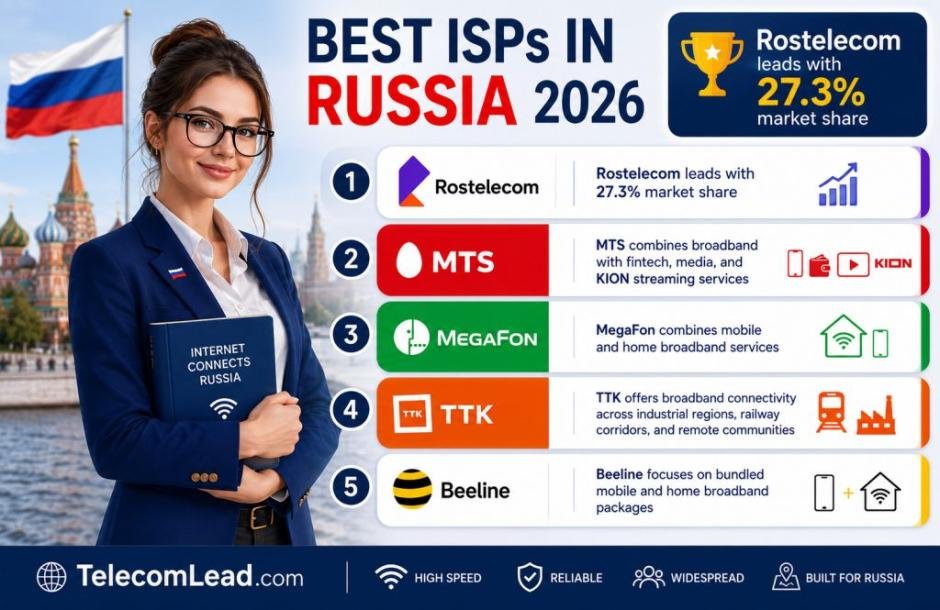
The country has approximately 39 million fixed broadband subscriptions, representing 4.7 percent year-on-year growth, while household broadband penetration exceeds 84 percent across urban areas. Although subscription growth is slowing, operators continue investing in FTTH, XGS-PON, smart home services, and regional fiber expansion.
Russia’s Broadband Market Becomes More Consolidated
Russia remains one of Europe’s largest broadband markets, with the top five ISPs controlling approximately 71 percent of all fixed broadband connections. Industry consolidation has enabled operators to expand nationwide fiber networks while supporting government-backed digital infrastructure projects.
For consumers, this means wider fiber availability, improved bundled services, and expanding gigabit broadband options in major cities.
Rostelecom Remains Russia’s Largest Internet Provider
Rostelecom continues to lead the market with a 27.3 percent market share and manages approximately 23.7 million fixed connections across residential, enterprise, and government networks.
The company plays a major role in expanding broadband into rural regions through the Digital Equality initiative, bringing internet access to nearly 24,000 small communities and improving rural connectivity by 37 percent during the past five years.
MTS Targets Premium Fiber Customers
MTS is Russia’s largest private broadband operator with a 22.5 percent market share and nearly 10 million fixed broadband subscribers.
Its strategy focuses on combining broadband with fintech, media, and KION streaming services. More than 15 million users already use MTS ecosystem services. The operator is expanding XGS-PON deployments in Moscow, offering 10 Gbps broadband plans while targeting 22 percent annual growth in demand for multi-gigabit internet.
MegaFon Expands Fixed-Mobile Convergence
MegaFon holds 15.2 percent of Russia’s broadband market after expanding beyond its mobile business.
The operator continues integrating regional fiber assets while promoting fixed-mobile convergence (FMC), allowing customers to combine mobile and home broadband services under a single subscription.
TTK Leverages Massive National Fiber Network
TransTeleCom (TTK) controls 12.6 percent of the broadband market and operates one of Russia’s largest backbone networks spanning approximately 78,000 kilometers of fiber-optic infrastructure.
TTK continues expanding high-capacity broadband connectivity across industrial regions, railway corridors, and remote communities.
ER-Telecom (Dom.ru) Strengthens Regional Broadband
ER-Telecom, operating under the Dom.ru brand, holds around 11.2 percent market share while serving roughly 4 million households.
Its investments focus on fiber-to-the-building (FTTB), managed Wi-Fi solutions, and smart home security services across Russia’s regional cities.
Beeline Focuses on Broadband Bundles
VimpelCom (Beeline) accounts for approximately 6.2 percent of the broadband market.
Rather than competing nationally on scale, Beeline emphasizes bundled mobile and home broadband packages to improve customer retention in Moscow and St. Petersburg.
Internet Speed in Russia 2026
Russia’s nationwide broadband performance varies considerably between metropolitan and rural regions.
The national median fixed broadband download speed reaches 35.03 Mbps, while upload speeds average 10.19 Mbps, placing Russia 52nd globally.
In Moscow, however, 100 Mbps has become the standard broadband package, while 1 Gbps services deliver real-world download speeds of up to 920 Mbps.
National median latency stands at 63 ms, while locally hosted services such as VK and Yandex achieve latency below 15 ms.
Broadband Prices Remain Competitive
Russia continues to offer some of the world’s lowest broadband prices.
Average unlimited broadband costs approximately 658.6 rubles per month.
Typical pricing includes:
100 Mbps: 450-600 rubles per month
1 Gbps: 900-1,200 rubles per month
Customers are increasingly choosing premium packages that include smart home services, cloud storage, Wi-Fi mesh systems, streaming platforms, and cybersecurity features.
What Internet Customers Want in 2026
Broadband users increasingly expect more than internet connectivity.
Demand for ISP-provided domestic cloud storage has increased 34 percent, while 41 percent of urban households now seek managed Wi-Fi mesh systems to improve home-office performance and eliminate indoor coverage gaps.
Professionals also prefer faster upload speeds for cloud applications and remote work.
Challenges Facing Broadband Users
Although fiber availability continues expanding, customers face several challenges.
Many providers increased broadband prices by 10 percent to 15 percent during early 2026 to offset approximately 287 billion rubles in industry costs associated with domestic equipment requirements.
Since March 2026, government-directed network restrictions have also affected internet availability during security events. Regulators have additionally blocked more than 469 VPN services, limiting access to certain international websites and applications.
Some users have also reported dissatisfaction with locally manufactured networking equipment, citing reduced wireless performance and longer repair times in regional areas.
Broadband Investment Continues Despite Market Changes
Russia’s broadband market is expected to attract US$17.02 billion in investment during 2026, supported by a 3.59 percent compound annual growth rate (CAGR).
The government has invested more than 1.2 trillion rubles in the Digital Economy program, including 14.9 billion rubles allocated specifically for broadband infrastructure during 2026.
Meanwhile, operators are investing 83.7 billion rubles in network management and traffic systems while upgrading domestic telecommunications infrastructure.
Outlook for Russia’s Internet Market
Russia’s broadband industry is entering a new phase where network quality, fiber expansion, and digital ecosystems matter more than subscriber growth alone.
Data traffic continues growing at 28.1 percent annually, while 5G Fixed Wireless Access (FWA) is expanding at 12 percent in suburban markets where fiber deployment remains expensive.
For consumers choosing the best ISP in Russia, the leading providers — Rostelecom, MTS, MegaFon, TTK, ER-Telecom (Dom.ru), and Beeline — offer different strengths depending on location, desired broadband speed, bundled services, and smart home capabilities. Customers in major cities can increasingly access gigabit fiber, while regional users continue benefiting from ongoing investments in nationwide broadband infrastructure.
FASNA SHABEER

