
Sunrise Communications, the Swiss telecom operator, reported a 1.2 percent decline in revenue to CHF 732 million in the third quarter of 2026, as pressure on fixed broadband ARPU continued despite price increases and growth in business services.
Sunrise reduced capital expenditure (Capex) by 17 percent to CHF 88 million, reflecting lower mobile network capacity investment requirements, changes in coverage investment timing and a more focused IT development strategy.
The telecom operator is accelerating its digital transformation through AI-native mobile services, sovereign enterprise AI solutions and a multi-year operating model restructuring aimed at improving efficiency and supporting future investments.
Sunrise Revenue and Capex Performance
Sunrise generated CHF 2.168 billion in revenue during the first nine months of 2026, down 1.2 percent from CHF 2.195 billion in the corresponding period of 2025.
Capex for the nine-month period declined 11.6 percent to CHF 323 million from CHF 366 million.
The Capex-to-revenue ratio improved to 12 percent in Q3 2026 from 14.3 percent a year earlier. For the first nine months, the ratio declined to 14.9 percent from 16.7 percent.
Sunrise attributed lower Capex to reduced mobile capacity requirements following earlier network investments, lower coverage-related spending and tighter prioritisation of IT projects.
The company reiterated its 2026 financial guidance, expecting broadly stable annual revenue and Capex below 15 percent of revenue.
Mobile Subscribers and Broadband Customer Trends
Sunrise added 19,000 net mobile postpaid subscribers during Q3 2026, compared with 20,000 in Q3 2025 and 21,000 in Q2 2026.
Mobile subscriber additions were supported by its multibrand strategy, including contributions from flanker brands and business customers.
The fixed internet subscriber base remained stable during the quarter, with approximately zero net additions, compared with a loss of 7,000 internet subscribers in Q3 2025.
Sunrise reported improving fixed broadband customer churn, which helped stabilise its internet subscriber base despite price increases and competitive pressure.
Fixed-mobile convergence (FMC) penetration increased to 61.5 percent in Q3 2026 from 59 percent in Q3 2025 and 61.1 percent in Q2 2026.
Sunrise is prioritising customer retention, loyalty programmes and bundled fixed-mobile services to increase customer lifetime value.
Sunrise Mobile and Fixed Broadband ARPU
Sunrise reported mobile ARPU of CHF 29.6 in Q3 2026, compared with CHF 29.7 in Q3 2025, representing a 0.3 percent decline.
Mobile ARPU improved from CHF 28.9 in Q2 2026, supported by price increases implemented in August.
The operator said lower roaming-related revenue and changes in its subscriber mix partly offset the benefits of higher pricing.
Fixed broadband ARPU declined 4.8 percent to CHF 54.1 from CHF 56.8 a year earlier.
Fixed ARPU was also below the CHF 54.5 recorded in Q2 2026.
Sunrise attributed the decline to lower pricing for new fixed broadband customers, changes in its brand mix, legacy UPC customer migrations and adjustments to fixed-mobile convergence discounts.
The operator expects both mobile and fixed ARPU to benefit from the full impact of its August price increases during Q4 2026.
Sunrise Fiber, 5G and Network Coverage Strategy
Sunrise is shifting its network investment strategy from capacity expansion towards optimising existing infrastructure and prioritising customer experience.
The company reported lower mobile network capacity investment requirements following earlier infrastructure spending.
Coverage-related Capex also declined because of reduced spending compared with elevated B2B investment in the previous year and changes in the timing of mobile access projects.
Sunrise highlighted strong results in Connect assessments covering fixed network quality, customer service and retail operations.
The operator continues to focus on integrated fixed broadband and mobile connectivity, supported by its growing FMC subscriber base.
The Q3 presentation does not provide updated numerical figures for fiber network coverage, fiber homes passed, 5G population coverage, 5G base stations or standalone 5G deployment. It also does not disclose separate fiber and 5G Capex amounts.
Sunrise AI Strategy: five Mobile Brand and Business AI Assistant
Sunrise introduced five, an AI-native mobile brand, on November 9, 2026, targeting the premium end of Switzerland’s price-conscious mobile customer segment.
The new digital mobile service allows customers to create personalised mobile tariffs through conversational interfaces, including ChatGPT, WhatsApp and the five mobile application.
The platform uses AI to adjust mobile plans according to customer behaviour and preferences.
Sunrise is also introducing AI-based customer support, with Swiss-based human agents available when automated support cannot resolve an issue.
The five proposition includes AI subscriptions hosted in Switzerland and a scalable architecture based on network application programming interfaces (APIs).
The company expects the digital-first model to support new subscriber acquisition channels, flexible pricing and lower-complexity customer service.
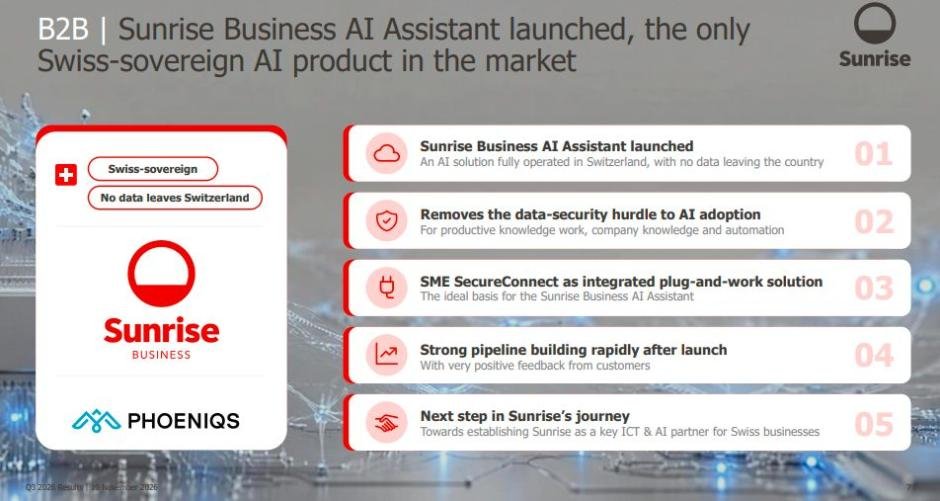
In the enterprise segment, Sunrise launched its Business AI Assistant in partnership with PHOENIQS.
The Swiss-sovereign AI solution operates entirely within Switzerland, with customer data remaining inside the country.
The platform targets enterprise knowledge management, employee productivity and business process automation.
Sunrise is integrating the AI Assistant with its SME SecureConnect offering as part of its strategy to expand beyond traditional telecom connectivity into enterprise ICT and AI services.
Digital Strategy Focuses on Customer Retention
Sunrise is strengthening its digital customer engagement strategy through Sunrise Rewards, device-as-a-service (DaaS) offerings and personalised mobile subscriptions.
Its Sunrise Rewards programme has recorded more than 100,000 ticket redemptions and transactions, with more than 50 percent of transactions attributed to unique users.
The operator said more than 75 percent of iPhone sales associated with its latest launch were linked to DaaS offerings, including Smart Upgrade and Flex Upgrade.
Sunrise is using device financing, premium mobile bundles and loyalty programmes to strengthen customer retention and support mobile ARPU.
Its multibrand approach combines premium Sunrise subscriptions with more flexible digital mobile offerings designed for different customer segments.
Sunrise Restructuring and AI-Enabled Operating Strategy
Sunrise has launched a multi-year operating model transformation aimed at creating a more streamlined, digitally enabled telecom business.
The company is implementing more than 500 employee terminations during 2026 as part of the restructuring.
Sunrise expects approximately CHF 70 million in annual run-rate operating and capital expenditure savings from the restructuring measures.
Sunrise 2026 Revenue and Capex Outlook
Sunrise maintained its full-year 2026 revenue guidance of broadly stable performance.
The company expects its annual Capex-to-revenue ratio to remain below 15 percent.
Revenue performance during Q4 2026 is expected to benefit from the full-quarter impact of August price increases and improving subscriber momentum.
Sunrise will continue prioritising mobile subscriber acquisition, fixed broadband customer retention, FMC adoption, enterprise digital services and AI-driven operational efficiency.
The operator’s strategy combines lower network investment requirements with higher-value mobile subscriptions, digital customer engagement and new AI services, while addressing ongoing pressure on fixed broadband ARPU.
BABURAJAN KIZHAKEDATH