
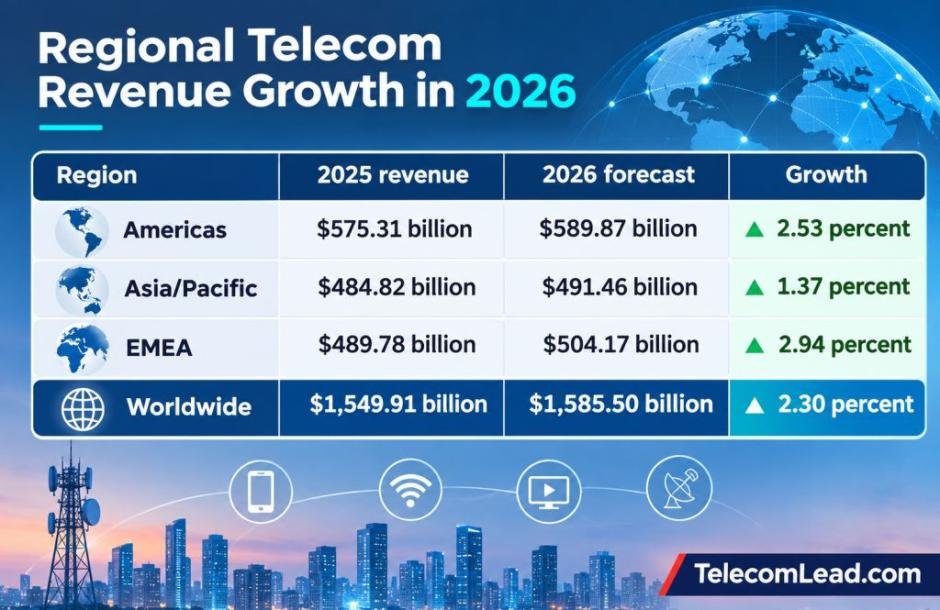
Worldwide spending on telecommunication and pay TV services is forecast to reach $1.585 trillion in 2026, representing 2.3 percent annual growth, according to the IDC Worldwide Semiannual Telecom Services Tracker.
The latest IDC forecast on global telecom and Pay TV spending indicates that there will be a revision of 0.5 percentage points from its earlier projection, driven primarily by inflation, rising operating costs and expected tariff increases by telecom operators.
Global telecom and pay TV services revenue is projected to increase from $1.549 trillion in 2025 to $1.585 trillion in 2026, adding approximately $35.6 billion in annual market value.
EMEA is expected to record the fastest regional growth at 2.94 percent, generating $504.17 billion in telecom and pay TV revenue.
The Americas will remain the largest regional market, with spending reaching $589.87 billion, an increase of 2.53 percent.
Asia Pacific will register slower growth of 1.37 percent, with revenue increasing to $491.46 billion.
Kresimir Alic, research director, Worldwide Telecom Services at IDC, expects tariff increases will support nominal revenue growth in Europe and North America, while affordability challenges could limit spending increases across Africa and parts of Asia/Pacific.
Mobile Data, Fiber Broadband and Satellite Connectivity Drive Growth
Mobile services will remain the largest telecom revenue segment, supported by increasing mobile data consumption and machine-to-machine connectivity.
Fixed data services, including fiber broadband, will benefit from growing demand for high-speed connectivity and higher bandwidth.
Meanwhile, traditional fixed voice, mobile messaging and pay TV services face declining revenue as customers migrate toward internet-based communications and streaming platforms.
Low Earth Orbit satellite broadband providers, including Starlink and Amazon Leo, are expected to expand connectivity in rural locations, maritime operations, aviation and enterprise markets.
IDC also identifies direct-to-device satellite connectivity as an emerging growth opportunity for telecom operators.
Partnerships between mobile operators and satellite providers could extend network coverage, improve customer retention and create additional revenue opportunities.
However, IDC cautions that inflation-driven tariff increases represent nominal rather than real market expansion, highlighting the continuing pressure on the global telecom industry’s underlying growth.
IDC says operators are facing higher energy-related operating expenses.
MTN Nigeria is facing rising energy expenses as diesel prices increase across Nigeria. MTN Group reported that diesel costs averaged approximately NGN 1,100 per litre in H1 2026, while the Q2 reference price affecting Q3 expenses was below NGN 1,800 per litre. MTN warned that diesel prices reaching NGN 2,000 per litre during H2 2026 could reduce its full-year EBITDA margin by 1.8–2.0 percentage points. Higher electricity and diesel expenses at telecom tower sites are expected to increase network operating costs.
Vodacom Group reported an 11 percent increase in energy costs to R5.48 billion in FY2026, compared with R4.95 billion in FY2025. The increase reflected higher energy prices across its operating companies and greater electricity consumption following network expansion. Total energy consumption increased 4 percent to 2,056.7 GWh from 1,981.9 GWh. Vodacom is investing in network modernization and energy efficiency to control operating expenses.
Bharti Airtel and Vodafone Idea face rising network energy expenses following higher diesel prices in India. According to IIFL Capital estimates published in April 2026, energy costs represent approximately 6 percent of Bharti Airtel’s India revenue and 12 percent of Vodafone Idea’s revenue. Airtel’s quarterly energy expenses were estimated at ₹2,865 crore, including more than ₹700 crore for diesel. Analysts estimated that a 20 percent increase in diesel costs could reduce telecom operating margins by 30–60 basis points. These are estimated cost pressures, not confirmed increases in company-reported energy expenditure.
Tariff increases
BT Group implemented annual price increases across its UK telecom services in March 2026.
BT broadband customers on applicable plans faced increases of £4 per month, equivalent to £48 annually. Mobile SIM-only and airtime plans increased by £2.50 per month, while certain handset plans increased by £4 monthly.
BT explained that price adjustments support continued investment in networks, technology and customer services.
Vodafone UK introduced annual tariff increases from April 2026, citing rising network and service costs.
Under its published pricing structure, applicable pay-monthly mobile airtime plans increased by £2.50 per month, while home broadband plans increased by £3.50 per month.
Vodafone said the increases would support investment in network infrastructure, products and services. The company also maintained protections for customers on social tariffs and those registered as financially vulnerable.
Telefonica’s Movistar increased prices for bundled fiber broadband, mobile and television services by approximately 4 percent from January 13, 2026.
The typical increase was around €3 per month, equivalent to €36 annually, although some customers faced larger adjustments.
The operator attributed the increases primarily to higher operating expenses and television content costs, rather than specifically to energy prices. The 2026 increase followed a 5 percent adjustment in 2025.
Orange France increased prices for selected fixed-line subscriptions and calling packages by €2 per month from January 21, 2026, equivalent to €24 annually.
Orange explained that the adjustment was necessary to maintain service quality, particularly its traditional telephone network.
The monthly price for its main fixed-line subscription in metropolitan France increased to €25.96. The increase illustrates how operators are adjusting legacy-service tariffs to support ongoing network operating expenses.
BABURAJAN KIZHAKEDATH