The global direct-to-device (D2D) satellite market is developing into a strategic battle between Starlink and AST SpaceMobile, with telecom operators treating satellite connectivity as an extension of their mobile networks rather than a separate satellite service.
The stakes increased further in the United States on October 1, 2026, when AT&T, T-Mobile and Verizon announced a joint venture aimed at expanding satellite-enabled mobile coverage in underserved areas. The initiative will pool limited spectrum resources while allowing the operators’ existing satellite partnerships to continue.
The development demonstrates a change in the telecom industry. Satellite connectivity is no longer primarily about emergency messaging. Operators are preparing for a future in which smartphones automatically move between terrestrial 4G/5G networks and satellites.
Ookla’s report on D2D satellite market shows Starlink holding an early lead over AST SpaceMobile in direct-to-device satellite connectivity, particularly in commercial deployment and operator partnerships.
Starlink has 59 mobile-operator partnerships compared with 28 for AST SpaceMobile, while global D2D connections increased 24.5 percent between July 2025 and March 2026. However, adoption remains limited, indicating that satellite D2D currently serves mainly as a complement to 4G and 5G networks for eliminating coverage gaps, rather than a replacement for terrestrial mobile networks.
Ookla reported that Starlink has 59 mobile-operator partnerships, compared with 28 for AST SpaceMobile.
Actual adoption remains small. Only 0.46 percent of Ookla Speedtest users in the U.S. registered a D2D satellite connection in March 2026. Chile recorded the highest penetration among measured markets at 1.26 percent.
Ookla’s RootMetrics testing of T-Mobile’s Starlink-powered service in rural New York also illustrates the current performance limitations. Of 238 text-message attempts, 143 succeeded, producing a success rate of about 60 percent. Successful exchanges averaged 1 minute 17 seconds, ranging from one second to five minutes.
For mobile operators, however, the critical question is becoming: which satellite platform should they back?
Starlink has the advantage of satellite scale and launch capacity. AST SpaceMobile is pursuing a carrier-centric strategy built around operator spectrum and broadband connectivity. Meanwhile, new competitors such as Elveo Mobile are ensuring that D2D will not become a two-company market.
Starlink Builds the Largest Satellite-to-Mobile Footprint
SpaceX has turned Starlink Mobile’s direct-to-device network into a formidable telecom platform.
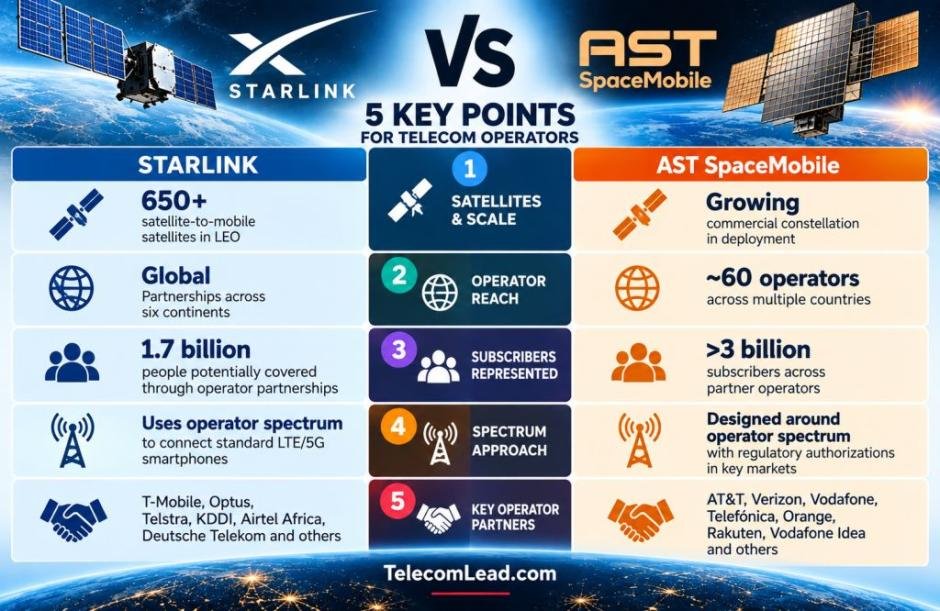
Starlink says it has more than 650 satellite-to-mobile satellites in low-Earth orbit, with its service accessible through operator partnerships across six continents and potentially reaching more than 1.7 billion people.
Its growing operator list includes T-Mobile, Optus, Telstra, Rogers, One NZ, KDDI, Globe, Salt, Entel, Kyivstar, Virgin Media O2, Airtel Africa, MasOrange, Deutsche Telekom, MTN, NTT Docomo, SoftBank and others.
The scale matters because D2D economics depend heavily on satellite availability, coverage and network capacity.
Starlink’s current architecture essentially turns satellites into mobile towers in space. Existing LTE smartphones communicate with satellites using spectrum supplied by mobile operators, while Starlink integrates with the operator similarly to a roaming partner.
The next-generation Starlink Mobile V2 architecture could significantly strengthen this proposition. SpaceX says the next generation will offer around 20 times the throughput capability of its first-generation satellite-to-mobile system and ultimately support full 5G cellular connectivity.
That creates a potentially powerful proposition for operators: extend coverage without building thousands of additional terrestrial towers in locations where conventional infrastructure is uneconomic.
AST SpaceMobile Takes a Different Operator-First Approach
AST SpaceMobile is attacking the same opportunity from a different direction.
Rather than starting with a massive satellite broadband business and extending it toward mobile, AST has designed its network specifically around cellular broadband delivered directly to conventional smartphones.
Its mobile operator partnership network now covers nearly 60 operators representing more than 3 billion subscribers.
Its partners include major operators such as AT&T, Verizon, Vodafone, Telefónica, Orange, Rakuten, stc and Vodafone Idea.
AST’s U.S. position is particularly important. It has agreements with AT&T and Verizon and received authorization in 2026 to provide supplemental satellite coverage using low-band spectrum associated with AT&T, Verizon and FirstNet.
AST also signed a commercial agreement with TELUS in Canada in March 2026. TELUS agreed to invest in ground-based satellite infrastructure and become an AST SpaceMobile shareholder.
In India, AST has established a strategic arrangement with Vodafone Idea covering D2D connectivity. Vi’s spectrum holdings across all 22 licensed service areas potentially provide a foundation for widespread satellite-mobile coverage, subject to India’s regulatory framework.
The operator relationships give AST a different competitive strength: it is positioning itself as infrastructure behind the operator rather than a consumer satellite brand competing for control of the subscriber.
Starlink vs AST: The Battle Is Really About the Operator Relationship
The most important difference between Starlink and AST may therefore be less about satellites and more about who controls the customer and network economics.
Starlink possesses enormous advantages in satellite manufacturing, launch capability and constellation scale. SpaceX can manufacture satellites, launch them using its own rockets and expand capacity rapidly.
AST’s advantage is its telecom-centric architecture and close integration with established operators.
For operators, this distinction matters.
A satellite partner that behaves like a wholesale network extension allows the mobile operator to retain the customer relationship, pricing, billing, spectrum assets and service differentiation.
This is one reason AST repeatedly emphasizes its “partner-first” model.
Starlink is also building deep MNO partnerships, however, and its growing operator roster demonstrates that carriers are comfortable integrating its satellite network.
The competition could therefore shift toward commercial terms: capacity pricing, revenue sharing, spectrum utilization, service quality and the amount of control retained by the mobile operator.
Spectrum Becomes the Strategic Asset
D2D is also changing the strategic value of mobile spectrum.
The U.S. Supplemental Coverage from Space framework allows satellite providers to use spectrum held by partner mobile operators to extend connectivity beyond terrestrial coverage.
That means spectrum traditionally deployed through towers can effectively be transmitted from satellites.
The October 2026 AT&T-T-Mobile-Verizon joint venture takes the concept further by pooling limited spectrum resources for satellite-enabled coverage.
This could create a new investment calculation for operators.
Building terrestrial coverage in cities and high-traffic areas remains essential because satellite capacity cannot match dense terrestrial networks. But in mountains, deserts, highways, offshore locations and sparsely populated rural areas, satellite D2D could become cheaper than building and maintaining conventional radio sites.
The result will not be satellite replacing mobile networks. It will be operators deciding where the terrestrial network should stop and satellite coverage should begin.
Vodafone Gives AST a Powerful European Route
Europe may become an important test of AST’s operator strategy.
Vodafone and AST established a jointly owned European satellite service business designed to distribute SpaceMobile connectivity to European mobile operators.
The venture is intended to provide a turnkey satellite service rather than requiring every European operator to build its own satellite integration platform.
Vodafone has already demonstrated space-based mobile broadband technology, including a video call using an ordinary smartphone from an area without terrestrial mobile coverage.
This model could appeal to European operators because it preserves the MNO-centered structure of the market while providing access to satellite capacity as another network layer.
A Third D2D Challenger Is Emerging
Starlink and AST will not have the market to themselves.
The merger of Lynk and Omnispace created Elveo Mobile, which plans to combine terrestrial mobile spectrum with mobile satellite service spectrum.
Elveo says it has 56 contracts with operators and distribution partners covering more than 60 countries. Its longer-term plan calls for a constellation of around 320 LEO satellites, with commercial services targeted for 2028.
SES has also invested in and expanded its strategic collaboration with Elveo.
Competition is therefore developing around several models: Starlink’s massive constellation and vertically integrated launch capability, AST’s operator-focused broadband architecture, and Elveo’s multi-spectrum and multi-orbit strategy.
Telecom Operators Could Be the Biggest Winners
The satellite race is often presented as Starlink versus AST SpaceMobile. For the telecom industry, however, the more important outcome could be the increased bargaining power it gives mobile operators.
Carriers may not need to choose a single global winner.
Operators could potentially use different satellite partners across markets, applications and spectrum bands, just as they already work with multiple roaming, tower, cloud and network-equipment suppliers.
The October 2026 U.S. joint venture reinforces that possibility because AT&T, T-Mobile and Verizon explicitly intend to preserve their existing carrier-satellite relationships while cooperating on spectrum and satellite coverage.
The emerging architecture is therefore terrestrial-first but satellite-extended.
Dense cities will continue to depend on fiber-connected macro cells, small cells and 5G. Satellite networks will fill the expensive gaps between those networks.
If Starlink, AST SpaceMobile and their rivals deliver sufficient capacity at competitive wholesale prices, one of telecom’s oldest investment problems — providing nationwide geographic coverage without nationwide tower economics — could finally change.
The real winner of the D2D satellite battle may consequently be neither Starlink nor AST SpaceMobile alone.
It could be the mobile operator that gains the ability to promise customers something the terrestrial network has never economically delivered: connectivity almost everywhere.
BABURAJAN KIZHAKEDATH