
Telecom operators are accelerating 2G and 3G network shutdowns as they reclaim spectrum, reduce the cost and energy required to maintain legacy networks, and redirect network resources toward 4G, 5G and 5G Standalone. The transition is moving faster for 3G, while IoT devices are making the final retirement of 2G more complicated.
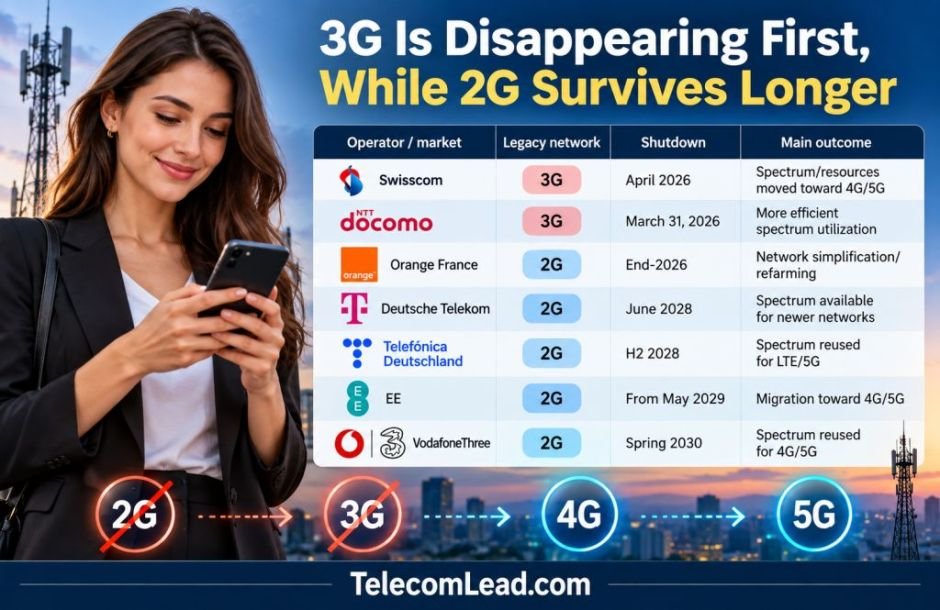
The global shutdown of 2G and 3G networks is accelerating, but telecom operators are not simply retiring technologies because they are old. They are reclaiming valuable spectrum and network resources that can be used more efficiently for 4G and 5G.
By June 2026, GSA had identified 313 completed, planned or ongoing 2G and 3G switch-offs across 89 countries and territories. Europe represented 43 percent of global shutdown activity, followed by Asia at 26 percent and Latin America and the Caribbean at 9 percent.
The GSA 2G and 3G Switch-Off report shows that 139 operators across 70 markets have completed or planned 2G shutdowns, with 56 already finalized. For 3G, 174 operators across 67 markets have started the transition and 102 have completed their shutdowns.
Almost 58 percent of operators retiring legacy networks are upgrading to both 4G and 5G, while 27 operators have already retired both 2G and 3G.
The economics behind the transition can be reduced to four major objectives: recover spectrum, increase 4G/5G capacity, reduce energy and operating requirements, and simplify complex mobile networks.
Why Operators Want 2G and 3G Spectrum Back
Spectrum is one of the most valuable assets controlled by a mobile operator.
Frequencies allocated decades ago to 2G and 3G can be used for technologies capable of carrying substantially more data. Once legacy traffic has migrated, operators can refarm those frequencies for LTE and 5G.
Telefonica Deutschland provides a good example.
The operator plans to retire 2G during the second half of 2028 and reuse the released frequencies for LTE and 5G.
The reason becomes clearer when traffic growth is considered. Telefonica Deutschland’s O2 network carried 6.4 billion GB of data during 2025, approximately 20 times the volume carried ten years earlier.
Telefonica Deutschland says 4G and 5G provide higher data rates while using scarce mobile spectrum more efficiently.
The result is an difficult economic equation: operators need more spectrum for rapidly growing data traffic while portions of their spectrum portfolios remain allocated to technologies carrying declining traffic.
Why 3G Is Disappearing Faster Than 2G
One of the most interesting features of the global shutdown cycle is that 3G is disappearing considerably faster than 2G.
GSA counts 102 completed 3G shutdowns, compared with 56 completed 2G retirements.
Swisscom demonstrates why.
The Swiss operator completed the final shutdown of its 3G network on April 7, 2026. Before the closure, only 1 percent of its mobile data traffic was being carried over 3G, while 4G and 5G handled the remaining 99 percent.
Swisscom said newer mobile technologies can be up to three times more efficient.
Maintaining a complete network technology to carry only a small fraction of data traffic becomes difficult to justify. The spectrum and network capacity previously assigned to 3G can instead support technologies carrying almost all current mobile broadband traffic.
Japan provides another major example. NTT Docomo ended its FOMA 3G service on March 31, 2026, after more than two decades, as customer usage migrated toward 4G and 5G.
The operator said retiring FOMA would enable more effective utilization of radio spectrum and support higher-quality communications services.
Why Running Four Mobile Generations Becomes Expensive
Spectrum is only part of the shutdown economics.
Operators that simultaneously support 2G, 3G, 4G and 5G are effectively maintaining several generations of mobile-network technology.
That creates operational complexity across radio infrastructure, software, spectrum planning, maintenance, security, device compatibility and technical support.
Legacy networks can also continue consuming energy even when they carry relatively little traffic.
GSA identifies lower network energy consumption as one of the benefits of legacy shutdowns, alongside spectrum refarming and stronger security available through modern network technologies.
Eliminating an obsolete network layer therefore allows operators to concentrate investment and operational resources on 4G, 5G and 5G Standalone networks.
The objective is not simply to remove old base-station equipment. It is to make the entire network architecture more efficient.
2G Is Harder to Shut Down Because of IoT
If 3G carries little data, why are many operators planning to retain 2G for several more years?
The answer is IoT and machine-to-machine communications.
2G remains embedded in equipment with much longer replacement cycles than smartphones. These can include smart meters, alarm systems, industrial equipment, telecare devices, lift alarms and other machine-to-machine applications.
This creates a different migration challenge.
Telefonica Deutschland says its planned 2G retirement particularly affects older devices, existing enterprise applications and some IoT solutions.
India illustrates the potential scale of cellular M2M ecosystems. TRAI reported 113.46 million cellular M2M connections in January 2026, including 70.18 million at Bharti Airtel, 20.60 million at Reliance Jio, 18.81 million at Vodafone Idea and 3.88 million at BSNL.
Not all these connections depend on 2G. However, the size of the cellular M2M installed base demonstrates why operators and enterprises need carefully managed device-migration programs before legacy technologies can disappear.
Europe Maps Out the Final 2G Exit
Europe is already moving from 3G shutdowns toward the more difficult task of eliminating 2G.
Orange is scheduled to complete its mainland France 2G shutdown by the end of 2026, while its 3G retirement is scheduled for the end of 2028.
Germany’s three major operators have also established 2G retirement timelines. Deutsche Telekom plans to close its network by June 30, 2028, while Vodafone Germany is targeting September 2028 and Telefonica Deutschland plans its transition during the second half of 2028.
Some critical German IoT applications may continue using 2G in exceptional circumstances until the end of 2030.
The UK is taking a longer transition path.
The government’s telecommunications modernization timeline says EE will begin nationwide 2G retirement in May 2029, Virgin Media O2 in summer 2029 and VodafoneThree in spring 2030.
VodafoneThree has simultaneously committed to reaching 99 percent 5G Standalone population coverage by 2030 and 99.96 percent by 2034.
The UK’s 2G Switch-off Charter also illustrates why 2G shutdowns require more preparation than simply switching off radio equipment. Operators must identify remaining 2G phones and IoT devices, protect critical infrastructure and ensure adequate 4G or 5G coverage before retiring legacy service.
What Operators Gain From Legacy Network Shutdowns
The business case for eliminating 2G and 3G extends across several parts of network economics.
Spectrum: frequencies previously occupied by legacy technologies can be refarmed for LTE and 5G.
Capacity: reallocating spectrum can create additional bandwidth for networks carrying rapidly growing mobile-data traffic.
Energy: operators can retire equipment supporting networks that carry relatively little traffic.
Operating costs: fewer network generations reduce the complexity of maintaining overlapping technologies.
Capital efficiency: operators can extract more capacity from spectrum they already own rather than depending entirely on additional spectrum acquisitions.
Security: GSA says newer network technologies offer stronger security capabilities and better protection against cyberattacks.
These benefits explain why legacy shutdown is becoming closely connected with operators’ broader 5G investment strategies.
Legacy Shutdowns Can Become 5G Capacity
The shutdown process ultimately connects directly with spectrum refarming.
The migration can broadly follow this path:
2G/3G shutdown → spectrum released → LTE/5G refarming → wider carriers and additional network capacity.
Operators do not necessarily need to move every released frequency directly to 5G. Spectrum allocation depends on LTE traffic, 5G adoption, device penetration, coverage requirements and each operator’s spectrum portfolio.
But as traffic progressively migrates toward 5G, the opportunity to dedicate more existing spectrum to 5G increases.
That makes network shutdown and spectrum refarming two parts of the same mobile-network modernization strategy.
2026–2030: Mobile Networks Move From Four Generations Toward Two
The global shutdown cycle is now entering two different phases.
3G is rapidly disappearing because smartphone data has overwhelmingly migrated to 4G and 5G. Swisscom’s experience — where just 1 percent of mobile data remained on 3G before shutdown — demonstrates how little justification can remain for maintaining an entire 3G network.
2G will take longer. Its long tail of IoT, M2M and specialist devices means operators must coordinate migrations with enterprises, governments and equipment owners before shutting networks down.
The direction, however, is clear.
Maintaining four generations of mobile technology becomes harder to justify as most mobile data moves across LTE and 5G.
Between 2026 and 2030, legacy spectrum will progressively become available for newer technologies. Operators will be able to consolidate network layers, reduce legacy operating requirements, improve energy efficiency and redirect existing spectrum toward higher-capacity 4G and 5G networks.
The retirement of 2G and 3G is therefore becoming more than the end of old mobile technologies. It is an important part of 5G network economics and spectrum strategy.
FASNA SHABEER