Japan mobile network performance in H1 2026 showed intense competition among SoftBank, NTT DoCoMo, au and Rakuten Mobile, with no single operator dominating every network metric. SoftBank emerged as the strongest operator for overall connectivity and 5G speed, NTT DoCoMo delivered the widest 5G availability, while Rakuten Mobile led overall network consistency.
The findings from Ookla’s Japan Connectivity Report H1 2026 highlight how Japanese operators are competing across download speed, 5G coverage, latency, reliability, video streaming and mobile gaming rather than speed alone.
For telecom operators, the results also demonstrate the growing importance of 5G network quality and consistency as consumers increasingly depend on mobile networks for video, gaming, cloud applications and other data-intensive services.
SoftBank Leads Japan Mobile Network Performance
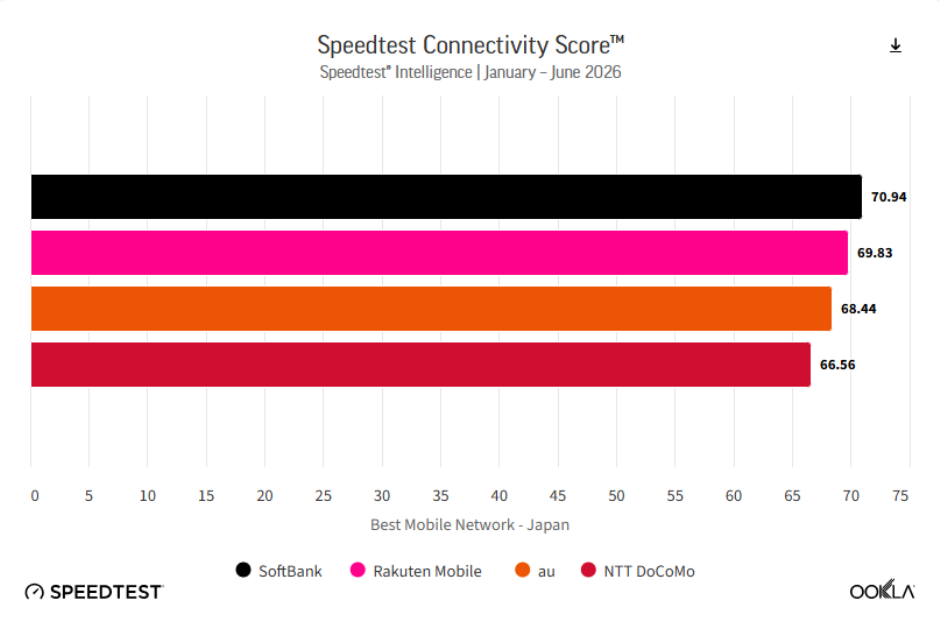
SoftBank delivered the strongest overall mobile network performance during the first half of 2026, securing a Speedtest Connectivity Score of 70.94. It also led the dedicated 5G ranking with a 5G Connectivity Score of 67.52.
Speed was one of SoftBank’s biggest competitive advantages.
SoftBank achieved Japan’s fastest overall median mobile download speed at 73.78 Mbps, ahead of au at 67.85 Mbps. SoftBank also recorded a median upload speed of 10.11 Mbps and the lowest overall latency at 45 milliseconds.
The performance advantage became even clearer on 5G.
SoftBank delivered a median 5G download speed of 153.55 Mbps. Rakuten Mobile ranked second at 124.59 Mbps, leaving SoftBank with a lead of almost 29 Mbps.
SoftBank’s median 5G upload speed reached 16.53 Mbps, while its 5G latency was 42 ms.
The results reinforce SoftBank’s position as one of the leading operators in Japan’s increasingly competitive 5G mobile network market.
SoftBank plans to increase average annual capital expenditure to about ¥410 billion under its new medium-term plan, compared with roughly ¥330 billion previously. Key priorities include strengthening base-station infrastructure, expanding 5G Standalone, using AI and big data for network management, submarine cables and integrating terrestrial networks with satellite and HAPS connectivity. SoftBank is also testing AI-based RAN optimization on its commercial 5G network.
NTT DoCoMo Leads Japan in 5G Availability
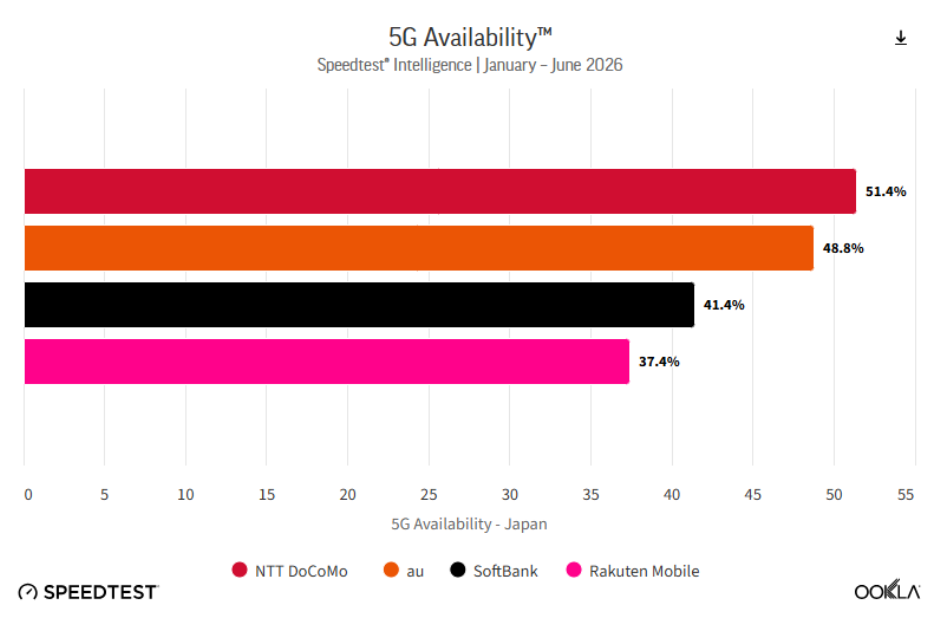
Network speed, however, tells only part of the story. NTT DoCoMo emerged as Japan’s leader for 5G Availability, indicating that its customers spent a greater proportion of their connected time using 5G.
NTT DoCoMo achieved 51.4 percent 5G Availability, followed closely by au at 48.8 percent.
SoftBank recorded 41.4 percent, despite having the country’s fastest 5G download performance. Rakuten Mobile’s 5G Availability was 37.4 percent.
The gap highlights an important distinction in Japan’s mobile market: the operator offering the highest 5G speed does not necessarily provide the greatest amount of time connected to 5G.
DoCoMo’s 51.4 percent result was 10 percentage points higher than SoftBank’s 41.4 percent, while the difference between DoCoMo and Rakuten Mobile reached 14 percentage points.
For operators, improving availability will remain an important element of 5G network investment, alongside adding capacity and improving peak network speeds.
NTT DoCoMo is concentrating investment on increasing 4G/5G capacity while improving network efficiency. In June 2026, DoCoMo completed Japan’s first commercial deployment of Ericsson’s RAN Processor 6672, which offers up to 4 times higher capacity efficiency while reducing energy consumption by more than 50 percent versus the previous generation. DoCoMo has also launched a commercial 5G Core on AWS, using AI automation to dynamically expand network capacity when traffic increases.
Rakuten Mobile Tops Overall Network Consistency
Rakuten Mobile emerged as the leader when performance was measured by the ability to consistently deliver minimum mobile broadband speeds.
Rakuten Mobile achieved Japan’s highest overall Consistency Score of 89.9 percent. The metric represents the percentage of user samples that achieved at least 5 Mbps download and 1 Mbps upload.
Rakuten Mobile is making the most aggressive network investment push among the four operators in 2026. Its network-related Capex plan rises from ¥63 billion in 2025 to ¥200 billion in 2026, more than tripling year on year. Rakuten is accelerating base-station construction and network optimization to improve coverage and quality as its subscriber base expands. Rakuten Mobile reached 10.75 million subscriptions at the end of June 2026, while Q2 capital expenditure reached ¥39.3 billion.
Consistency is increasingly important because headline download speeds do not always represent the network experience available to customers throughout the day or across different locations.
SoftBank, meanwhile, led Ookla’s dedicated 5G Consistency measurement at 83.9 percent. The 5G metric uses substantially higher minimum performance thresholds of 25 Mbps download and 3 Mbps upload.
SoftBank’s combination of 153.55 Mbps median 5G download speed and 83.9 percent 5G Consistency indicates that its advantage was not limited to peak speed measurements.
SoftBank Leads Mobile Video Streaming
Application performance revealed further differences among Japan’s four major mobile operators.
SoftBank achieved the highest overall Video Streaming Score of 78.97 and strengthened its lead on 5G with a 5G Video Streaming Score of 81.27.
Strong video performance is becoming increasingly significant for operators because streaming represents a major component of mobile network traffic and places sustained demand on network capacity.
Rakuten Mobile performed particularly strongly in gaming, achieving the country’s highest overall Game Score of 84.00.
au, however, was the leader specifically for 5G gaming, achieving a 5G Game Score of 86.79.
The differences show why operators increasingly need to optimize networks for specific applications rather than relying exclusively on improvements in headline download speeds.
au Leads Customer Satisfaction
Network performance did not translate directly into customer satisfaction rankings.
au achieved Japan’s highest customer rating at 3.29 out of 5 stars, despite SoftBank leading many of the technical network measurements.
This suggests that customer perception can depend on several factors beyond raw speed, including network coverage, service reliability, pricing, customer support and performance in the locations where subscribers use their smartphones most frequently.
The results demonstrate the challenge facing operators as telecom network strategies increasingly focus on improving overall customer experience rather than simply increasing network capacity.
KDDI, which operates the au mobile brand, is shifting from the peak phase of nationwide 5G rollout toward network quality, efficiency and advanced digital infrastructure. KDDI reported capital expenditure of ¥679 billion after major mobile 5G investment began to peak. Its 2026-2028 strategy targets a Capex-to-Sales ratio of 12 percent or less, while maintaining communications investment and directing more resources toward 5G, AI, data centers and satellite-related growth areas.
Osaka Leads Japan in Mobile Download Speed
Japan also showed significant geographical differences in mobile network performance.
Osaka recorded the fastest median mobile download speed among the cities measured by Ookla at 113.82 Mbps, with SoftBank identified as the top-performing provider.
Tokyo’s Chiyoda City followed with 93.89 Mbps, while Minato City recorded 88.19 Mbps.
At the opposite end of the ranking, Narita recorded a median download speed of only 43.01 Mbps.
That means Osaka’s 113.82 Mbps median was more than 2.6 times Narita’s mobile download speed, demonstrating how dramatically network experience can vary by location even in a highly developed telecom market.
The pattern was also visible at the prefectural level.
Osaka ranked first with a median mobile download speed of 93.66 Mbps, followed by Tokyo at 80.95 Mbps and Kyoto at 79.36 Mbps.
Tochigi was the slowest measured prefecture at 37.01 Mbps. Osaka’s median speed was therefore approximately 153 percent higher than Tochigi’s.
Japan’s Mobile Market Has No Single Network Winner
The H1 2026 results reveal a Japanese mobile market where leadership depends heavily on how network performance is measured.
SoftBank was the strongest overall performer, leading the Connectivity Score at 70.94, 5G Connectivity Score at 67.52, overall median download speed at 73.78 Mbps and 5G median download speed at 153.55 Mbps. It also led video streaming and 5G Consistency.
NTT DoCoMo’s strength was 5G reach, with its 51.4 percent 5G Availability exceeding au’s 48.8 percent, SoftBank’s 41.4 percent and Rakuten Mobile’s 37.4 percent.
Rakuten Mobile led overall network reliability, posting a Consistency Score of 89.9 percent, while also recording the highest overall Game Score of 84.00.
au demonstrated strength in customer and application experience, leading 5G gaming with a score of 86.79 and achieving the highest customer satisfaction rating at 3.29 out of 5.
Japan’s mobile network competition is therefore moving beyond a simple race for the fastest download speed. Operators increasingly need to balance 5G availability, network consistency, latency, application performance and regional coverage.
For Japanese consumers, the H1 2026 data suggests that the “best” mobile operator depends on what matters most: SoftBank for speed and overall 5G performance, NTT DoCoMo for 5G availability, Rakuten Mobile for consistency, or au for 5G gaming and customer satisfaction.
FASNA SHABEER