Global telecom operators are spending billions of dollars on spectrum in 2026 as regulators release frequencies for 5G capacity, rural coverage, fixed wireless access and future network expansion.
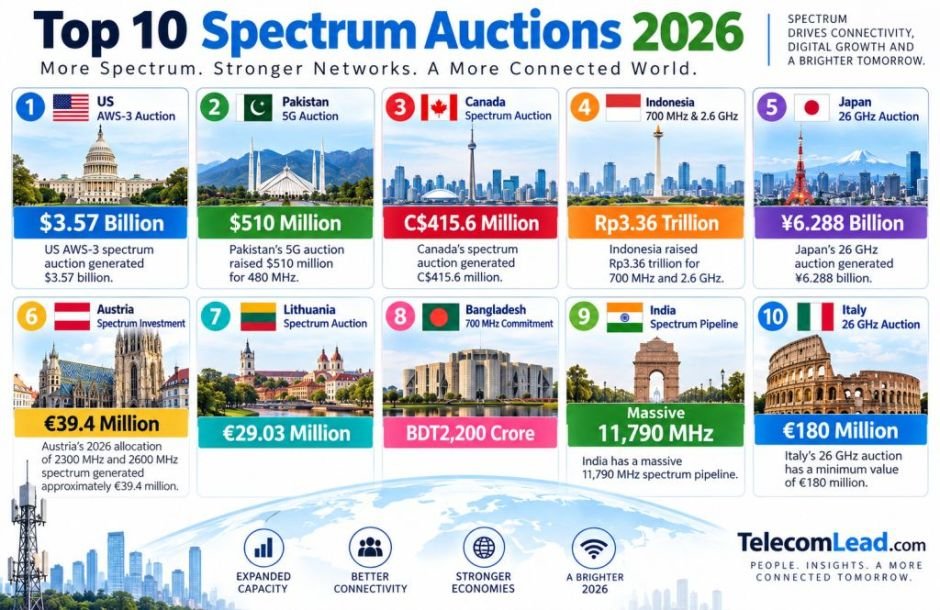
The U.S. AWS-3 auction alone raised $3.57 billion, while Pakistan sold 480 MHz for about $510 million. Canada collected C$415.6 million, and Indonesia’s three major operators committed around Rp3.36 trillion.
But spectrum fees represent only part of the investment. Operators must subsequently spend on 5G radios, Massive MIMO antennas, towers, fiber backhaul, data centers, power systems and network optimization to monetize their new frequencies.
Here are 10 important spectrum auctions and allocations shaping telecom investment in 2026.
1. US AWS-3 Auction: $3.57 Billion
The U.S. Federal Communications Commission’s Auction 113 generated $3.573 billion in gross winning bids and about $3.572 billion in net proceeds.
FCC Auction 113 results show that seven bidders won all 200 AWS-3 licences after 72 bidding rounds. The auction covered frequencies within 1695-1710 MHz, 1755-1780 MHz and 2155-2180 MHz.
The mid-band frequencies can provide additional capacity for commercial mobile networks, including 5G.
Importantly, up to $3.3 billion of auction proceeds can be used to cover amounts borrowed for the U.S. government’s Secure and Trusted Communications Networks reimbursement — commonly called the “rip and replace” program — and other Commerce Department programs.
The auction also restarted the FCC’s spectrum-auction pipeline after a four-year gap. The next major U.S. investment opportunity is the Upper C-Band, where the FCC must complete competitive bidding for at least 100 MHz by July 2027.
2. Pakistan 5G Auction: $510 Million for 480 MHz
Pakistan’s March auction generated approximately $510 million, or PKR142 billion, from 480 MHz of spectrum.
Jazz, Ufone and Zong acquired frequencies across the 700 MHz, 2.3 GHz, 2.6 GHz and 3.5 GHz bands.
The significance goes beyond auction revenue. Pakistan previously had only about 270 MHz available for mobile services. The auction increased total spectrum supply by 2.8 times to more than 750 MHz.
GSMA analysis of Pakistan’s 5G spectrum auction shows that each operator secured more than 100 MHz of mid-band spectrum, creating the capacity foundation for commercial 5G networks.
Operators must now convert their $510 million spectrum commitment into network investment through 5G radios, antennas, transport networks and site upgrades.
3. Canada Spectrum Auction: C$415.6 Million
Canada’s residual spectrum auction raised C$415.565 million from 196 licences covering the 2 GHz, 2300 MHz, 3500 MHz and 3800 MHz bands.
Canada 2026 spectrum auction results show that TELUS was by far the largest spender, winning 103 licences for C$317.595 million, equivalent to about 76 percent of total auction revenue.
Rogers acquired 30 licences for C$84.485 million, while Bell Mobility spent C$13.485 million on 63 licences.
The auction is particularly relevant for 5G investment because the 3500 MHz and 3800 MHz bands provide valuable mid-band capacity.
A total of 207 licences had been offered, meaning 196 were successfully awarded.
4. Indonesia: Rp3.36 Trillion for 700 MHz and 2.6 GHz
Indonesia’s spectrum selection triggered approximately Rp3.36 trillion of commitments from XLSMART, Telkomsel and Indosat.
The 700 MHz auction generated the largest payments. XLSMART paid Rp1.0602 trillion for 30 MHz, Telkomsel paid Rp642.5 billion for 20 MHz and Indosat committed Rp507.48 billion for 20 MHz.
In 2.6 GHz, Telkomsel spent Rp545.84 billion for 80 MHz, Indosat Rp372 billion for 60 MHz and XLSMART Rp231.6 billion for 50 MHz.
The different prices illustrate spectrum economics clearly. XLSMART’s winning 700 MHz price was Rp35.34 billion per MHz, compared with Telkomsel’s Rp6.823 billion per MHz for its 2.6 GHz allocation.
Indonesia 700 MHz and 2.6 GHz spectrum results show that low-band 700 MHz spectrum commands strategic value because fewer sites are generally required to provide broad geographic and indoor coverage.
5. Japan 26 GHz Auction: ¥6.288 Billion
Japan completed its first-ever spectrum auction in June 2026, marking an important change from its traditional comparative allocation system.
NTT DOCOMO won the nationwide 25.8-26.2 GHz licence for ¥6.288 billion, or about $38.7 million. Its winning bid was approximately 60 percent above the reserve price, beating SoftBank and KDDI.
The licence runs for 10 years.
DOCOMO plans to deploy the millimetre-wave spectrum in high-traffic locations including railway stations, stadiums and shopping districts.
Regional 26 GHz licences were also awarded to JTOWER and Hitech Inter, creating opportunities for shared indoor, underground and industrial 5G infrastructure.
6. Austria: €39.4 Million Spectrum Investment
Austria’s 2026 allocation of 2300 MHz and 2600 MHz spectrum generated approximately €39.4 million.
A1 Telekom Austria, Hutchison Drei Austria and T-Mobile Austria acquired spectrum, providing additional capacity for their mobile networks.
Unlike 700 MHz, these frequencies are primarily valuable for adding network capacity in areas with higher traffic. The real investment requirement will therefore include new radio equipment and site upgrades needed to exploit the additional bandwidth.
7. Lithuania: €29.03 Million
Lithuania’s auction raised approximately €29.03 million across the 700 MHz, 1500 MHz and 2100 MHz bands.
Telia Lietuva, Tele2 and Bitė Lietuva acquired frequencies.
Tele2 alone committed approximately €9.8 million for 2×5 MHz at 700 MHz, 20 MHz at 1500 MHz and renewed 2×20 MHz at 2100 MHz.
The auction combines low-band coverage with additional capacity and includes network expansion and service-quality requirements — demonstrating how regulators increasingly link spectrum awards with infrastructure investment.
8. Bangladesh: BDT2,200 Crore 700 MHz Commitment
Grameenphone secured 10 MHz of 700 MHz spectrum for a 13-year period in Bangladesh.
The allocation is expected to contribute approximately BDT2,200 crore to the national exchequer over the licence period.
For Grameenphone, 700 MHz has particular investment value because its propagation characteristics can improve rural and indoor coverage.
That can reduce the number of incremental sites required to expand geographic coverage compared with using higher-frequency spectrum alone.
9. India: Massive 11,790 MHz Spectrum Pipeline
India could become one of the biggest spectrum-investment stories beyond the completed 2026 auctions.
TRAI has recommended putting approximately 11,790 MHz on the market across multiple bands, including 600 MHz, 800 MHz, 900 MHz, 1800 MHz, 2100 MHz, 2300 MHz, 2500 MHz and 3300-3600 MHz, alongside high-band spectrum.
This is a proposed auction rather than completed spectrum spending, so the 11,790 MHz figure should not be confused with frequencies already purchased by operators.
The eventual financial impact could nevertheless be significant for Reliance Jio, Bharti Airtel and Vodafone Idea, because operators must balance spectrum purchases against billions of dollars of continuing 5G and 4G network investment.
Reserve prices, licence terms and the final spectrum inventory will therefore be crucial in determining bidding appetite.
10. Italy 26 GHz: €180 Million Minimum Value
Italy is preparing another significant European millimetre-wave spectrum award.
The proposed auction covers 24.25-26.5 GHz, with a combined minimum value of approximately €180.08 million.
This figure represents the reserve value rather than completed auction revenue.
The frequencies can support high-capacity 5G, fixed wireless access, enterprise connectivity and dense urban networks.
The ultimate investment will be substantially greater than the licence price because 26 GHz networks typically require dense infrastructure and extensive fiber connectivity to exploit their high capacity.
Spectrum Price Is Only the First Stage of Operator Investment
The 2026 results demonstrate why auction revenue alone does not measure the economic impact of spectrum.
The U.S. collected $3.57 billion, Pakistan about $510 million, Canada C$415.6 million, Indonesia roughly Rp3.36 trillion, Japan ¥6.288 billion, Austria €39.4 million and Lithuania €29.03 million.
But operators then need to spend additional capital to deploy the spectrum.
700 MHz is particularly important for nationwide and rural coverage. AWS-3, 2.3 GHz, 2.6 GHz, 3.5 GHz and 3.8 GHz provide valuable mobile capacity, while 26 GHz targets extremely high-capacity environments.
The cost per MHz therefore cannot be compared directly across countries without considering population coverage, licence duration, paired versus unpaired spectrum, frequency characteristics and deployment conditions.
5G Investment Moves From Spectrum to Networks
The most important question after the 2026 auctions is how quickly operators can turn spectrum into revenue-generating network capacity.
Pakistan has increased available mobile spectrum from around 270 MHz to more than 750 MHz. Indonesia’s operators have gained both 700 MHz coverage and 2.6 GHz capacity. TELUS has committed more than C$317 million to additional Canadian spectrum, while DOCOMO has paid a premium for Japan’s first nationwide auctioned millimetre-wave licence.
Meanwhile, the U.S. is already preparing its next major spectrum investment cycle through the Upper C-Band.
For telecom operators, the real 2026 spectrum equation is therefore auction price + network Capex + coverage obligations + monetization. Operators that combine sufficient spectrum with disciplined infrastructure spending and rising data traffic will be best positioned to turn these expensive licences into sustainable 5G returns.
FASNA SHABEER