Starlink has deployed its first batch of advanced V3 satellites, promising faster broadband, latency below 20 milliseconds and expanded direct-to-cell services as Elon Musk-owned SpaceX prepares for large-scale constellation deployment.
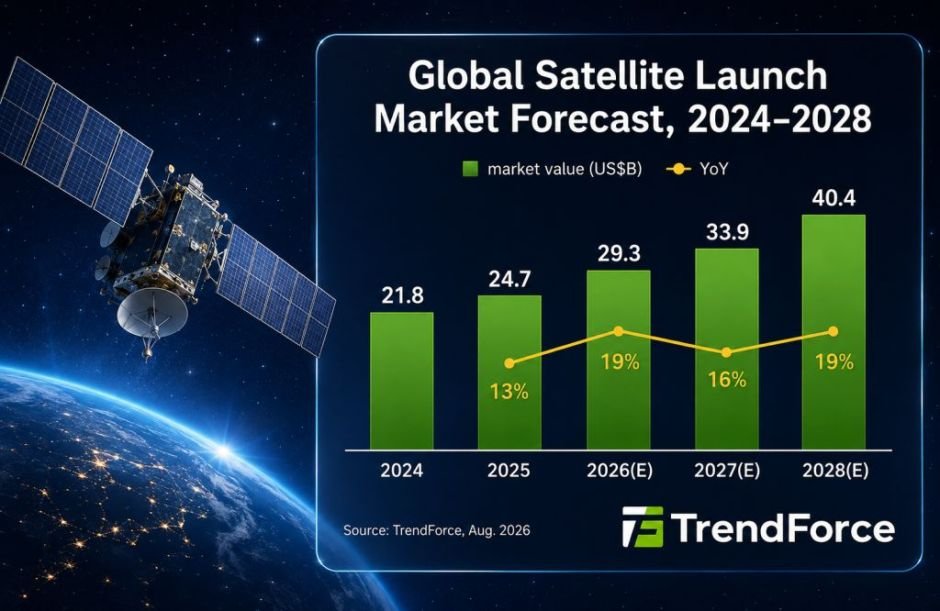
The introduction of Starlink V3, combined with rising satellite communications demand and lower Starship launch costs, is expected to propel the global satellite launch market from $29.3 billion in 2026 to $40.4 billion by 2028, according to TrendForce.
Starlink V3 Targets Faster Satellite Broadband
Each Starlink V3 satellite features a 2,048-element phased-array antenna designed to support ultra-low-latency broadband, direct-to-cell connectivity and improved in-flight internet services.
Starlink upgraded from its V2 Mini satellites in response to growing satellite broadband demand from customers in suburban areas and on the fringes of metropolitan markets. V2 Mini satellites operated at altitudes above 500 kilometres, where increasing orbital congestion created potential interference challenges.
The new V3 satellites operate at an altitude of about 350 kilometres. The lower orbit is intended to reduce signal interference across the Ka- and Ku-bands while improving network performance.
Starlink V3 is expected to deliver:
End-to-end latency below 20 milliseconds
Average uplink speeds of 100–200 Mbps
Average downlink speeds of 1–2 Gbps
Direct-to-cell voice services
Enhanced in-flight connectivity
The improved broadband performance is initially relevant to suburban users in the United States, Brazil, Chile and Argentina, where satellite connectivity can complement terrestrial telecom networks.
V-Band and W-Band Create Semiconductor Opportunities
Starlink V3 introduces support for the V-band, covering frequencies from 50 GHz to 75 GHz, and the W-band, ranging from 75 GHz to 110 GHz.
These higher-frequency bands could allow ground-based electronically steered array antennas to become smaller and more compact. However, signal attenuation becomes substantially more severe at such frequencies, creating additional technical requirements for radio frequency components.
RF front-end modules will need to evolve toward highly integrated millimetre-wave monolithic microwave integrated circuits. They will also require low-power compound semiconductor materials such as gallium nitride and gallium arsenide for high-frequency power amplifiers.
The technology transition has prompted Starlink to award next-generation RF module orders to Taiwanese semiconductor and microwave component suppliers UMT, WIN Semiconductors and Transcom. It is also creating business opportunities for WNC, which provides one-stop RF module integration solutions.
Starship Deploys 20 Starlink V3 Satellites
The first V3 deployment mission was conducted using SpaceX’s Starship, marking the successful completion of the launch vehicle’s validation, TrendForce said.
Starship’s Super Heavy booster ignited 33 Raptor engines to carry 20 of the significantly larger Starlink V3 satellites into orbit. The mission also enabled SpaceX to gather critical performance data on technologies including the vehicle’s thermal protection system.
Successful launch validation is strategically important because the V3 constellation is expected to enter large-scale deployment as Starlink’s satellite communications subscriber base expands.
6G Could Accelerate Satellite Launch Demand in 2028
The emergence of 6G around 2028 is expected to create new connectivity models that combine satellites, high-altitude platform stations and unmanned aerial vehicles.
These integrated networks could extend broadband and mobile coverage across remote regions, transport routes, aircraft and areas where conventional telecom infrastructure is difficult or expensive to deploy.
Growing demand for broadband satellites, direct-to-cell services, in-flight connectivity and future 6G networks is expected to increase the number of launch missions. Starship could capture a significant part of this demand because of its satellite capacity and reusable architecture.
Starship Could Cut Launch Costs to a Few Million Dollars
SpaceX’s Falcon 9 currently recovers only its first-stage booster. Starship, by comparison, is designed to recover both the Super Heavy first stage and the spacecraft’s second stage.
Full reusability would allow SpaceX to move away from manufacturing a new rocket for every mission and focus primarily on routine inspection and maintenance.
TrendForce estimates that this transition could reduce the cost of a launch from tens of millions of U.S. dollars per mission to only a few million dollars.
Lower launch costs could ease pressure on SpaceX’s cash flow while enabling the company to accelerate Starlink V3 deployment and invest more heavily in emerging space technologies. One potential growth area is space-based artificial intelligence, including AI computing capabilities operating directly in orbit.
With 20 V3 satellites already deployed, latency below 20 milliseconds, downlink speeds reaching 2 Gbps and the satellite launch market forecast to hit $40.4 billion in 2028, Starlink V3 and Starship are positioned to reshape satellite broadband, direct-to-cell communications and the economics of space launches.
BABURAJAN KIZHAKEDATH