SoftBank reported record first-quarter revenue of ¥1.8147 trillion for the three months ended June 30, 2026, representing 9.4 percent year-on-year growth, supported by strong demand for AI infrastructure, enterprise digital transformation, cloud services, broadband, and financial technology.
Operating income of SoftBank increased 4.0 percent to ¥302.3 billion, while net income rose 10.5 percent to ¥201.5 billion. Net income of SoftBank reached ¥150.1 billion, up 3.3 percent, and adjusted EBITDA increased 7.9 percent to ¥508.1 billion, marking another quarter of profitable growth.
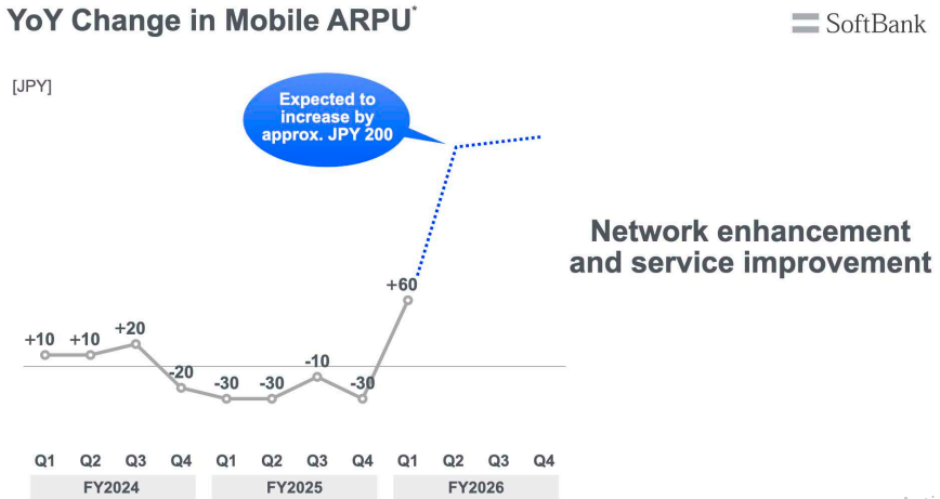
Consumer business of SoftBank generated revenue of ¥749.7 billion, an increase of 4.4 percent. Service revenue of SoftBank climbed 4.0 percent to ¥564.8 billion, driven by higher mobile ARPU, broadband expansion and electricity services.
Mobile service revenue of SoftBank increased 0.8 percent to ¥400.5 billion, while broadband revenue rose 4.4 percent to ¥108.8 billion. Electricity revenue recorded the fastest growth, surging 34.3 percent to ¥55.5 billion. SoftBank attributed the mobile revenue improvement to higher ARPU resulting from increased adoption of its PayToku pricing plans and earlier Y!mobile tariff revisions.
Enterprise revenue of SoftBank increased 11.4 percent to ¥260.4 billion, reflecting accelerating digital transformation across Japanese businesses.
Telecommunications revenue of SoftBank grew 4.4 percent to ¥131.5 billion, supported by growth in mobile subscriptions.
Solutions revenue rose 5.8 percent to ¥51.8 billion, while Cloud & AI revenue delivered the strongest performance, jumping 31.0 percent to ¥77.1 billion as enterprises increased spending on AI computing infrastructure, cloud platforms and security services. Enterprise segment income climbed 27.5 percent to ¥62.2 billion.
SoftBank continued to position AI as its next major growth engine under its “Activate AI for Society” strategy. The company said it is building next-generation digital infrastructure by monetizing AI infrastructure and AI services while expanding AI adoption across all business segments. It also launched a Japan-based battery business to support future AI data centers and growing electricity demand created by AI workloads.
Capital expenditure of SoftBank nearly doubled to ¥332.7 billion from ¥182.8 billion a year earlier. Telecommunications investment increased to ¥84.6 billion from ¥82.4 billion, while AI-related capital expenditure expanded sharply from ¥3.4 billion to ¥10.3 billion. The higher spending was primarily driven by leasing telecommunications infrastructure, including dark fiber, following the launch of OpenFiber Japan.
Broadband expansion also contributed to growth, with OpenFiber Japan commencing operations during the quarter, supporting fiber network deployment and broadband revenue growth. The company additionally introduced new customer offerings including satellite connectivity, enhanced 5G services and overseas unlimited data plans to strengthen its digital ecosystem.
SoftBank’s quarterly report did not disclose subscriber numbers or churn figures for the reporting period. Instead, it highlighted higher mobile subscriptions within the enterprise business and improved mobile ARPU as key contributors to revenue growth.
BABURAJAN KIZHAKEDATH