The global semiconductor industry is entering an unprecedented expansion phase, driven by explosive demand for artificial intelligence (AI), high-performance computing and hyperscale data centers.
According to the Semiconductor Industry Association (SIA), global semiconductor sales reached a record $795.6 billion in 2025 and are projected to surge to $1.5 trillion in 2026, representing 90 percent growth and marking the first time the industry surpasses the $1 trillion milestone.
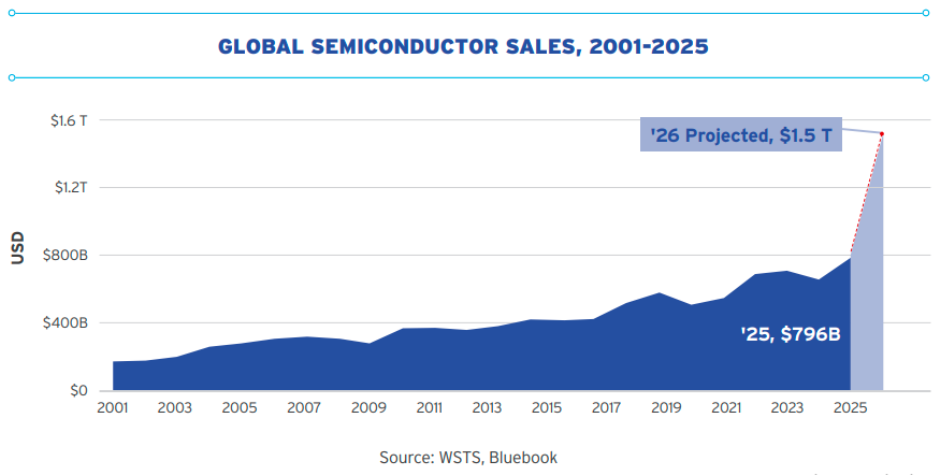
AI has emerged as the biggest catalyst for semiconductor demand. Logic chip sales climbed to $299.5 billion in 2025, rising 38.8 percent, while memory semiconductor revenue reached $230 billion, increasing 39 percent year over year, SIA report indicated.
Although foundational chip revenue declined 5.2 percent from its 2022 peak, shipment volumes still grew 6.3 percent compared with 2024, highlighting resilient demand across industrial and automotive applications. Regionally, semiconductor sales increased 45.4 percent in Asia Pacific, 31.4 percent in the Americas, 17.9 percent in China and 6.7 percent in Europe, while Japan recorded a 4.3 percent decline.
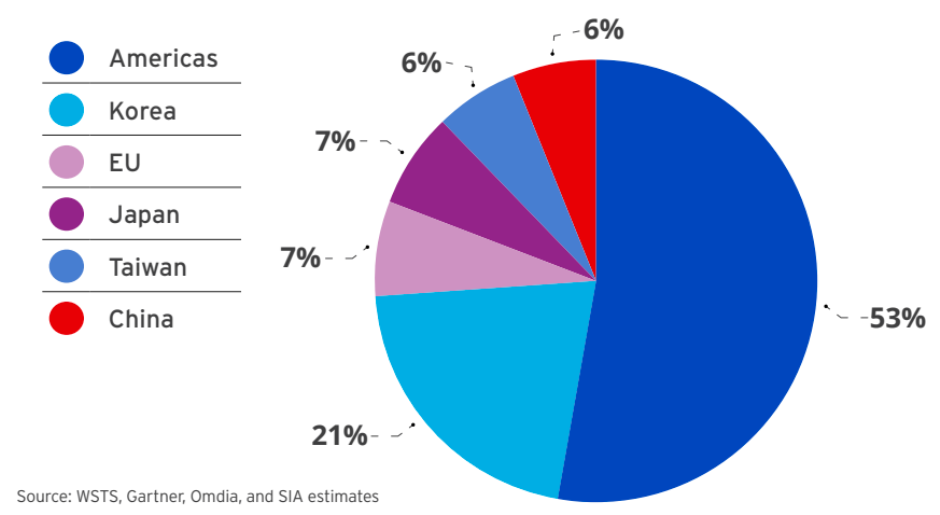
The United States strengthened its leadership in the global semiconductor market, with U.S.-headquartered companies generating $425 billion in semiconductor sales during 2025 and capturing 53.4 percent of worldwide revenue, the country’s highest market share since 1984. South Korea accounted for 21 percent of global company headquarters market share, followed by the European Union, Japan and Taiwan at 7 percent each, while China represented 6 percent.
AI infrastructure is rapidly transforming semiconductor demand. SIA estimates that government and industry will invest more than $4 trillion in new AI data center infrastructure through 2028, with up to $2.8 trillion allocated to semiconductors. Annual semiconductor revenue from AI data centers alone could exceed $1.2 trillion by 2028, representing nearly a tenfold increase within four years. A modern AI server rack contains more than 4,500 packaged chips, with semiconductors accounting for over 95 percent of server rack value and 50-70 percent of AI data center capital expenditure.
The semiconductor investment cycle continues to accelerate across the United States. Since 2020, companies have announced more than $770 billion in semiconductor investments spanning 160 projects across 30 states, strengthening domestic manufacturing, packaging, materials, equipment production and research capabilities.
Innovation spending also reached new highs. U.S. semiconductor companies invested $76.8 billion in research and development during 2025, up from $69.6 billion in 2024, representing 10.3 percent annual growth. The semiconductor industry remains among the world’s most research-intensive sectors, with R&D spending equivalent to 12.7 percent of sales, compared with 18.5 percent for pharmaceuticals and biotechnology, 13.2 percent for software, 11.2 percent for semiconductor manufacturing equipment, 5.8 percent for consumer electronics and 4 percent for mobile telecom. By geography, semiconductor R&D intensity stands at 15 percent in the United States, 14.6 percent in Europe, 10.6 percent in South Korea, 10 percent in China, 8.5 percent in Japan and 8.1 percent in Taiwan.
The industry’s economic impact continues to expand alongside investment. The U.S. semiconductor sector directly employs around 342,000 workers while supporting nearly 2 million indirect and induced jobs. Every semiconductor job generates 5.7 additional jobs across the broader U.S. economy, while industry salaries average more than 30 percent above comparable occupations. However, the sector is projected to face a shortage of 67,000 technicians, engineers and computer scientists by 2030, contributing to a broader U.S. talent gap of 1.4 million skilled workers.
International markets remain critical for semiconductor growth. More than 70 percent of revenue generated by U.S.-headquartered semiconductor companies comes from overseas customers, while over 85 percent of semiconductors produced are shipped outside the United States.
The industry recorded a U.S. semiconductor trade surplus of $9.93 billion in 2025 and semiconductor exports totaled $57.8 billion, making chips the country’s sixth-largest export category behind aircraft ($152.8 billion), refined oil ($115.2 billion), crude oil ($99.7 billion), non-ferrous metals ($89.4 billion) and natural gas ($82.5 billion).
BABURAJAN KIZHAKEDATH