
Orange Romania maintained leadership in overall mobile performance and 5G reach during Q1 2026, supported by the country’s strongest low-band spectrum position, according to the latest Ookla report.
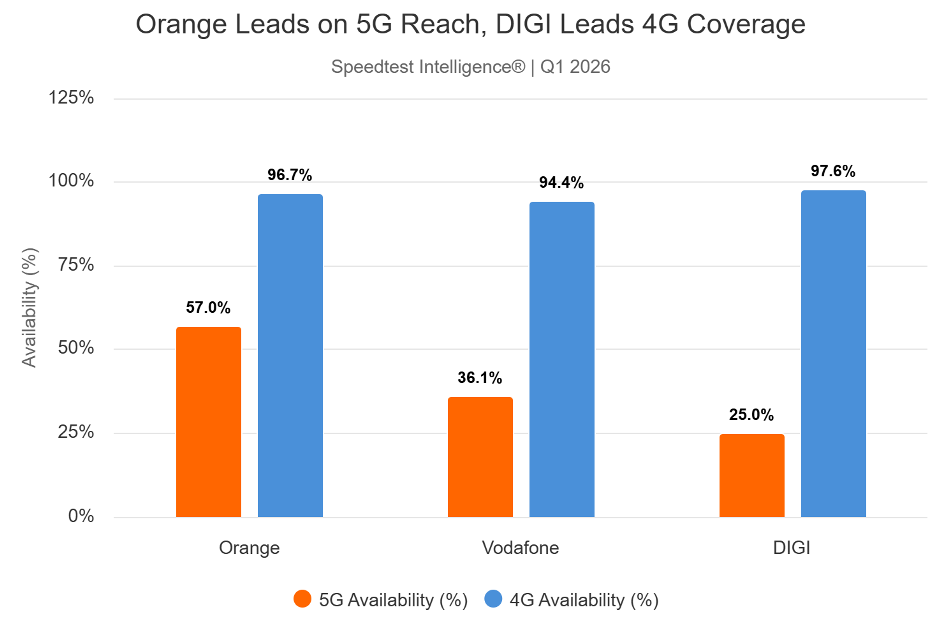
Orange recorded 57 percent 5G Availability, significantly ahead of Vodafone at 36 percent and DIGI at 25 percent. The operator also delivered the highest overall median download speed at 97.70 Mbps, outperforming Vodafone and DIGI by as much as 39 percent and 45 percent respectively.
Orange said its 5G and 5G+ services were available in 88 cities during 2025, while consolidated turnover rose 3 percent to €1.46 billion. The company plans to invest more than €200 million in 2026 to expand network capabilities further.
Vodafone Romania emerged as the market leader in median 5G download speed, reaching 180.57 Mbps in Q1 2026, double its Q1 2025 result of 90.57 Mbps. The improvement followed Vodafone’s integration of Telekom Romania spectrum assets and additional network investments worth €150 million. However, Vodafone continued to lag competitors on web page loading times and broader quality-of-experience metrics.
DIGI Romania maintained a different competitive profile focused on consistency and latency performance. Although its median 5G download speed trailed rivals due to limited spectrum assets, DIGI led Romania in 4G Availability at nearly 98 percent and delivered the lowest cloud latency and fastest web page load times on 5G. DIGI also recorded the best 5G consistency performance and lowest multi-server latency, with results up to 14 percent faster than competitors in cloud responsiveness tests.
DIGI plans to expand 5G population coverage from 30 percent at the end of 2025 to 70 percent by 2028 and nearly 100 percent by 2030, supported by approximately 4,500 mobile sites.
Why Romania’s Telecom Performance Is Lagging Behind Central and Eastern Europe
Romania’s telecom sector is struggling to match the mobile network performance of its Central and Eastern European (CEE) peers despite the country’s strong reputation in fixed broadband connectivity. The gap is becoming increasingly visible during the transition toward 5G, where Romania continues to rank near the bottom of the region for mobile speeds, 5G coverage, latency, and user experience.
Romania’s 5G Coverage Remains Too Low
One of the biggest reasons behind Romania’s weak telecom performance is limited 5G reach. In Q1 2026, Romania’s 5G Availability stood at only 39 percent, among the lowest levels in the CEE region. This directly affected mobile network quality, pushing Romania’s median mobile download speed down to 78.43 Mbps, the weakest result among the eight CEE markets analyzed.
Although Romania’s operators have improved 5G speeds year over year, users still spend a significant amount of time connected to older 4G layers because nationwide 5G coverage remains insufficient. This creates inconsistent user experiences, especially outside urban areas.
Weak Spectrum Allocation Has Hurt Network Expansion
Romania’s telecom performance has also been constrained by limited spectrum resources. During the 2022 5G auction, only 30 MHz of 700 MHz spectrum was assigned nationally, roughly half the regional norm of 60 MHz. The shortfall emerged after Telekom Romania Mobile chose not to participate in the auction, leaving one major spectrum block unsold.
The country also has the lowest assigned C-band spectrum depth below 3.7 GHz among CEE peers, with only 310 MHz allocated. Competing markets such as Poland, Greece, Hungary, and Serbia hold between 390 MHz and 480 MHz in the same critical mid-band range.
This shortage limits operators’ ability to build broad, high-capacity 5G networks capable of delivering consistent mobile performance.
Telecom Consolidation Created Temporary Disruption
Romania’s telecom market shifted from four operators to three after Vodafone Romania and DIGI split Telekom Romania Mobile in October 2025. Vodafone acquired the postpaid and enterprise business alongside most network infrastructure, while DIGI absorbed the prepaid customer base and selected spectrum assets.
While consolidation may strengthen long-term investment capacity, Q1 2026 represented the first full quarter of integration activities. Network migration, spectrum refarming, and infrastructure optimization are still ongoing, creating temporary operational inefficiencies and uneven customer experiences.
Vodafone migrated approximately 250,000 Telekom Romania customers by November 2025, but the full legal merger is expected only after July 2026.
Low ARPU Is Limiting Telecom Investment
Romania generates the lowest mobile ARPU in the CEE region, severely restricting operator investment power. According to GSMA Intelligence, Romania’s mobile ARPU was only €6.45 in Q1 2026, far below Hungary’s €13.84 and significantly lower than most regional competitors.
Although Romanian operators maintain relatively healthy capital intensity levels, the actual amount of revenue available for reinvestment remains limited because subscription prices are extremely low. Years of aggressive price competition weakened profitability across the market, making it difficult for operators to finance large-scale 5G rollouts.
This low monetization environment has become one of the biggest structural challenges facing Romania’s telecom industry.
Romania’s Mobile Experience Suffers Beyond Speed Tests
Romania’s telecom weakness extends beyond headline download speeds. The country recorded the highest median mobile latency in the CEE group at 41 ms and also ranked poorly for web page loading times, cloud application responsiveness, and Full HD video streaming performance on 5G.
The issue points to deeper infrastructure inefficiencies involving transport networks, peering, routing, CDN placement, and cloud connectivity optimization. Even where radio performance is competitive, application-level experience often remains weaker than regional peers.
DIGI demonstrated this contrast clearly in Q1 2026. While its median 5G download speed was lower than competitors at 126.51 Mbps, it delivered the highest 5G upload speeds at 33.03 Mbps and the lowest 5G cloud latency at 79 ms, suggesting advantages in fiber density and traffic routing optimization.
Strong Fixed Broadband Has Not Translated Into Mobile Leadership
Romania remains one of Europe’s strongest fixed broadband markets, with extensive fiber infrastructure and high gigabit penetration. DIGI covers nearly 100 percent of urban households with FTTH, while Orange Romania operates more than 26,000 km of national fiber backbone and approximately 85,000 km of metro fiber.
However, the country’s success in fixed broadband has not translated into mobile leadership because mobile telecom performance depends heavily on spectrum depth, nationwide radio deployment, monetization strength, and sustained 5G investment capacity.
Outlook for Romania’s Telecom Industry
Romania’s telecom market is showing signs of gradual improvement. Median mobile download speeds increased 12 percent year over year in Q1 2026, while median 5G speeds rose 9 percent. Vodafone’s median 5G download speeds doubled to 180.57 Mbps following the Telekom Romania spectrum integration.
The consolidation of spectrum assets between Vodafone and DIGI could improve both coverage and network capacity over the coming years. DIGI significantly expanded its low-band and mid-band spectrum holdings through the restructuring process, while Vodafone emerged with one of the strongest overall spectrum portfolios in the market.
Still, Romania’s telecom industry faces a difficult balancing act between expanding 5G coverage, improving network quality, and sustaining investment in a low-ARPU environment. Until operators close the spectrum gap and strengthen monetization, Romania is likely to remain behind leading CEE telecom markets in mobile performance.
BABURAJAN KIZHAKEDATH

