The global telecommunications industry is entering the next major phase of wireless evolution as commercial 6G deployments move closer to reality.
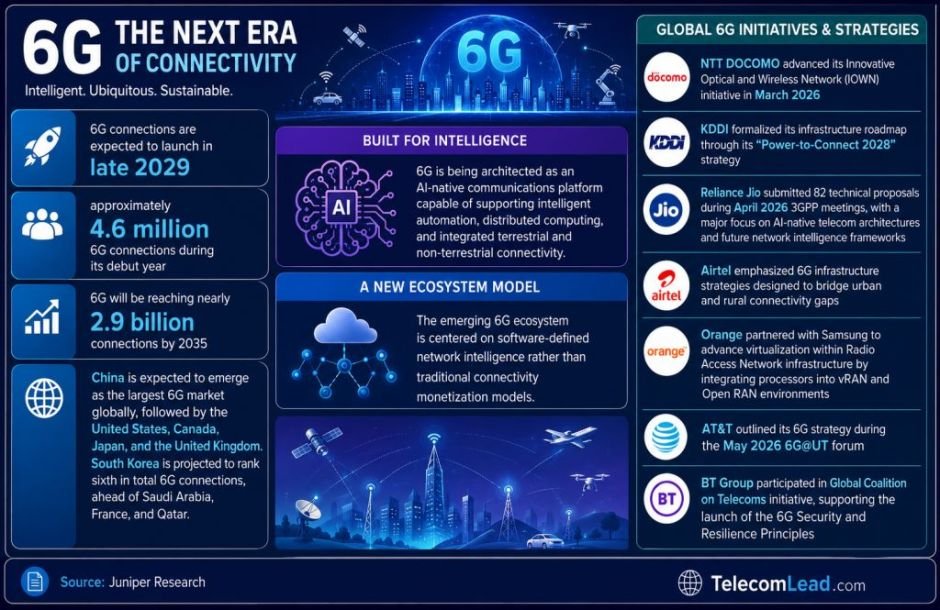
According to a May 2026 market study from Juniper Research, the first commercial 6G connections are expected to launch in late 2029, with the market forecast to generate approximately 4.6 million 6G connections during its debut year.
The report projects extraordinary long-term expansion for 6G, with global connections expected to surge by 70,331 percent over the forecast period, reaching nearly 2.9 billion connections worldwide by 2035. Early commercialization efforts are expected to be led by the United States and South Korea, positioning both countries at the forefront of the next-generation wireless ecosystem.
6G Transition Accelerates Beyond 5G-Advanced
The telecom sector is rapidly shifting from theoretical 6G discussions into structured global research, standardization, and infrastructure planning. Industry collaboration is intensifying within frameworks established by 3rd Generation Partnership Project and International Telecommunication Union under the ITU-R IMT-2030 initiative.
Unlike earlier mobile generations focused primarily on speed improvements, 6G is being architected as an AI-native communications platform capable of supporting intelligent automation, distributed computing, and integrated terrestrial and non-terrestrial connectivity.
Telecom operators are investing heavily in high-frequency spectrum technologies, including sub-1THz bands and Reconfigurable Intelligent Surfaces (RIS), aimed at improving signal propagation and reducing interference challenges associated with ultra-high-frequency wireless communications.
AI-Native Networks and Compute-as-a-Service Become Core 6G Pillars
The emerging 6G ecosystem is increasingly centered on software-defined network intelligence rather than traditional connectivity monetization models. Mobile operators are under pressure to avoid the revenue challenges experienced during the global 5G rollout, particularly as mobile data traffic growth slows while consumer ARPU expansion remains limited.
As a result, operators are redesigning their infrastructure around enterprise-oriented network APIs, AI-driven automation, and Compute-as-a-Service (CaaS) platforms. Future 6G networks are expected to integrate AI-native core architectures, advanced edge computing, and non-terrestrial network (NTN) connectivity to support robotics, industrial automation, autonomous systems, immersive applications, and real-time analytics.
China, United States, and Japan Expected to Lead Early 6G Adoption
By 2030, the Juniper Research report forecasts that nine countries will have commercially launched 6G services.
Based on projected connection volumes for 2030, China is expected to emerge as the largest 6G market globally, followed by the United States, Canada, Japan, and the United Kingdom. South Korea is projected to rank sixth in total 6G connections, ahead of Saudi Arabia, France, and Qatar.
While these nations are expected to dominate early subscriber growth and commercial deployment timelines, the broader 6G ecosystem will rely heavily on contributions from additional global technology markets including India, Germany, and the United Arab Emirates. These countries are expected to play significant roles in standards development, telecom manufacturing, semiconductor ecosystems, and regional infrastructure deployment.
Asian Telecom Operators Accelerate 6G Infrastructure Development
In Asia, telecom operators are already conducting advanced research programs designed to support future 6G commercialization.
NTT DOCOMO advanced its Innovative Optical and Wireless Network (IOWN) initiative in March 2026 through a successful demonstration of low-latency AI video analytics using in-network computing technology. The development highlights how future 6G infrastructure could process massive real-time workloads required for robotics and autonomous industrial systems.
Meanwhile, KDDI formalized its long-term infrastructure roadmap through its “Power-to-Connect 2028” strategy announced in May 2026. The company committed 1.2 trillion yen toward the development of a regional Digital Belt infrastructure platform. KDDI also conducted energy-efficiency trials with Nokia that demonstrated a 40 percent reduction in power consumption, addressing one of the most critical sustainability challenges associated with future 6G network scaling.
India Strengthens Position in Global 6G Standardization
India is rapidly emerging as a major contributor to the global 6G ecosystem through both government-backed initiatives and operator-driven R&D investments.
Reliance Jio submitted 82 technical proposals during April 2026 3GPP meetings, with a major focus on AI-native telecom architectures and future network intelligence frameworks. These contributions align closely with India’s Bharat 6G Mission, which aims to position the country as a central participant in future global telecom standards development.
At the Bharat 6G 2026 conference held in May 2026, Bharti Airtel emphasized infrastructure strategies designed to bridge urban and rural connectivity gaps while supporting inclusive digital transformation through next-generation wireless technologies.
Open RAN, vRAN, and AI Workloads Shape Western 6G Strategies
Telecom operators in Europe and North America are focusing heavily on virtualized and autonomous network architectures as the foundation for 6G deployments.
Orange partnered with Samsung to advance virtualization within Radio Access Network infrastructure by integrating high-performance processors into vRAN and Open RAN environments. This architecture is designed to efficiently distribute AI workloads across edge infrastructure while improving network flexibility and scalability.
In the United States, AT&T outlined its 6G strategy during the May 2026 6G@UT forum, highlighting efforts to redesign network topology for future uplink-heavy traffic patterns generated by AI agents, edge devices, and autonomous systems. This marks a major architectural shift away from legacy downlink-centric consumer mobile networks.
Security-by-Design Becomes Foundational for 6G Networks
Cybersecurity is becoming a foundational pillar of future 6G infrastructure planning as operators and governments seek to secure increasingly intelligent and interconnected networks.
BT Group recently participated in the Global Coalition on Telecoms initiative, supporting the launch of the 6G Security and Resilience Principles at Mobile World Congress 2026. The initiative reflects a growing industry-wide commitment to embedding security-by-design principles directly into future 6G standards and architectures.
As telecom operators prepare for commercial launches beginning in 2029, the global industry is positioning 6G not merely as a faster wireless standard, but as a fully intelligent digital infrastructure platform capable of powering AI-driven economies, industrial automation, autonomous systems, and immersive next-generation digital services.
FASNA SHABEER