
Investment in artificial intelligence (AI) is reshaping the telecom industry as operators move beyond traditional connectivity services toward AI infrastructure, sovereign cloud, edge computing, AI-native networks, and GPU-as-a-service (GPUaaS). According to Omdia, AI-driven infrastructure transformation is creating a major opportunity for telecom operators to reclaim strategic value in the digital economy.
1. AI Workloads Are Increasing Pressure on Telecom Infrastructure
AI-enhanced enterprise applications are significantly increasing processing requirements, traffic volumes, and network complexity. Applications such as enterprise SaaS, analytics, intelligent search, collaboration tools, and AI-enabled cybersecurity platforms require greater compute density and lower latency.
Omdia said even a one-second delay in customer interactions or packet loss affecting operational technology systems can create serious business consequences. Telecom operators are therefore under pressure to deliver premium low-latency services capable of supporting mission-critical AI workloads.
The expansion of AI applications is forcing telecom operators to modernize networks, improve transaction delivery, and ensure real-time performance for enterprise customers.
2. Telcos Are Expanding Into AI Data Centers and Edge Computing
Major telecom operators are rapidly investing in AI infrastructure beyond connectivity networks. European telecom companies including Deutsche Telekom, Orange, and Telefónica are building AI data centers and modernizing edge infrastructure across Europe.
In Asia-Pacific, Singtel and SK Telecom are leading AI infrastructure deployments, while Indian telecom giants Bharti Airtel and Reliance Jio are planning massive AI infrastructure expansions.
Japanese operators including SoftBank, NTT DATA, and KDDI are also increasing AI computing investments.
3. Sovereign AI Is Creating New Revenue Opportunities
Demand for sovereign AI is becoming a major driver for telecom-led AI infrastructure investments. Enterprises and governments increasingly require AI data and processing capabilities to remain within national or regional borders for compliance, privacy, and security reasons.
Telecom operators are well-positioned to deliver sovereign AI because of their established regional presence, trusted infrastructure, and regulatory relationships. Omdia believes sovereign AI will become a critical competitive advantage for telecom operators in Europe and Asia-Pacific markets.
4. AI Inferencing Growth Will Outpace AI Training
Omdia expects AI inferencing to grow much faster than AI model training. Inferencing workloads require ultra-low latency and highly distributed computing environments, making telecom edge networks strategically important.
Telecom operators can leverage local edge data centers, fiber infrastructure, and network expertise to deliver AI inferencing services closer to enterprise customers. This creates opportunities for operators to differentiate performance and monetize premium AI connectivity services.
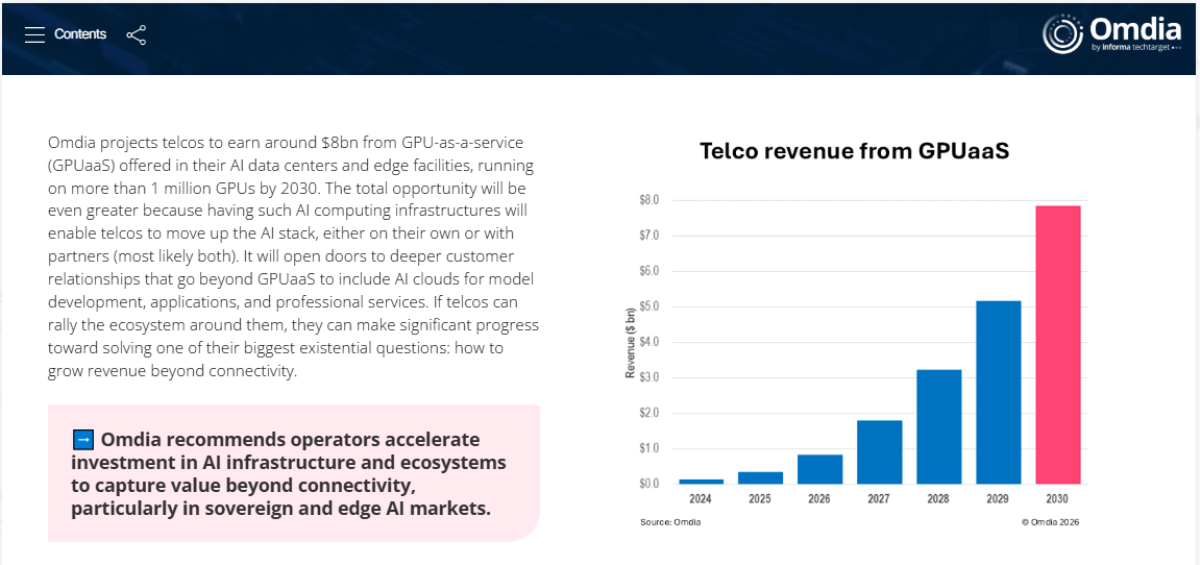
5. Telcos Could Generate $8 Billion From GPUaaS by 2030
Omdia projects telecom operators could generate around $8 billion in GPU-as-a-service (GPUaaS) revenue by 2030 through AI data centers and edge facilities powered by more than 1 million GPUs.
The GPUaaS market opportunity extends beyond infrastructure leasing. Telecom operators can also monetize AI cloud platforms, AI application hosting, model development services, and professional AI integration services.
Omdia said telecom operators that successfully build AI ecosystems and partnerships can significantly expand enterprise revenue streams beyond traditional connectivity businesses.
6. AI Is Driving Specialized Hardware Adoption
Telecom cloud infrastructure is rapidly evolving from CPU-centric systems toward specialized AI hardware architectures. According to Omdia’s Telco Cloud and Vendor Perception Survey, 70 percent of telecom operators consider AI and machine learning workload support a key factor in cloud infrastructure decisions.
The survey also revealed that 58 percent of telecom operators favor GPU-based infrastructure for AI processing and inferencing workloads. More than half are also evaluating DPUs and NPUs as part of future AI infrastructure deployments.
These specialized hardware platforms are becoming critical for supporting generative AI, predictive analytics, and AI-native telecom operations.
7. AI-Native Networks Are Becoming Core Telecom Strategy
Communication service providers are increasingly transitioning toward AI-native networks where artificial intelligence is embedded throughout network architecture and operations.
AI-native telecom networks continuously analyze network conditions, automate operational decisions, and optimize performance without human intervention. Telecom operators are using AI to improve scalability, operational efficiency, reliability, and network resilience.
The growing complexity of interconnected AI-native networks is also increasing demand for real-time analytics, automation, and predictive operational intelligence.
8. AI-RAN Is Delivering Double-Digit Performance Gains
AI-Radio Access Networks (AI-RAN) are emerging as one of the most important areas of telecom AI innovation. Telecom vendors are embedding AI into both purpose-built and virtualized RAN platforms to improve efficiency and network performance.
Omdia said early AI-for-RAN experiments are showing double-digit percentage improvements in key performance indicators such as cell-edge throughput.
AI is also being integrated directly into radio hardware using programmable silicon capable of AI inferencing within radio units. Vendors expect specialized AI models to increasingly replace traditional algorithms for channel estimation and link adaptation functions.
9. Optical Networking Is Entering a New AI Supercycle
The rapid expansion of AI infrastructure is driving a global optics upgrade cycle across data center interconnects, wide-area networks, and carrier services.
Omdia said the AI infrastructure build cycle has now entered its third year. Initially focused on interconnect technologies inside GPU clusters, the market is now shifting toward large-scale GPU pod scale-out networking.
The rise of managed optical fiber networks (MOFNs), wavelength services, and advanced optical transport infrastructure is creating significant investment opportunities across telecom transport networks.
10. AI and SDANs Are Transforming Broadband Infrastructure
Software-defined access networks (SDANs) are enabling telecom operators to modernize broadband infrastructure using cloud-native and AI-driven architectures.
Operators identified network optimization as the top AI automation priority over the next two years. Cloud-native SDN platforms improve telemetry, real-time monitoring, closed-loop automation, and AI/ML data collection capabilities.
AI-enabled SDAN architectures are expected to improve scalability, network intelligence, operational efficiency, and service automation across fixed broadband and enterprise connectivity markets.
Telecom Operators Face a Critical Strategic Window
Omdia warned that telecom operators risk being confined to basic connectivity services if they fail to move higher in the AI value chain. Most AI-related profits currently flow to hyperscalers and cloud platform providers rather than network operators.
However, telecom operators that invest aggressively in sovereign AI, AI inferencing, edge computing, GPUaaS, AI-native networks, and optical infrastructure can reclaim strategic relevance in the AI economy.
Omdia recommends operators accelerate investments in AI infrastructure, cloud ecosystems, edge facilities, and AI partnerships to capture long-term enterprise value beyond connectivity services.
BABURAJAN KIZHAKEDATH



