Omdia has sharply upgraded its semiconductor market outlook for 2026, forecasting revenue growth of 62.7 percent, driven primarily by unprecedented demand for memory technologies such as DRAM and NAND. The DRAM segment alone is expected to nearly double in value, while the smaller NAND market could expand up to four times compared to 2025, reflecting both strong demand and persistent supply shortages.
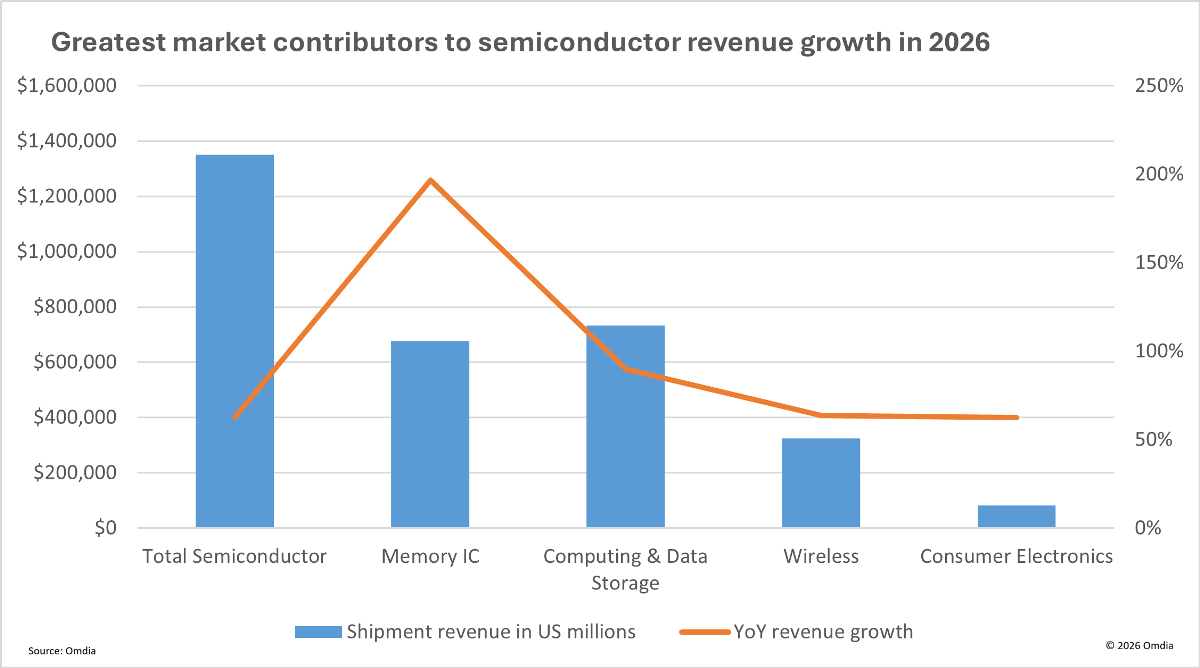
The supply-demand imbalance is being intensified by the industry’s strategic pivot toward High Bandwidth Memory (HBM), which delivers lower output volumes but significantly higher margins. As chipmakers prioritize HBM for AI workloads, conventional memory IC supply remains constrained, with meaningful relief unlikely before 2027, according to the latest Omdia report.
Enterprise IT modernization and hyperscaler investments are further accelerating demand. A major server refresh cycle in 2026, combined with record capital expenditure by cloud providers, is pushing organizations to replace legacy infrastructure with high-performance, memory-intensive systems. This transition toward advanced silicon architectures and high-speed connectivity is also driving up average selling prices across the semiconductor ecosystem.
Computing and data storage segments are expected to lead growth, with revenues projected to rise 90 percent year-on-year to exceed $700 billion in 2026. This surge is fueled by expanding data center deployments and increasing reliance on memory-heavy AI applications.
Consumer electronics and wireless markets are also contributing to growth. While smartphone shipments are expected to remain relatively flat, semiconductor revenues will increase due to higher memory pricing, raising bill of materials costs. The market will see new flagship launches, including foldable devices and AI-powered smartphones with advanced photography capabilities. Wearables such as smartwatches and fitness devices are also set to generate additional revenue momentum.
According to Myson Robles-Bruce, Senior Principal Analyst at Omdia, the rapid expansion of AI beyond basic applications is significantly increasing demand for both memory and processing chips. However, concerns remain about how quickly suppliers can scale production capacity and whether long-term returns will justify the massive investments in AI infrastructure.
Despite the bullish outlook, risks persist. Macroeconomic pressures including tariffs, rising energy costs, and geopolitical tensions could impact growth. Additionally, the current cycle is being driven more by higher chip prices than shipment volumes, echoing past memory super cycles such as those seen during crypto mining booms. However, the scale and cross-industry impact of the current AI-driven surge are far more extensive than previous cycles, marking a transformative phase for the global semiconductor industry.
Semiconductor market in 2025
The annual size of the global semiconductor market was more than $830 billion in 2025, registering more than 20 percent annual growth for the second consecutive year.
Artificial intelligence was the primary growth engine, significantly boosting demand for memory and processing chips. DRAM was the standout segment, with revenues rising above $150 billion in 2025, nearly tripling from 2023 levels and growing more than 50 percent.
BABURAJAN KIZHAKEDATH