
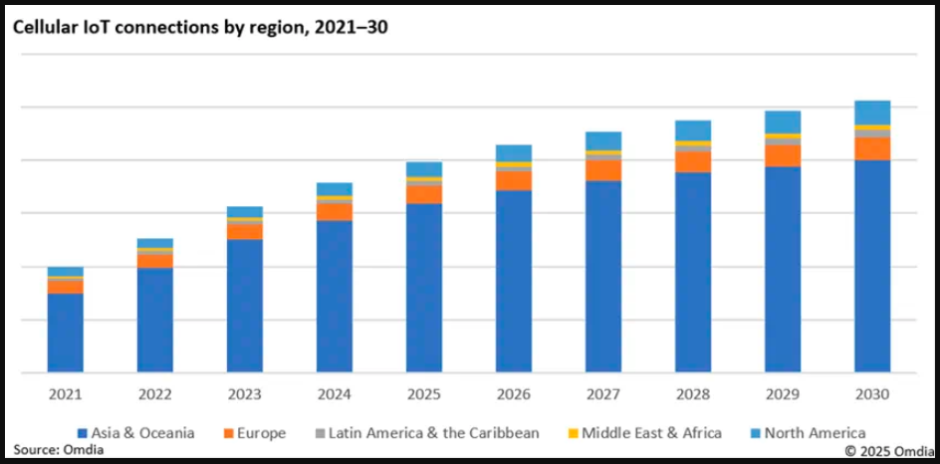
The global cellular IoT market is on a robust growth trajectory, with connections expected to reach 5.1 billion by 2030, according to a new report from Omdia. This expansion is being powered by key advancements in 5G technologies and a regionally concentrated push in IoT adoption, particularly in Asia and Oceania.
Growth Trends
One of the standout trends is the emergence of 5G Reduced Capability (RedCap) as a mid-tier connectivity option, optimized for devices that don’t need the full suite of 5G features like ultra-low latency or massive bandwidth.
While RedCap deployments have been slower than initially expected, momentum is expected to build from 2025 as standalone 5G (SA) rollouts regain pace. RedCap is also seen as a futureproof solution, helping device manufacturers transition away from 4G networks, which are set to phase out beyond 2030.
Alongside RedCap, 5G Massive IoT and 4G LTE Cat-1bis modules are identified as key enablers of cellular IoT scale, allowing billions of lightweight, cost-effective devices to connect securely across industries.
Regional Strategy and Market Drivers
Omdia’s data shows that Asia & Oceania will dominate IoT growth, accounting for over 67 percent of global IoT module shipments and nearly 80 percent of all IoT connections in 2024 alone. The surge is largely driven by the automotive sector, where demand for smart, connected vehicles with embedded 5G functionality is accelerating.
This regional dominance underlines the importance of Asia & Oceania not only as a consumer market but also as a global innovation hub for IoT technologies. The strategic concentration of IoT deployments in this region is reshaping how vendors, operators, and OEMs approach product design, manufacturing, and market entry plans.
Strategic Implications
Vendors should prioritize RedCap-based product roadmaps to address mid-tier 5G device needs, particularly for industrial and automotive use cases.
Telecom operators must accelerate 5G SA rollouts to unlock the full potential of RedCap and Massive IoT capabilities.
Enterprises and OEMs should align their IoT strategies with the Asian market, where infrastructure readiness and device demand are strongest.
Governments and regulators can influence IoT maturity by supporting 5G deployment incentives and fostering cross-industry collaboration in connected mobility, healthcare, and manufacturing.
With foundational 5G technologies maturing and the Asia-Pacific region taking the lead in adoption, cellular IoT is entering a high-growth phase that will define connectivity strategies well into the next decade, Alexander Thompson, Senior Analyst for IoT at Omdia, said.
TelecomLead.com News Desk


