
Reliance Jio delivered the fastest download speed at 287.91 Mbps, Airtel recorded zero dropped calls, and Vodafone Idea led upload speeds at 25.41 Mbps in TRAI’s August 2026 drive test across New Delhi and Central Delhi.
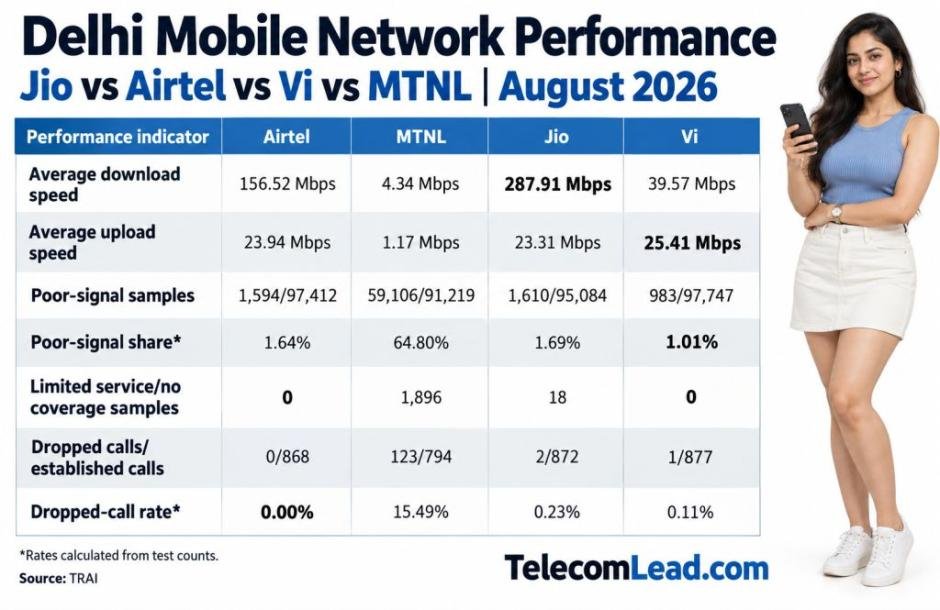
The results show different strengths among the three private operators. Jio led download performance, Airtel delivered the strongest call reliability on the tested route, and Vodafone Idea, operating under the Vi brand, recorded the lowest share of poor-signal samples, TRAI said in its report.
MTNL trailed substantially, with download speed of 4.34 Mbps, poor signal in 64.80 percent of collected voice-test samples and a 15.49 percent dropped-call rate.
TRAI’s appointed agency conducted the assessment from August 10 to August 14, 2026, covering 322.9 km of city driving, 11 hotspot locations, a 2.2 km walk test and inter-operator calling at one location.
Delhi Mobile Network Performance: Jio vs Airtel vs Vi vs MTNL
Jio Download Speed Was 84% Higher Than Airtel
Jio’s download speed of 287.91 Mbps placed it first among the four operators, ahead of Airtel at 156.52 Mbps, Vi at 39.57 Mbps and MTNL at 4.34 Mbps.
Jio delivered download speed approximately 84 percent higher than Airtel and 7.28 times Vi’s measured speed. Its absolute lead over Airtel was 131.39 Mbps.
Airtel ranked second, delivering nearly four times Vi’s download speed.
The download results favour Jio for bandwidth-intensive activities on the tested route, including large file transfers, application downloads and high-resolution video streaming. However, average throughput does not establish the speed available at every location or during every session.
The technology difference also matters: MTNL’s network supported up to 3G, while the other three operators supported up to 5G. The results therefore compare the networks available to users during testing across different technology generations.
Vi Leads Upload Performance at 25.41 Mbps
Vi topped upload throughput at 25.41 Mbps, followed by Airtel at 23.94 Mbps, Jio at 23.31 Mbps and MTNL at 1.17 Mbps.
Vi’s upload speed was approximately 6.1 percent higher than Airtel’s and 9.0 percent higher than Jio’s.
The gap between the three private operators was much narrower for uploads than downloads. Their measured upload speeds ranged from 23.31 Mbps to 25.41 Mbps, a spread of just 2.10 Mbps.
Vi’s result is relevant to users sending videos, uploading documents and transferring files to cloud services. Nevertheless, upload throughput alone does not determine video-call quality, which also depends on latency, packet loss and connection stability.
Vi Records Lowest Poor-Signal Share
Vi recorded 983 poor-signal samples out of 97,747, giving it the lowest poor-signal share at approximately 1.01 percent.
Airtel followed at 1.64 percent, based on 1,594 poor-signal samples out of 97,412. Jio recorded 1,610 out of 95,084, equivalent to 1.69 percent.
Both Airtel and Vi recorded zero samples with limited service or no coverage. Jio recorded 18 such samples.
MTNL’s coverage results were significantly weaker. Poor signal appeared in 59,106 of 91,219 samples, or 64.80 percent. It also recorded 1,896 limited-service/no-coverage samples, equivalent to approximately 2.08 percent of its collected samples.
These measurements describe signal conditions observed during voice testing along the drive route. They should not be interpreted as the percentage of Delhi’s geographical area covered by each operator.
Airtel Delivers Zero Dropped Calls
Airtel recorded no dropped calls among 868 successfully established calls, giving it the best dropped-call result in the assessment.
Vi recorded one dropped call out of 877, equivalent to approximately 0.11 percent. Jio recorded two dropped calls out of 872, or 0.23 percent.
MTNL recorded 123 dropped calls out of 794 successfully established calls, producing a dropped-call rate of approximately 15.49 percent — roughly one dropped call for every six to seven established calls.
Airtel’s zero-drop result, combined with its low poor-signal share, indicates strong voice continuity during the test. Vi and Jio also recorded low dropped-call rates, although Jio’s download-speed leadership did not translate into first place on every voice measure.
Airtel Also Records Fewest Call-Silence Instances
TRAI separately measured call silence lasting more than three seconds in auto-selection mode covering 5G/4G.
| Call-silence indicator | Airtel | Jio | Vi |
| Established calls within the operator’s network | 844 | 835 | 845 |
| Calls affected by silence exceeding three seconds | 3 | 40 | 9 |
| Share of calls affected* | 0.36% | 4.79% | 1.07% |
| Total silence instances exceeding three seconds | 3 | 46 | 11 |
Calculated from the number of affected calls and established calls. MTNL results were marked not applicable.
Airtel recorded the fewest affected calls and silence instances. Jio recorded 40 affected calls containing 46 silence instances, while Vi recorded nine affected calls containing 11 instances.
The distinction matters because a single call can contain multiple silence instances. These findings also show why download speed alone provides an incomplete picture of mobile network performance.
Measured Speeds Compared With Operator Declarations
TRAI’s report also compared measured throughput with each operator’s declared typical speed for the month.
| Operator | Declared typical download | Measured download | Declared typical upload | Measured upload |
| Airtel | 23.00 Mbps | 156.52 Mbps | 10.00 Mbps | 23.94 Mbps |
| MTNL | 8.00 Mbps | 4.34 Mbps | 1.00 Mbps | 1.17 Mbps |
| Jio | 15.00 Mbps | 287.91 Mbps | 7.00 Mbps | 23.31 Mbps |
| Vi | 15.00 Mbps | 39.57 Mbps | 8.00 Mbps | 25.41 Mbps |
Airtel, Jio and Vi exceeded their declared typical download and upload figures during testing. MTNL exceeded its declared upload figure but fell below its declared download speed.
These comparisons relate to declared typical throughput; they do not establish performance against a guaranteed minimum speed.
What the Delhi Results Mean for Mobile Users
The tested route included India Gate, Khan Market, Civil Lines, Kashmere Gate, Daryaganj, Lajpat Nagar, Hauz Khas, Chanakyapuri and other areas. Hotspot testing covered locations including Red Fort, Old Delhi Railway Station and Sadar Bazar, while the walk test covered Bhagirath Palace Electronic Market.
Across this assessment, Jio led downloads, Vi led uploads and signal coverage, and Airtel led call continuity. MTNL’s high poor-signal share and dropped-call rate identified substantial performance weaknesses.
For consumers, the findings support comparing operators across several measures. The best-performing network for fast downloads may differ from the one delivering the strongest voice experience on a particular route.
BABURAJAN KIZHAKEDATH