
Africa’s telecommunications industry faces growing pressure to expand 4G and 5G networks, improve mobile broadband speeds and increase digital adoption as declining revenue per user, high spectrum costs and rising capital expenditure requirements challenge operators.
According to the October 2026 GSMA Intelligence report Spectrum Policy in Africa, regulatory reforms could extend 5G coverage to an additional 170 million people and 4G coverage to another 50 million people by 2035.
The reforms could also improve average mobile download speeds by 30–50 percent and generate more than $120 billion in additional cumulative GDP between 2026 and 2035.
However, African operators have access to an average of 570 MHz of mobile spectrum, compared with 750 MHz in the rest of the world, while paying 24 percent more per unit of spectrum after adjusting for revenue and spectrum holdings.
Mobile Subscribers and 4G, 5G Coverage
Africa has achieved significant improvements in mobile connectivity over the past decade, but subscriber adoption remains below global levels.
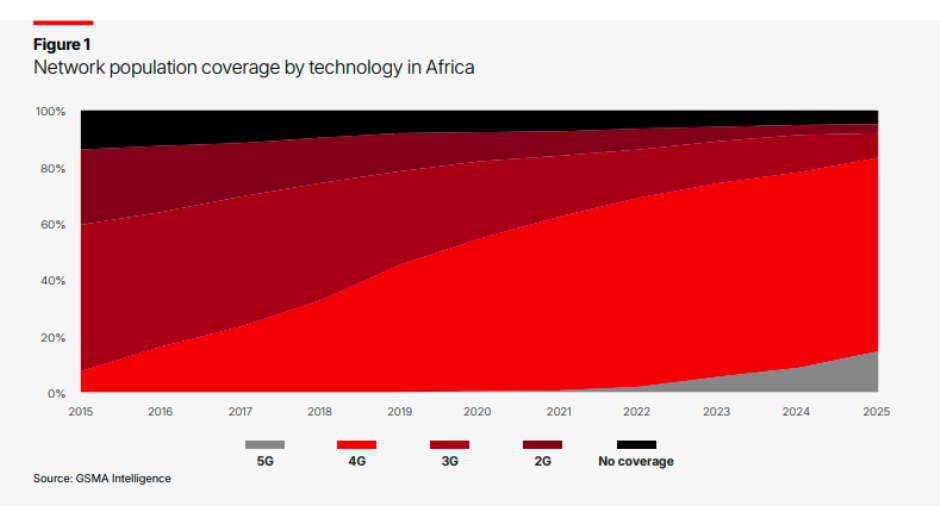
Mobile broadband population coverage increased from 59 percent in 2015 to 92 percent in 2025, while 4G coverage expanded from 7 percent to 83 percent.
5G networks reached 15 percent of Africa’s population by the end of 2025.
Despite these investments, only 28 percent of Africa’s population used mobile internet on their own device, compared with 66 percent in the rest of the world.
Approximately 64 percent of Africa’s population lived within mobile broadband coverage but did not use mobile internet, highlighting the significant gap between network availability and subscriber adoption.
Mobile internet penetration reached 42 percent in Northern Africa, 30 percent in Western Africa, 28 percent in Southern Africa, 22 percent in Eastern Africa and 15 percent in Central Africa.
Eastern Africa recorded the highest usage gap at 72 percent, while Central Africa had the largest coverage gap at 24 percent.
Telecom Revenue and ARPU Under Pressure
Revenue growth remains challenging for African mobile operators despite increasing mobile data consumption.
GSMA Intelligence reports that average mobile ARPU declined approximately 49 percent in real terms between 2015 and 2025.
Revenue per gigabyte of mobile data fell by approximately 92 percent during the same period, reflecting lower data prices and increasing affordability.
Revenue generated per megahertz of spectrum per connection declined by more than 69 percent over the decade.
Meanwhile, Africa’s mobile data traffic is forecast to increase by approximately 160 percent between 2025 and 2030, reaching 2.6 times its 2025 level.
This creates a financial challenge as operators must expand network capacity while generating less revenue per unit of data.
Telecom Capex Remains Around 20 Percent of Revenue
African telecom operators have maintained capital expenditure at approximately 20 percent of recurring revenue despite declining revenue per connection.
These investments have supported mobile broadband expansion, 4G coverage improvements and the introduction of 5G services.
However, declining revenue per connection limits the absolute capital available for future network deployment.
Spectrum acquisition costs further constrain investment in radio networks, towers, backhaul infrastructure and rural coverage.
The GSMA argues that affordable spectrum pricing could release additional financial resources for network expansion and improve the commercial viability of telecommunications investments.
Network Performance: Africa Trails Global Mobile Speeds
Africa’s mobile network performance remains significantly below international benchmarks.
Average mobile download speeds exceeded 27 Mbps in 2025, compared with 98 Mbps in the rest of the world.
Average upload speeds reached approximately 9 Mbps in Africa, against 17 Mbps elsewhere.
Mobile data consumption averaged approximately 3 GB per connection per month, compared with 14 GB in the rest of the world.
Nearly half of Africa’s mobile internet subscribers continue to use feature phones or 3G smartphones, restricting access to faster broadband services.
The GSMA estimates that a 10 percentage-point increase in the spectrum-cost-to-revenue ratio is associated with 4 percentage points lower 4G coverage, 6 percentage points lower 5G coverage and 8 percent slower download speeds.
Conversely, increasing assigned spectrum by 10 percent could improve mobile upload and download speeds by approximately 3–4 percent.
Spectrum Shortage Limits 5G Expansion
African operators had access to approximately 570 MHz of assigned mobile spectrum in 2025, compared with 1,136 MHz in North America, 945 MHz in Europe, 848 MHz in the Middle East and 698 MHz in Asia Pacific.
Only 24 of Africa’s 54 countries had assigned spectrum in the 3.5 GHz band, which is important for 5G capacity and network performance.
Just five African countries had assigned at least 300 MHz in this band.
More than 30 African countries had not assigned spectrum in the 700 MHz band, which supports cost-effective rural broadband coverage.
The GSMA estimates that an additional 50 MHz of spectrum below 1 GHz could increase 4G coverage by 7 percentage points and 5G coverage by 11 percentage points.
Tanzania, Somalia and Nigeria are among the African markets that have assigned more than 1,000 MHz of low- and mid-band spectrum.
Spectrum Costs and Licensing Challenges
Spectrum licensing obligations create additional financial pressure for operators.
In Benin, direct spectrum costs represent approximately 7 percent of annual operator revenue, while coverage and quality-of-service obligations add costs equivalent to another 66 percent.
In Rwanda, combined spectrum and obligation costs reach approximately 14 percent of revenue, compared with 8 percent in Uganda.
Across Africa, 21 countries lack fully technology-neutral licensing frameworks, while 26 do not have unified licensing frameworks.
Only nine countries have published spectrum roadmaps, and only nine have licence terms of at least 20 years across all active licences.
These restrictions can delay spectrum refarming, 5G deployment and long-term network investment.
Digital Transformation and AI Opportunities
Improved mobile broadband coverage could accelerate Africa’s digital economy by expanding access to digital payments, e-commerce, education, healthcare and enterprise services.
The GSMA estimates that comprehensive spectrum reforms could increase Africa’s average Digital Policy and Regulatory Index score from 46 to 56 out of 100.
The Digital Nations and Society Index score could improve from 36 to 42, reflecting stronger digital adoption among consumers, businesses and governments.
Artificial intelligence could provide additional opportunities for telecom operators through network optimization, predictive maintenance, automated customer service and fraud detection.
AI-driven traffic management could also help operators improve network efficiency as mobile data consumption increases.
However, the GSMA report does not provide specific forecasts for AI-related telecom revenue or investment.
Spectrum Reforms Could Unlock $120 Billion Economic Growth
The GSMA recommends lower spectrum auction reserve prices, technology-neutral licensing, predictable renewals and licence durations of at least 20 years.
It also advocates allocating the upper 6 GHz band for future mobile capacity and the 600 MHz band for rural broadband coverage.
Implementing comprehensive reforms could extend 4G coverage to another 50 million people, expand 5G coverage to an additional 170 million and improve download speeds by 30–50 percent by 2035.
The resulting improvements in connectivity and digital adoption could generate more than $120 billion in additional cumulative GDP across Africa between 2026 and 2035.
For African telecom operators, affordable spectrum, sustainable capex and improved regulatory certainty will be essential to expanding subscribers, strengthening network performance and developing new digital revenue opportunities.
BABURAJAN KIZHAKEDATH