
The biggest mobile network deals of 2026 show a clear change in operator priorities. Telecom companies are no longer investing only in wider 5G coverage. Spending is moving toward 5G Standalone, AI-RAN, Open RAN, cloud-native core networks, automation, network slicing and energy-efficient radio infrastructure.
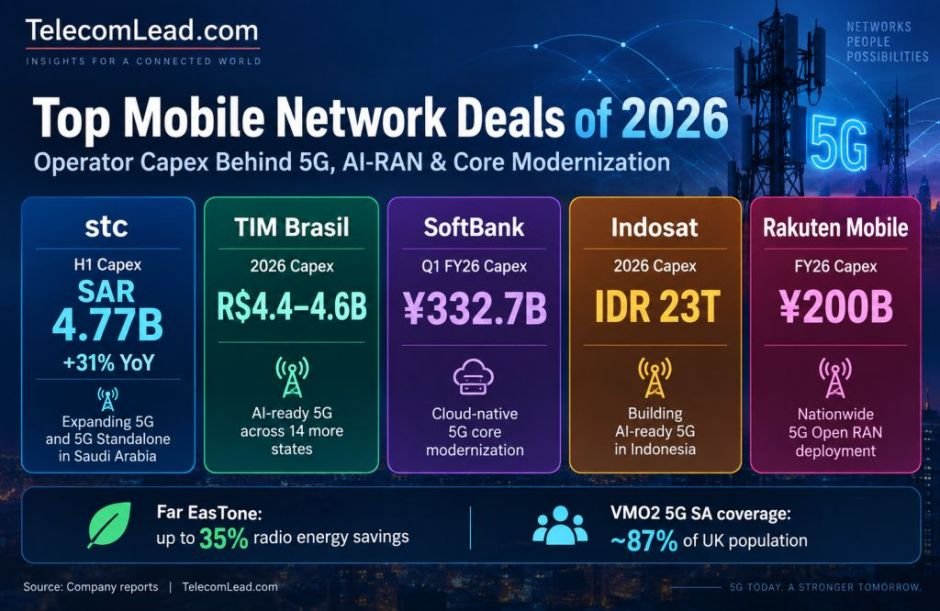
Ericsson, Nokia, Samsung and Huawei are winning major contracts as operators modernize RAN and core platforms while preparing networks for AI-driven traffic, 5G-Advanced and eventually 6G.
The latest agreements also reveal a stronger focus on extracting more capacity from existing spectrum, reducing energy consumption and improving network automation rather than simply adding more base stations.
1. stc-Ericsson: Saudi Arabia Expands 5G and 5G Standalone
Saudi Arabia’s stc signed a multi-year agreement with Ericsson in September 2026 to expand its 5G network, increase capacity and accelerate 5G Standalone deployment.
The agreement includes the first commercial deployment of Ericsson’s Radio 4496, a 400-watt quad-band FDD radio supporting stc’s new 600 MHz spectrum. The broader deployment also includes Massive MIMO, mid-band radio systems, baseband platforms and RAN software.
stc’s financial scale illustrates the investment behind the modernization program. The operator generated SAR40.11 billion in H1 2026 revenue, up 3.8 percent year on year, while capital expenditure increased 31 percent to SAR4.77 billion.
stc also reported 30.3 million mobile subscribers, giving Ericsson exposure to one of the largest telecom networks in the Middle East.
The deal highlights how operators are combining new spectrum with 5G network modernization and Standalone expansion rather than treating coverage and capacity expansion as separate investment programs.
2. Virgin Media O2-Ericsson: Major UK RAN Upgrade
Virgin Media O2 extended its Ericsson partnership for another five years in March 2026 under a contract worth several hundred million euros to Ericsson.
Ericsson will become VMO2’s primary RAN supplier and power the majority of its UK radio network.
The upgrade covers Massive MIMO, multiband radios, AI-based optimization, 5G Standalone, network slicing, Cloud RAN and future 5G-Advanced technologies.
VMO2’s 5G SA network already reaches about 87 percent of the UK population.
The operator reported £2.008 billion in Q1 2026 service revenue, while quarterly capital expenditure was approximately £368 million.
The contract demonstrates how large European operators are increasingly concentrating network investment on software intelligence, automation and spectrum efficiency.
3. TIM Brasil-Nokia: AI-Ready 5G Across 14 More States
TIM Brasil expanded its partnership with Nokia in March 2026 to cover 14 additional states, representing approximately 42 percent of Brazil’s population.
Nokia is supplying AirScale baseband, Habrok Massive MIMO radios, Pandion remote radio heads, small cells and MantaRay SON automation.
The agreement is particularly significant because it introduces AI-RAN with NVIDIA into TIM Brasil’s network strategy.
TIM generated R$6.806 billion in Q1 2026 revenue, while its full-year capital expenditure guidance stands at R$4.4 billion-R$4.6 billion. Q1 CapEx was approximately R$1.35 billion.
The deal shows how AI-RAN investment and AI-native network optimization are beginning to move from trials toward mainstream network planning. Commercial tests are already demonstrating how AI inside the RAN can improve throughput and spectral efficiency without relying entirely on additional spectrum or hardware.
4. Far EasTone-Ericsson: Taiwan Moves Toward AI-Native Networks
Far EasTone signed a three-year agreement covering 2026-2028 with Ericsson to modernize both its radio and core networks.
The program includes spectrum refarming, AI-powered rApps, network automation, dual-mode 5G Core and network slicing.
One of the strongest commercial benefits is energy efficiency, with Ericsson estimating potential radio-network energy savings of up to 35 percent.
Far EasTone generated approximately NT$57.3 billion in H1 2026 revenue, while its full-year revenue guidance is NT$117.48 billion.
The operator also plans NT$9.6 billion in 2026 CapEx, with RAN capacity and 5G Standalone among the main priorities.
The partnership demonstrates how energy reduction and automation are becoming central to the economics of 5G upgrades.
5. SoftBank-Ericsson: Japan Expands Cloud-Native 5G Core
SoftBank selected Ericsson in March 2026 under a multi-year framework to modernize its nationwide mobile core and accelerate 5G Standalone.
The deployment includes cloud-native dual-mode 5G Core, Cloud IMS, subscriber data management and policy control.
SoftBank Corp. generated ¥1.815 trillion in Q1 FY2026 revenue, up 9 percent year on year.
Capital expenditure reached ¥332.7 billion, highlighting the financial scale of Japan’s ongoing mobile infrastructure investment.
The agreement reflects a wider industry trend in which operators are modernizing core platforms alongside RAN infrastructure so that they can support slicing, enterprise services and new 5G applications.
6. Wind Tre-Ericsson: Seven-Year Italian Core Modernization
Wind Tre selected Ericsson for a seven-year agreement covering 2026-2032 to modernize its network core.
The program supports 4G, 5G NSA and 5G SA customers and includes Packet Core, UDM, IMS, signaling, provisioning, security, automation and network slicing.
One major operational change is the planned consolidation of Wind Tre’s data centers from 18 sites to 12.
Reducing the number of infrastructure sites can lower complexity and operating costs while allowing the network to handle heavier 5G workloads.
The contract is one of the clearest examples of how cloud-native 5G core networks are becoming a central component of long-term operator modernization. SoftBank’s own Ericsson agreement similarly combines dual-mode 5G Core, cloud-native infrastructure, subscriber data management and IMS as part of its transition toward 5G SA.
7. Taiwan Mobile-Nokia: AI-Powered 5G Expansion
Taiwan Mobile expanded its partnership with Nokia in July 2026 to strengthen AI-powered automation, energy management, network intelligence, resilience, network slicing and RedCap.
Taiwan Mobile generated NT$99.2 billion in H1 2026 revenue, compared with NT$95.6 billion a year earlier.
Q2 revenue reached NT$49.43 billion.
The operator’s 2026 capital expenditure budget is NT$8.24 billion, with mobile network investment representing a significant part of the program.
The Nokia partnership shows how operators in advanced Asian markets are shifting from first-stage 5G rollouts toward intelligent network operations and 5G-Advanced capabilities.
8. Indosat-Nokia: Indonesia Builds AI-Ready 5G
Indosat Ooredoo Hutchison and Nokia announced a 5G collaboration in June 2026 spanning both low-band and mid-band spectrum.
The companies are also working on AI-RAN and AI Grid capabilities with NVIDIA, making artificial intelligence a core component of the network roadmap.
Indosat generated IDR30.7 trillion in H1 2026 revenue, up 13.1 percent year on year.
Its 2026 CapEx guidance was subsequently increased to IDR23 trillion, while H1 capitalized CapEx reached approximately IDR9.5 trillion.
Indonesia’s growing data usage and expanding 5G adoption create a strong investment case for broader radio coverage as well as additional capacity.
9. Rakuten Mobile-Samsung: Nationwide Open RAN Deployment
Rakuten Mobile selected Samsung in March 2026 as a nationwide 5G Open RAN radio supplier.
Samsung will provide O-RAN-compliant radios supporting 700 MHz, 1.7 GHz and 3.8 GHz, including Massive MIMO systems.
Rakuten Mobile generated ¥101.3 billion in Q2 FY2026 revenue, up 11.9 percent year on year.
Network-related quarterly capital expenditure reached ¥39.3 billion, while Rakuten maintained its ¥200 billion FY2026 CapEx plan to accelerate base-station construction.
The agreement is strategically important because Rakuten remains one of the industry’s highest-profile examples of large-scale commercial Open RAN deployment.
Samsung’s role also demonstrates how Open RAN is expanding beyond software architecture into large-scale commercial radio procurement. Its March 2026 agreement with Rakuten covers O-RAN-compliant 5G radios and reinforces the commercial maturity of virtualized, cloud-native RAN infrastructure.
10. U Mobile-Huawei: Malaysia Targets 5G-Advanced
U Mobile and Huawei Malaysia signed an MoU in March 2026 covering 5G-Advanced, AI, 3.5 GHz dual-carrier operation, three-component-carrier aggregation, network slicing and AI-based network operations.
Although the agreement is not a disclosed commercial network contract, it provides an important indication of U Mobile’s technology direction.
The operator achieved 80 percent Coverage of Populated Areas by March 2026 and is targeting Level 4 autonomous network operations.
U Mobile also secured RM4.3 billion in syndicated financing to support next-generation 5G deployment and working capital.
The partnership underlines Huawei’s continued role in advanced mobile-network technologies, particularly across Asian and emerging markets.
2026 Mobile Network Deals Show New Investment Priorities
The leading telecom contracts of 2026 reveal four important changes in network spending.
First, 5G Standalone is becoming a mainstream investment priority. stc, Virgin Media O2, Far EasTone, SoftBank and Wind Tre are all advancing SA capabilities across RAN or core platforms.
Second, AI is moving directly into the network architecture. TIM Brasil, Indosat, Far EasTone and Taiwan Mobile are incorporating AI-RAN, automation and network intelligence into commercial modernization programs.
Third, operators are paying greater attention to energy efficiency and infrastructure simplification. Far EasTone is targeting radio energy savings of up to 35 percent, while Wind Tre is reducing its core data-center footprint from 18 sites to 12.
Finally, Open RAN is gaining additional commercial credibility through Rakuten Mobile’s nationwide Samsung agreement.
Ericsson and Nokia Lead, but Competition Is Expanding
Ericsson appears prominently across the largest 2026 agreements, including stc, Virgin Media O2, Far EasTone, SoftBank and Wind Tre.
Nokia has secured significant network expansion and modernization work with TIM Brasil, Taiwan Mobile and Indosat.
Samsung’s nationwide Rakuten Mobile agreement strengthens its position in Open RAN, while Huawei remains involved in 5G-Advanced and AI-driven network development through U Mobile.
The competitive battle is therefore no longer focused simply on supplying radios.
Vendors increasingly need to deliver a combination of RAN, cloud-native core, AI, automation, energy optimization, Open RAN capabilities and 5G-Advanced readiness.
The RAN vendor competition in the AI-RAN era shows how Ericsson, Nokia and Huawei are being assessed on software, artificial intelligence, openness and energy efficiency in addition to traditional radio performance.
The biggest mobile network deals of 2026 show that telecom investment is entering a more software-driven phase. Operators are shifting from building basic 5G coverage toward creating intelligent, programmable and AI-ready networks capable of supporting enterprise services, higher traffic volumes and future 6G architectures.
For Ericsson, Nokia, Samsung and Huawei, the next growth opportunity will depend on how effectively they can turn this transition into long-term network modernization contracts.
FASNA SHABEER


