
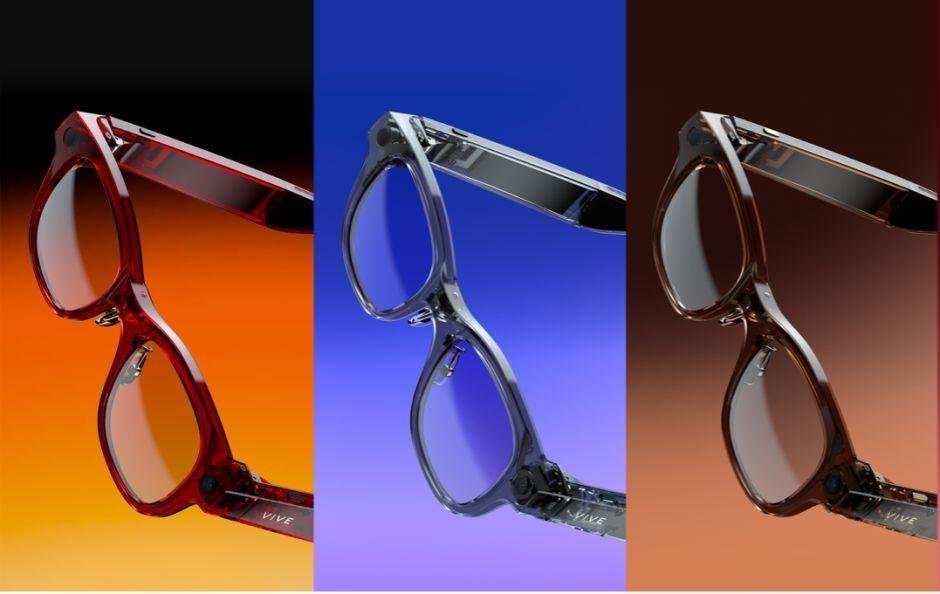
Taiwan’s HTC is doubling down on an open platform strategy to gain market share in the smartglass industry, positioning its newly launched AI powered eyewear as a flexible alternative to more closed ecosystems dominated by Big Tech rivals.
Credit: HTC
The company believes that allowing users to choose between multiple artificial intelligence models will give it a competitive edge as the global race to commercialize AI enabled wearables intensifies, Reuters news report said.
Open AI Strategy at the Core of HTC’s Smartglasses Push
“AI is advancing very fast, and large language model developers are engaged in an arms race that requires massive resources,” said Charles Huang, senior vice president of global sales and marketing at HTC. “We want to leverage the strengths of different platforms instead of building a closed ecosystem.”
HTC’s VIVE Eagle smartglass supports multiple AI platforms, including Google’s Gemini and models from OpenAI. This approach allows users of smartglass to benefit from improvements across different AI systems rather than being locked into a single proprietary model.
By contrast, Meta’s smartglasses rely exclusively on Meta AI, while smartglasses from Chinese brands such as Xiaomi and Alibaba are built around domestically developed AI models. HTC’s open model strategy aims to differentiate its products in a market where AI capabilities are becoming a primary purchase driver.
VIVE Eagle Smartglasses: Features and Pricing
HTC launched the VIVE Eagle smartglasses earlier this month in Hong Kong, pricing the device at HK$3,988, or about $512. The AI powered eyewear integrates voice based assistance, real time information access, and other smart features enabled by large language models.
The company plans to expand sales to Japan and Southeast Asia in the first quarter of next year, followed by a broader rollout in Europe and the United States later in 2026. HTC said the phased expansion reflects both market readiness and regional consumer preferences.
Meta smart glasses (Ray-Ban & Oakley) are available in Hong Kong from around HK$3,300 to over HK$4,000, depending on the model (Wayfarer, Skyler, HSTN) and retailer, with prices varying slightly between shops like Fortress and airport duty-free. Meta Ray-Ban Display glasses (with a screen) are available for $799 USD globally and are expected in HK at a premium price, like HK$3,990 RRP for standard models.
Asia First Strategy and Design Considerations
Huang said HTC’s decision to launch first in Asia was deliberate. Many smartglasses currently on the market are designed with what he described as a “Western fit,” which may not be comfortable or suitable for Asian users.
By prioritizing Asia, HTC aims to tailor both hardware design and user experience to regional needs, a strategy it believes could help build early brand loyalty before entering Western markets.
China Market Remains Complex
Smartglasses Market Growth and Competitive Landscape
Global shipments of smartglasses surged 110 percent in the first half of this year, according to research firm Counterpoint. Meta currently dominates the sector with a 73 percent market share.
Meta, in partnership with EssilorLuxottica, has attracted significant attention with its smart Ray Ban and Oakley glasses, first launched in 2023. These devices allow users to answer calls, take photos, play music, and interact with AI features, helping to bring smartglasses into the mainstream.
Global smartglass (smart eyewear) shipments reached about 1.487 million units in the first quarter of 2025, up around 82 percent year-on-year, according to IDC report.
Privacy and Data Security as Key Differentiators
Despite strong demand, analysts have warned that privacy concerns could become a major issue as smartglasses adoption grows. Meta, which owns Facebook, Instagram, and WhatsApp, has faced scrutiny for leveraging user data to power its AI tools.
Huang said HTC does not use user data to train its AI models and views privacy and data security as key differentiators. He added that protecting user information is central to HTC’s product philosophy as AI powered wearables become more deeply integrated into daily life.
Renewed Consumer Hardware Push for HTC
The launch of the VIVE Eagle smartglass marks a renewed push by HTC into consumer facing hardware. Earlier this year, the company sold part of its extended reality headset and glasses unit to Google for $250 million, a move that streamlined its operations while preserving its focus on innovation.
BABURAJAN KIZHAKEDATH

