

Global semiconductor revenue surpassed $425 billion in Q2 2026, rising a record 31.4 percent quarter-over-quarter (QoQ) as artificial intelligence infrastructure, surging memory demand and higher chip prices reshaped the semiconductor market.

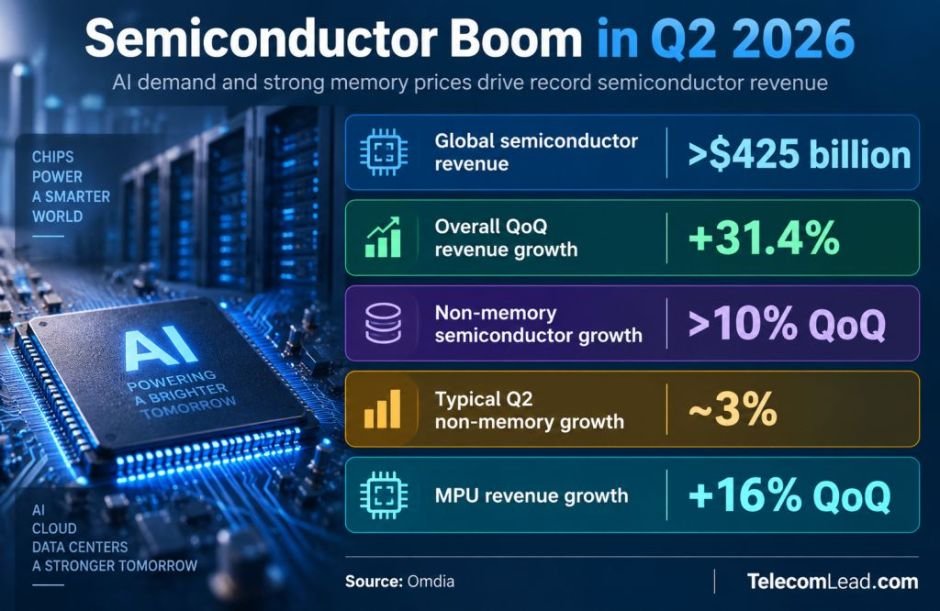
The industry generated $752 billion in revenue during the first half of 2026, according to Omdia. The research firm expects semiconductor revenue to exceed $500 billion in Q3 2026, potentially taking revenue for the first nine months of the year above $1.25 trillion.
For the telecom industry, the semiconductor boom is significant because mobile networks are becoming increasingly dependent on advanced computing. Investments in 5G-Advanced, AI-RAN, cloud-native 5G cores, IP and optical networks, edge computing, Fixed Wireless Access (FWA) and future 6G networks are expanding the role of processors, memory, networking silicon and other chips.
AI data-center investment is simultaneously increasing demand for high-capacity telecom networks connecting cloud platforms, data centers and enterprise customers.
Semiconductor Market Posts Record 31.4% Growth
The 31.4 percent sequential growth recorded in Q2 surpassed the previous semiconductor industry record of 29.2 percent in Q1 2026.
Such rapid expansion is historically unusual.
Since Omdia began tracking the semiconductor market in Q1 2002, only 10 out of 97 quarters have recorded sequential revenue growth above 10 percent.
More significantly, the industry has now achieved double-digit sequential growth for four consecutive quarters beginning in Q3 2025. Omdia expects Q3 2026 to continue this trend.
Memory remains the primary growth engine, but the latest numbers show that semiconductor demand is broadening into processors and other components.
This is particularly relevant to telecom because next-generation networks require increasing amounts of computing alongside traditional radio and transport infrastructure.
Memory Captures More Than Half of Semiconductor Revenue
Memory ICs accounted for more than half of worldwide semiconductor revenue in Q2 2026, demonstrating the extraordinary impact of DRAM, NAND and other memory products on the current chip cycle.
DRAM, NAND and NOR each recorded their highest sequential growth for a second quarter since Omdia began tracking the market. All three categories also achieved their highest quarterly revenue on record.
AI is changing memory demand because accelerated computing systems require substantially more high-performance memory. Production shifts by memory manufacturers are affecting supply-demand balances, contributing to higher average selling prices and revenue.
The impact extends beyond AI data centers.
DRAM and NAND are important components in smartphones, telecom servers, routers, switches, edge-computing systems and FWA customer-premises equipment. Higher memory prices can therefore affect equipment costs across the telecom ecosystem.
AI Boom Expands Beyond Memory
One of the most important indicators in Omdia’s Q2 report is the performance of semiconductors excluding memory.
The non-memory semiconductor market grew by more than 10 percent QoQ.
That compares with typical Q2 sequential growth of just over 3 percent, based on Omdia data covering 2002 through 2025.
This means semiconductor growth outside memory is running at more than three times the normal second-quarter rate.
The comparison is important because it suggests the semiconductor boom is broader than rising DRAM and NAND prices.
AI infrastructure requires an extensive chip ecosystem. GPUs and AI accelerators attract most attention, but AI systems also need CPUs, networking processors, memory controllers, storage components, power-management chips and high-speed connectivity technologies.
This expansion is increasingly relevant to the telecom sector as operators and network vendors examine the business opportunity from AI infrastructure and telecom networks.
Microprocessor Revenue Surges 16%
Microprocessor performance provides further evidence of unusually strong chip demand.
Omdia says MPU revenue increased 16 percent QoQ in Q2 2026.
Telecom networks are becoming more software-defined and cloud-native. Network functions that once depended primarily on dedicated hardware are running on general-purpose and accelerated computing platforms.
This transition could gradually increase the semiconductor content associated with mobile network infrastructure.
AI-RAN Opens New Semiconductor Opportunity
The intersection between AI and radio networks represents an emerging semiconductor opportunity.
Telecom operators and network vendors are developing AI-RAN technologies that use artificial intelligence to improve radio-resource management, spectral efficiency, traffic optimization and network energy efficiency.
The commercial potential is attracting greater industry attention as operators evaluate the AI-RAN business case and determine whether accelerated computing can deliver sufficient improvements in network performance and operating costs.
AI Traffic Drives IP and Optical Network Investment
The semiconductor opportunity extends beyond radio networks.
AI data centers generate enormous volumes of traffic between computing clusters, storage infrastructure, cloud platforms and end users. Telecom operators and cloud providers consequently require higher-capacity IP and optical networks.
Network upgrades toward 400G, 800G and multi-terabit optical technologies increase demand for advanced networking silicon and optical components.
Operators supplying connectivity to hyperscale data centers and AI cloud providers can benefit from increasing bandwidth requirements, while telecom equipment vendors gain opportunities from network upgrades required to transport AI traffic.
The impact is already becoming visible in the performance of equipment suppliers, with AI and cloud demand supporting optical network growth.
The boundary between traditional telecom networks and data-center networking is therefore becoming less distinct as cloud and AI traffic expand.
Smartphones and FWA Add to Chip Demand
Telecom semiconductor demand is not limited to network infrastructure.
Smartphones remain one of the world’s biggest semiconductor markets, using application processors, cellular modems, RF components, memory, connectivity chips and power-management ICs.
The expansion of 5G Fixed Wireless Access creates another growing device category.
Modern 5G FWA gateways combine cellular modems with Wi-Fi 6, Wi-Fi 6E or Wi-Fi 7, processors and memory to deliver high-speed broadband services.
According to the GSA FWA Forum’s 2026 industry survey, 5G devices are expected to represent around 70 percent of FWA CPE shipments in 2026, up from approximately 60 percent in 2025.
Growing adoption of 5G Standalone and 5G-Advanced could further increase semiconductor requirements as devices support more sophisticated connectivity, network slicing and advanced radio capabilities.
However, strong semiconductor and memory pricing could also increase device costs for smartphone manufacturers, telecom operators and FWA equipment suppliers.
5G-Advanced and 6G Will Need More Computing
The semiconductor boom is occurring as telecom operators prepare for another network technology transition.
5G-Advanced is expected to expand the role of artificial intelligence, automation, advanced radio capabilities and energy optimization in mobile networks.
The transition toward AI-native 6G networks could take this significantly further.
Future 6G infrastructure is expected to combine communications with artificial intelligence, distributed computing and sensing capabilities.
Delivering those services will require advances in radio-frequency chips, processors, accelerators, networking silicon and power-efficient computing.
Semiconductor innovation could consequently become increasingly important in determining network capacity, energy consumption and the economics of future mobile networks.
Semiconductor Revenue Set to Cross $500 Billion in Q3
The next major industry milestone could arrive in Q3 2026.
Omdia forecasts worldwide semiconductor revenue will exceed $500 billion during the quarter, taking semiconductor revenue for the first nine months of 2026 above $1.25 trillion.
The industry already generated $752 billion in H1 2026, exceeding the full-year semiconductor revenue recorded in every year except 2025.
Omdia says semiconductor revenue during the first three quarters of 2026 could be 50 percent higher than total semiconductor revenue for the whole of 2025.
The most significant finding from Omdia’s Q2 data on semiconductor market is therefore not simply the record 31.4 percent semiconductor revenue growth.
BABURAJAN KIZHAKEDATH