
Broadcom has unveiled its fourth wave of Wi-Fi 8 chipsets alongside an optimized 10G PON gateway SoC, targeting service providers operating in highly competitive, ARPU-constrained broadband markets. The new portfolio combines next-generation Wi‑Fi 8 with 10G PON, enabling operators to scale multi-gigabit fiber connectivity while lowering deployment costs and improving network efficiency.
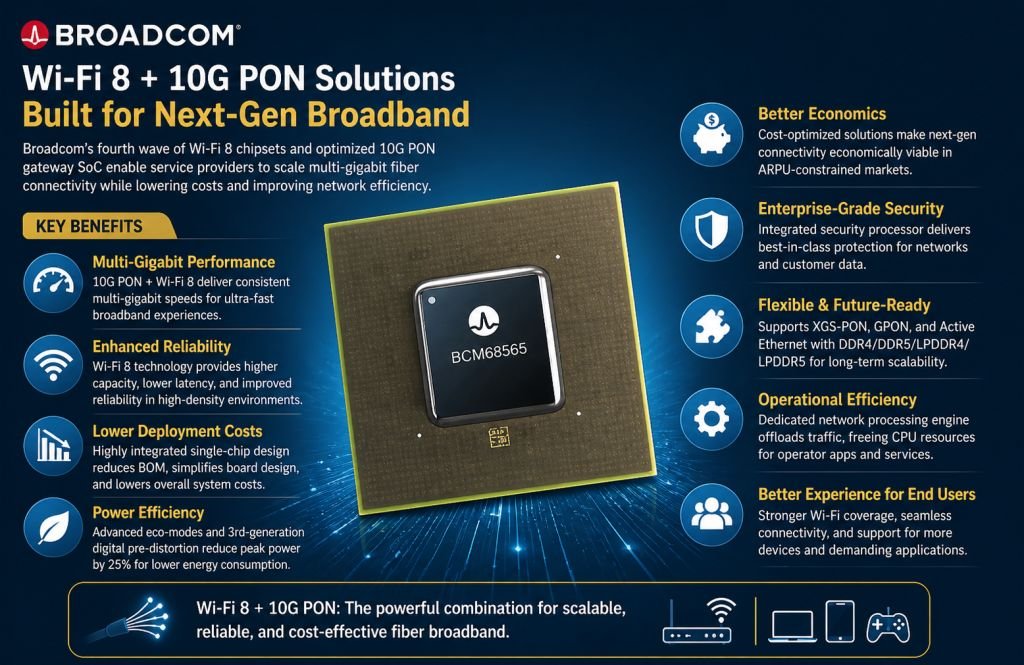
Key features driving next-gen broadband performance
At the core of the launch is BCM68565 PON gateway SoC, designed for mass-market fiber deployments with a 10-Gbps WAN interface supporting XGS-PON, GPON, and Active Ethernet. It integrates CPU, dedicated network processing engine, and advanced security processor, while supporting multiple memory standards including DDR4, DDR5, LPDDR4, and LPDDR5.
Complementing this are the BCM67142 and BCM67192 dual-band Wi-Fi 8 radio chips, which integrate 2.4 GHz and 5 GHz radios into a single silicon design. This reduces system complexity and bill of materials while delivering higher throughput, lower latency, and improved reliability. Power efficiency is enhanced through eco-modes and third-generation digital pre-distortion, cutting peak power usage by 25 percent.
Benefits for service providers and end users
The integration of Wi-Fi 8 with 10G PON enables operators to deliver consistent multi-gigabit broadband experiences across dense and high-demand environments. By optimizing CPU and memory resource sharing between the broadband SoC and Wi-Fi radios, Broadcom reduces hardware costs and energy consumption, making next-generation connectivity economically viable at scale.
For end users, this translates into ultra-reliable wireless performance, higher capacity for connected devices, and lower latency for applications such as cloud gaming, AI workloads, and immersive services.
What this means for operators
Broadcom’s latest platform provides a clear migration path from legacy copper and cable infrastructure to fiber-based broadband networks. The cost-optimized design allows operators to accelerate Wi-Fi 8 adoption without significantly increasing capital expenditure, helping them remain competitive while protecting margins.
The solution also supports open-source middleware frameworks such as RDK and prplWare, giving operators flexibility to deploy customized services and applications. As demand for high-bandwidth connectivity continues to surge, Broadcom’s integrated approach positions operators to deliver premium broadband services while maintaining operational efficiency and scalability.
BABURAJAN KIZHAKEDATH

