
Municipal broadband networks in the United States are outperforming many private internet service providers, particularly in upload speeds and network latency, according to a study by Ookla analyzing Speedtest Intelligence data from December 2024 to December 2025. The report evaluated the performance of 14 of the largest municipal broadband providers and compared them with competing ISPs in their respective markets.
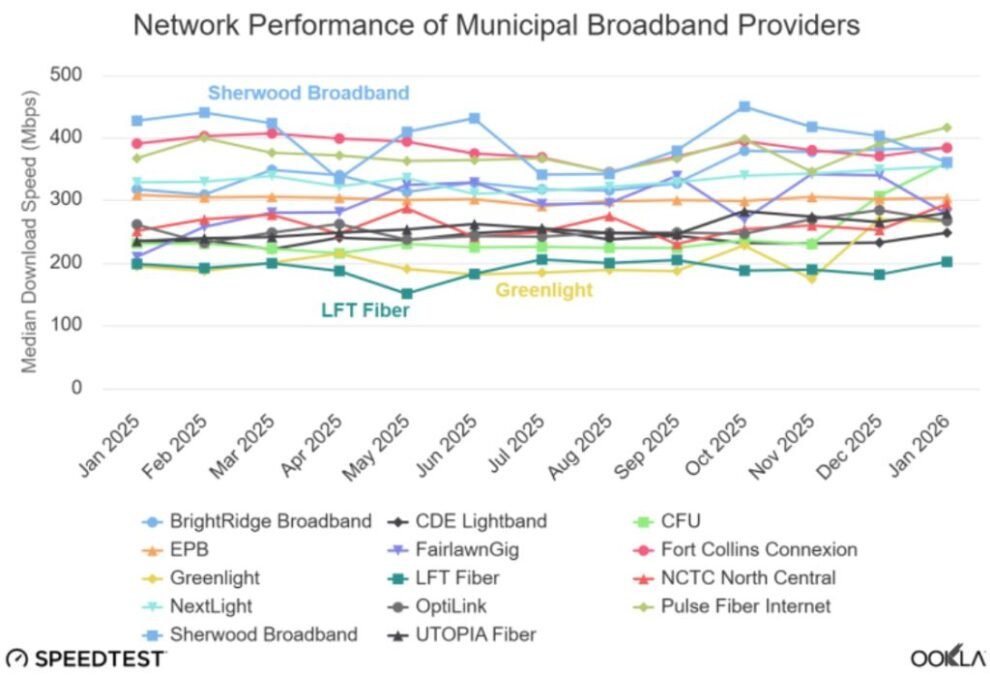
The study found that eight municipal providers delivered higher upload speeds than their broadband competitors, highlighting the strong performance of community-owned fiber networks.
Sherwood Broadband in Sherwood, Oregon, emerged as the top performer in download speeds, exceeding 400 Mbps in eight of the 13 months analyzed.
Meanwhile, Connexion in Fort Collins, Colorado, led in upload speeds, consistently delivering more than 300 Mbps throughout the entire study period.
UTOPIA Fiber in Utah stood out for network responsiveness, recording the lowest latency among the municipal providers, with multi-server latency consistently between 6 milliseconds and 8 milliseconds.
Municipal broadband networks are operated by local governments or municipal utilities and currently serve more than 700 communities across the United States. These networks are typically built using fiber-optic infrastructure, allowing them to deliver symmetrical upload and download speeds and avoid congestion issues such as bufferbloat that can affect cable networks.
Cedar Falls Utilities Fiber Network Delivers Faster Upload Speeds and Lower Latency Than Mediacom
Cedar Falls Utilities (CFU), a municipal broadband provider in Cedar Falls, Iowa, demonstrates the performance advantages of fiber-based networks despite facing competition from cable provider Mediacom. Mediacom recorded higher download speeds, reaching 407.38 Mbps in December 2024 compared to CFU’s 281.56 Mbps. By December 2025, the gap had narrowed, with Mediacom posting 361.4 Mbps and CFU reaching 311.64 Mbps.
CFU outperforms Mediacom in upload performance due to its symmetrical fiber network. In December 2025, CFU delivered upload speed of 247.55 Mbps, nearly five times higher than Mediacom’s 49.99 Mbps. The municipal network leads in latency performance, maintaining multi-server latency between 14 ms and 15 ms, compared with Mediacom’s range of 40 ms to 43 ms.
CFU serves 16,970 customers and competes with Mediacom’s Xtream-branded network, which covers nearly 99 percent of the city and has been expanding 2 Gbps broadband services.
Fort Collins Connexion Fiber Network Beats Xfinity in Upload Speeds and Latency
Connexion, the municipal fiber broadband network in Fort Collins, Colorado, outperforms its primary competitor in key performance areas such as upload speeds and latency, despite facing competition from Comcast’s Xfinity service. Xfinity improved its download speeds from 257.29 Mbps to 341.4 Mbps during the period, while Connexion’s download speeds declined slightly from 364.01 Mbps to 317.04 Mbps.
Connexion recorded upload speeds of 246.96 Mbps in December 2025, far higher than Xfinity’s 98.85 Mbps. Though Xfinity increased its upload speeds by more than three times during the period, from 28.16 Mbps in December 2024, Connexion still leads by a wide margin.
Connexion network consistently delivered multi-server latency between 8 ms and 9 ms during the 13-month study period, compared with Xfinity’s latency range of 22 ms to 24 ms.
Connexion serves 25,508 customers. Its primary competitor, Comcast’s Xfinity, continues to upgrade its cable network with mid-split technology to improve upload speeds, although the upgrades still cannot deliver symmetrical speeds like fiber networks.
LFT Fiber Faces Growing Speed Competition from AT&T Fiber in Lafayette Broadband Market
LFT Fiber, the municipal broadband network operated by Lafayette Utilities System in Lafayette, Louisiana, is facing competition from AT&T Fiber as the telecom giant expands its high-speed fiber services in the region. AT&T Fiber leads LFT Fiber by a significant margin in both download and upload speeds.
In December 2024, AT&T recorded a download speed of 350.59 Mbps compared with LFT Fiber’s 170.51 Mbps. By December 2025, the gap widened substantially, with AT&T reaching 473.80 Mbps while LFT Fiber recorded 112.90 Mbps. Upload performance favored AT&T, which delivered upload speeds of 424.17 Mbps in December 2025 compared with LFT Fiber’s 107.70 Mbps.
LFT Fiber initially delivered lower latency, with a median multi-server latency of 24 ms in December 2024. However, by December 2025 the latency increased to 42 ms, slightly higher than AT&T Fiber’s consistent range of 36 ms to 39 ms. The rise in latency may be linked to customers using older Wi-Fi routers, although the provider has begun deploying newer Wi-Fi 7 gateways to improve network performance.
LFT Fiber serves about 25,000 customers and has also played a key role in community connectivity, including providing high-speed internet access to more than 10,000 students during the Covid-19 pandemic.
Longmont’s NextLight Fiber Network Outperforms Xfinity in Upload Speeds and Latency
NextLight, the city-owned fiber broadband network in Longmont, Colorado, and its main competitor, Comcast’s Xfinity offer strong download performance, but NextLight leads in key areas that impact network responsiveness.
Xfinity recorded a download speed of 361.03 Mbps in December 2024 compared with NextLight’s 308.02 Mbps. By December 2025, the gap had nearly closed, with Xfinity delivering 341.93 Mbps and NextLight reaching 331.01 Mbps in download speeds.
NextLight’s upload speeds ranged from 279.23 Mbps in December 2024, peaked at 306.83 Mbps in March 2025, and reached 297.86 Mbps in December 2025. Xfinity’s upload speeds increased from 23.64 Mbps in December 2024 to 40.17 Mbps in December 2025 but remained far below the performance of the municipal fiber network.
NextLight delivered single-digit multi-server latency between 7 ms and 8 ms, ensuring near-instantaneous network responsiveness. Xfinity users experience relatively stable latency as well, typically between 19 ms and 22 ms, though this is more than double that of NextLight.
NextLight serves about 29,000 residential and business customers and covers more than 90 percent of Longmont. Xfinity continues to compete with bundled services including mobile and television across about 97 percent of the city.
Pulse Fiber Delivers Faster Upload Speeds and Lower Latency Than Xfinity in Loveland
Pulse Fiber, the municipal broadband network operated by the City of Loveland, Colorado, is delivering strong broadband performance and competing with Comcast’s Xfinity service in download speeds while significantly outperforming it in upload speeds and latency. Both providers deliver download speeds in the 300 Mbps to 400 Mbps range.
In December 2024, Pulse recorded a download speed of 328.65 Mbps compared with Xfinity’s 301.46 Mbps. By December 2025, Xfinity’s speeds increased to 404.27 Mbps while Pulse reached 389.42 Mbps, keeping the two providers closely matched in download performance.
Pulse Fiber delivered upload speeds exceeding 300 Mbps during the period, reaching 314.46 Mbps in December 2025. In comparison, Xfinity increased its upload speeds by about 77.5 percent from 44.98 Mbps in December 2024 to 79.83 Mbps in December 2025, but it still remained far below Pulse’s fiber-based performance.
Pulse consistently delivered single-digit multi-server latency between 8 ms and 9 ms, providing faster response times for users. Xfinity’s network recorded higher latency levels, ranging from 22 ms to 24 ms over the same period.
Pulse Fiber has an estimated 15,000 to 20,000 customers based on a 32 percent take rate. Xfinity is upgrading its hybrid fiber-coax network and deploying DOCSIS 4.0 technology to improve upload speeds.
BrightRidge Fiber Expands in Johnson City as Brightspeed Leads in Download Speeds
BrightRidge Broadband, the fiber network operated by the Johnson City Energy Authority in Tennessee, expanded broadband access while competing with fiber provider Brightspeed and cable operator Spectrum. BrightRidge is improving both download and upload performance as fiber competition intensifies in the region.
BrightRidge’s download speeds increased from 229.88 Mbps in December 2024 to 397.02 Mbps in December 2025. Its upload speeds improved from 252.86 Mbps to 288.75 Mbps. Brightspeed delivered the highest download performance, reaching 504.77 Mbps in December 2025 after recording 459.55 Mbps earlier in the year. Spectrum improved its cable-based network, with download speeds rising from 313.12 Mbps in December 2024 to 410.44 Mbps by December 2025.
In upload performance, BrightRidge trails Brightspeed but remains far ahead of Spectrum. BrightRidge recorded upload speed of 288.75 Mbps in December 2025 compared with Brightspeed’s 371.67 Mbps, while Spectrum’s cable network posted a much lower upload speed of 22.72 Mbps.
BrightRidge and Brightspeed recorded multi-server latency in the range of 28 ms to 30 ms. Spectrum’s latency is higher, typically ranging between 34 ms and 50 ms.
BrightRidge Broadband’s network covers more than 53,500 fiber locations and served 20,972 customers as of fiscal year 2025.
Brightspeed has deployed fiber to about 26,500 locations in the city, while Spectrum continues investing in nationwide network upgrades using high-split architecture and DOCSIS 4.0 technology to improve upload speeds and latency.
CDE Lightband Faces Strong Fiber Competition from AT&T in Clarksville Broadband Market
CDE Lightband, the municipal broadband provider in Clarksville, Tennessee, faces competition from AT&T Fiber in network performance. AT&T Fiber is leading in both download and upload speeds in the local market.
By December 2025, AT&T Fiber recorded download speed of 423.36 Mbps, nearly double CDE Lightband’s median download speed of 205.88 Mbps. AT&T delivered upload speed of 315.4 Mbps compared with CDE’s 205.45 Mbps.
CDE Lightband initially recorded lower latency, with a median multi-server latency of 11 ms in December 2024. By December 2025 its latency increased to 23 ms, aligning closely with AT&T Fiber’s latency range of 21 ms to 23 ms throughout the 13-month period.
CDE Lightband serves 30,482 broadband subscribers. AT&T Fiber remains its primary competitor in Clarksville and has expanded aggressively in the region, offering symmetrical fiber speed tiers ranging from 300 Mbps to 5 Gbps.
EPB Fiber Continues to Lead Chattanooga Broadband Market with High-Speed Municipal Network
EPB Fiber, the municipally owned broadband network operated by the Electric Power Board of Chattanooga, Tennessee, remains the dominant internet provider with 124,000 customers across Chattanooga.
EPB’s download speeds ranged from 193.35 Mbps in December 2024 to 176.45 Mbps in December 2025. The network’s upload speeds improved significantly from 102.77 Mbps to 158.79 Mbps. The provider also maintained stable multi-server latency levels between 8 ms and 12 ms.
Northcentral Connect Expands Fiber Broadband in Mississippi Amid Competition from C Spire
Northcentral Connect, the fiber broadband subsidiary of Northcentral Electric Cooperative, is expanding internet access across DeSoto and Marshall counties in Mississippi. Northcentral Connect has passed more than 18,000 homes with fiber.
Northcentral Connect delivers competitive broadband performance but trails regional provider C Spire Fiber in download and upload speeds. Northcentral recorded download speeds of 306.02 Mbps in December 2024 and 320.30 Mbps in December 2025. C Spire’s download speeds rose from about 386 Mbps to 442.42 Mbps.
C Spire maintained higher upload speeds, reaching 312.16 Mbps in December 2025, while Northcentral Connect delivered median upload speeds of 282.23 Mbps.
Northcentral Connect recorded multi-server latency of about 31 ms in December 2024 and maintained latency between 28 ms and 32 ms during most of the period, with only occasional increases to around 37 ms. C Spire’s latency remained slightly higher, starting at 42 ms in December 2024 and improving to 33 ms by December 2025.
OptiLink Fiber Delivers Strong Upload Speeds as Competition Intensifies in Dalton Broadband Market
OptiLink, the municipal broadband service operated by Dalton Utilities in Dalton, Georgia, plays a key role in providing high-speed connectivity to the city’s residents and businesses.
Spectrum leads the local market in download speeds. Spectrum recorded download speed of 345.95 Mbps in December 2024, increasing to 368.80 Mbps by December 2025. OptiLink delivered slightly lower download performance, rising from 272.64 Mbps to 298.71 Mbps.
OptiLink’s fiber infrastructure recorded upload speeds of 231.07 Mbps in December 2024, increasing to 252.09 Mbps in December 2025. Spectrum remained far behind due to the limitations of its coaxial cable network, with upload speeds typically in the low-to-mid 20 Mbps range.
Regional provider Kinetic by Uniti also operates in the market with a mix of DSL and fiber infrastructure. Its performance improved significantly toward the end of the study period as the company expanded XGS-PON fiber technology and partnered with Amazon’s eero to deploy Wi-Fi 7-certified home networks. This helped Kinetic increase both download and upload speeds by late 2025.
Kinetic recorded low multi-server latency between 11 ms and 14 ms. OptiLink improved its latency, reducing it from 23 ms in December 2024 to 14 ms in December 2025, while Spectrum maintained higher latency levels between 31 ms and 33 ms.
Sherwood Broadband Leads Local Market in Speeds and Latency with Municipal Fiber Network
Sherwood Broadband, the municipal fiber utility operated by the City of Sherwood in Oregon, recorded 390.95 Mbps in December 2024 and 399.41 Mbps in December 2025. This performance exceeds Comcast’s Xfinity service, which increased from 272.36 Mbps to 376.68 Mbps. Fiber competitor Ziply Fiber recorded lower download speeds, falling from 226.79 Mbps to 201.13 Mbps.
Sherwood Broadband also leads in upload performance thanks to its fiber network, delivering upload speeds of 291.06 Mbps in December 2024 and 296.59 Mbps in December 2025. Ziply Fiber also performs strongly with upload speeds rising from 214.56 Mbps to 241.88 Mbps, while Xfinity trails far behind despite improving its upload speeds from 23.72 Mbps to 41.45 Mbps.
Sherwood Broadband recorded very low multi-server latency between 7 ms and 8 ms, while Ziply Fiber maintained latency between 9 ms and 10 ms. In comparison, Xfinity’s cable network recorded higher latency ranging from 23 ms to 25 ms.
UTOPIA Fiber Expands Open-Access Broadband Network Across Utah Cities
UTOPIA Fiber, the Utah Telecommunication Open Infrastructure Agency, operates open-access municipal fiber networks in the United States, enabling more than 15 private internet service providers to deliver services over a shared fiber infrastructure.
UTOPIA Fiber served about 70,000 subscribers. Because the network operates in several cities and supports multiple retail providers, it competes with a range of broadband operators including GFiber, Comcast’s Xfinity, and TDS Telecom.
GFiber leads the market in both download and upload speeds. The provider delivered download speeds rising from 425.63 Mbps in December 2024 to 485.02 Mbps in December 2025, while upload speeds increased from 320.75 Mbps to 356.76 Mbps. UTOPIA Fiber recorded lower download speeds but maintained consistent performance, rising from 233.16 Mbps in December 2024 to 264.57 Mbps in December 2025.
In upload performance, UTOPIA continues to outperform cable-based providers by delivering upload speeds between 215.53 Mbps and 228.07 Mbps during the period. This is significantly higher than the upload speeds typically recorded by cable networks such as Xfinity and TDS Telecom.
GFiber delivered low multi-server latency of about 4 ms, while UTOPIA maintained latency between 6 ms and 8 ms during most of the study period. In comparison, TDS recorded latency between 8 ms and 9 ms, and Xfinity typically ranged from 11 ms to 12 ms.
FairlawnGig Municipal Fiber Network Delivers Faster Upload Speeds Than Spectrum
FairlawnGig, the city-owned fiber broadband network in Fairlawn, Ohio, provides connectivity for residents and businesses while competing with cable provider Spectrum. Both FairlawnGig and Spectrum are improving download performance. FairlawnGig increased its download speeds by 18.11 percent, rising from 284.84 Mbps in December 2024 to 336.43 Mbps in December 2025. Spectrum also improved download performance, growing from 316.65 Mbps to 361.42 Mbps during the same period.
The municipal fiber network significantly outperforms Spectrum in upload speeds. In December 2025, FairlawnGig recorded a median upload speed of 236.61 Mbps, which was about 90 percent higher than Spectrum’s 22.52 Mbps. This advantage reflects the symmetrical capabilities of fiber networks compared with hybrid fiber-coax cable infrastructure.
FairlawnGig recorded a median multi-server latency of 25 ms in December 2025, roughly 40 percent lower than Spectrum’s latency of 35 ms.
Greenlight Municipal Fiber Delivers Faster Upload Speeds and Lower Latency Than Spectrum in Wilson
Greenlight Municipal Broadband, the city-owned fiber network in Wilson, North Carolina, serves 19,239 customers and competes with cable operator Spectrum, owned by Charter Communications. Spectrum has invested heavily in its network in Wilson.
Spectrum is leading in download speeds in the local market. Greenlight’s fiber network significantly outperforms Spectrum in upload speeds and network latency. The municipal provider delivers much higher upload performance due to fiber’s symmetrical capabilities, while Spectrum’s hybrid fiber-coax network remains more limited in uplink capacity.

