
The global Direct-to-Cell (D2C) satellite connectivity market is poised for rapid growth, with monthly active users projected to increase from 17.4 million in 2026 to 133 million by 2031, according to industry forecasts from Juniper Research. This represents a net addition of 115.6 million users, a 664 percent growth rate, and a 7.6-fold expansion over five years as telecom operators accelerate the commercialization of satellite-enabled mobile services.
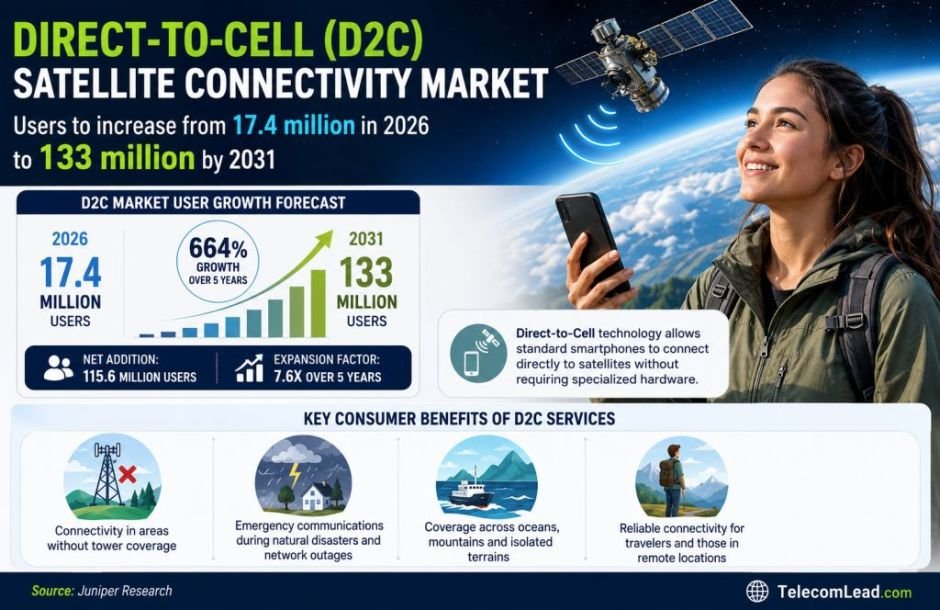
Direct-to-Cell technology allows standard smartphones to connect directly to satellites without requiring specialized hardware. The technology is expected to play a critical role in extending mobile coverage beyond traditional terrestrial networks, particularly in rural and remote regions where cellular infrastructure remains limited.
The key consumer benefits of D2C services include connectivity in areas without tower coverage, emergency communications during natural disasters and network outages, coverage across oceans, mountains and isolated terrains, and temporary connectivity for travelers and seasonal users. While adoption is expected to surge, industry analysts believe usage will remain concentrated in rural, maritime, remote and emergency scenarios rather than becoming a primary connectivity solution in urban markets.
The growth of the sector is being supported by significant technological innovation. Telecom operators are integrating satellite capabilities directly into their 4G and 5G ecosystems through hybrid satellite-mobile networks. Key developments include direct smartphone-to-satellite connectivity, low-Earth orbit (LEO) satellite constellation deployments, adoption of non-terrestrial network (NTN) standards, satellite backhaul integration, and cloud-native orchestration platforms designed to support global-scale service delivery.
Technology teams across telecom operators and satellite providers are focusing on NTN architecture design, radio access network interoperability, spectrum optimization, AI-driven network management, and scalable billing and service orchestration platforms. These capabilities are considered essential for supporting a projected user base of 133 million monthly active subscribers by 2031.
Major telecom operators are advancing aggressive deployment strategies. In the United States, AT&T, T-Mobile and Verizon are pursuing satellite-enabled direct-to-device services as part of their broader 5G evolution strategies, targeting rural and remote coverage gaps. In Europe, Orange plans satellite-enabled voice, SMS and data trials in Romania by 2026, while Vodafone, Telefónica and Kyivstar are expanding satellite partnerships across multiple markets to improve rural, maritime and cross-border connectivity.
Canada is emerging as another important market. Bell Canada plans a nationwide Direct-to-Cell rollout in 2026 through its partnership with AST SpaceMobile, offering voice, video, messaging and broadband services. Rogers Communications has already launched early satellite messaging services through its partnership with Starlink.
India represents one of the largest long-term opportunities for Direct-to-Cell services. Vodafone Idea is expanding satellite connectivity initiatives through AST SpaceMobile partnerships, focusing on rural inclusion and emergency communications. The opportunity is supported by India’s mobile subscriber base of more than 1.1 billion users.
The vendor ecosystem is being led by AST SpaceMobile and Starlink. AST SpaceMobile has partnerships with more than 50 mobile operators worldwide, over $1 billion in committed revenue agreements, a planned constellation of 248 satellites, and deployment plans for 45 to 60 satellites by 2026.
Meanwhile, Starlink is expanding its Direct-to-Cell platform through operator partnerships across 32 countries and six continents. Its next-generation V2 satellites are expected to deliver 100 times higher data density and 20 times greater throughput per satellite. Starlink’s long-term vision includes a constellation of approximately 15,000 satellites.
The market outlook highlights strong structural momentum, with monthly active users expected to rise from 17.4 million in 2026 to more than 130 million by 2031. As operators, satellite providers and technology partners continue investing in hybrid connectivity platforms, Direct-to-Cell is emerging as a foundational component of future global mobile infrastructure.
With 115.6 million new users projected over the next five years and a 664 percent growth trajectory, Direct-to-Cell technology is moving beyond pilot deployments and becoming a mainstream connectivity solution designed to eliminate coverage gaps and extend mobile access worldwide.
SHAFANA FAZAL

