
Thailand’s fixed broadband market in 2026 is one of the most advanced in Asia, offering internet customers faster fiber speeds, AI-powered services, and highly competitive broadband bundles. With fiber-to-the-home (FTTH) now accounting for nearly 90 percent of broadband connections and national download speeds reaching 272.65 Mbps, choosing the best ISP has become less about basic connectivity and more about reliability, customer experience, AI features, gaming performance, and value-added services.
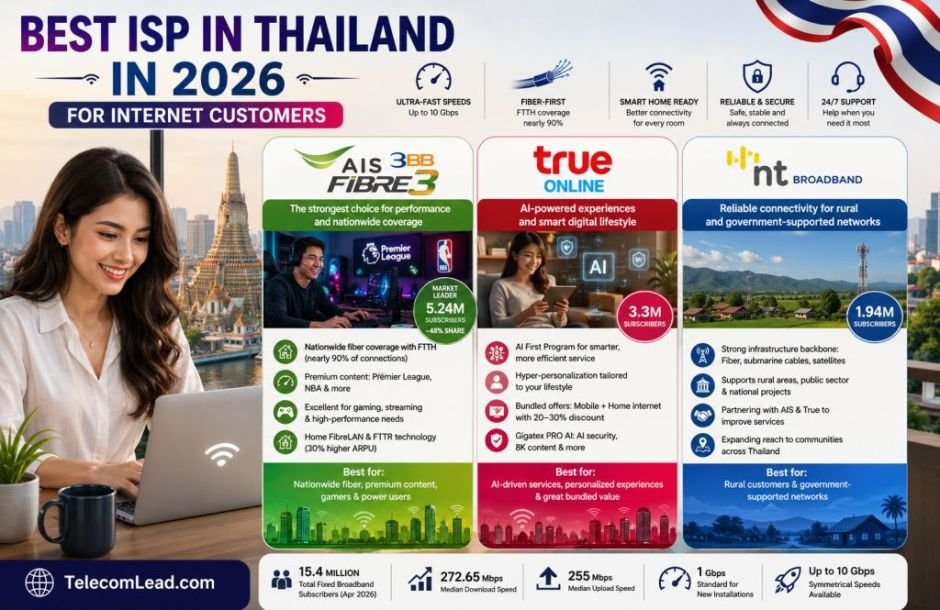
Thailand’s fixed broadband subscriber base has reached approximately 15.4 million connections, while household broadband penetration stands at around 55 percent. The broadband market is dominated by two major private operators — AIS 3BB Fibre3 and TrueOnline — alongside state-owned NT Broadband.
AIS 3BB Fibre3 has emerged as Thailand’s largest broadband provider following the integration of 3BB into Advanced Info Service (AIS). The operator serves 5.24 million internet customers and controls approximately 48 percent market share. AIS has adopted a quality-focused growth strategy that generated a 9.6 percent increase in broadband revenue during the latest fiscal period.
For internet customers, AIS offers one of the strongest fiber propositions in the market. The company’s Home FiberLAN innovations, premium sports content including the English Premier League and NBA, and extensive fiber network make it particularly attractive for gamers, streamers, remote workers, and smart-home users. AIS is also investing heavily in Fiber-to-the-Room (FTTR) technology, which has already delivered a 30 percent increase in average revenue per user (ARPU), reflecting strong customer demand for premium in-home connectivity.
AIS plans to invest between 30 billion and 35 billion Baht in network and IT modernization during 2026. Looking ahead, annual investments are expected to reach 35 billion to 40 billion Baht in both 2026 and 2027, representing a 50 percent to 60 percent increase compared with previous years. These investments are designed to support Thailand’s growing AI ecosystem and next-generation broadband infrastructure.
TrueOnline, part of the merged True-DTAC group, remains the primary challenger with approximately 3.3 million broadband subscribers. The company’s strategy centers on its “AI First Program,” which uses artificial intelligence to improve network performance, customer support, and personalized digital services.
True’s focus on premium urban customers has enabled significant EBITDA improvements despite pressure on service revenue. Through its “Hyper-Personalization” strategy, the company uses AI to customize broadband experiences and digital lifestyle offerings for customers in major metropolitan areas.
For households seeking advanced digital services, True offers Gigatex PRO AI packages that bundle broadband with AI-powered home security features, smart-home services, and support for 8K content streaming. The company also offers attractive convergence packages, with households receiving discounts of 20 percent to 30 percent when combining mobile and fixed broadband services.
National Telecom (NT Broadband) remains an important player with approximately 1.94 million retail broadband subscribers. The company owns digital infrastructure assets worth more than 200 billion Baht, including submarine cables, satellite systems, and extensive fiber networks. While NT continues to play a critical role in rural connectivity and government projects, it faces expected operating losses of approximately 6 billion Baht in 2026 and is exploring partnership opportunities with AIS and True to improve profitability.
Thailand’s broadband market is increasingly defined by hybrid connectivity. While fiber remains the foundation of fixed broadband services, AIS and True are aggressively deploying 5G Fixed Wireless Access (FWA) to reach customers in locations where fiber installation is difficult or uneconomical. This strategy allows operators to serve rural communities, temporary business sites, and rapidly growing urban areas without extensive construction work.
For speed-conscious consumers, Thailand remains among the world’s best-performing broadband markets. The national median download speed has reached 272.65 Mbps, while median upload speeds are approximately 255 Mbps. New installations now typically start at 1 Gbps, supported by widespread deployment of XGS-PON technology.
Premium users can access symmetrical 2 Gbps and even 10 Gbps broadband services. International connectivity has also improved significantly, with latency to regional hubs such as Singapore and Hong Kong ranging between 18 milliseconds and 25 milliseconds due to expanded subsea cable investments.
Broadband pricing remains highly competitive. Standard 1 Gbps fiber packages typically cost between 500 Baht and 600 Baht per month. However, operators increasingly encourage customers to adopt premium packages with enhanced features. AIS offers SuperFast Plus plans that include free Public IPv4 addresses, a feature normally valued at 200 Baht, making them attractive to gamers, remote workers, content creators, and small businesses.
Customer experience remains an important differentiator. AIS customers occasionally report IPv4 routing challenges and packet loss during peak evening periods, particularly affecting online gaming performance. Some former 3BB customers have also encountered issues during migration to AIS systems, including billing inconsistencies and loyalty reward transitions.
TrueOnline customers frequently cite concerns regarding automatic activation of paid value-added services after free trial periods expire. While AI-powered support systems improve efficiency, some users report delays when virtual assistants fail to resolve complex network faults that require technician intervention.
NT Broadband customers continue to face challenges related to rural infrastructure reliability, particularly during severe weather conditions. Weekend technical support availability and repair response times also remain areas for improvement.
A major industry challenge is Thailand’s estimated 70,000-person digital skills gap. To address this shortage, operators are deploying AI-driven Autonomous Operations and Maintenance platforms that automate network management, data center operations, liquid cooling systems, and infrastructure optimization. True has pledged to provide AI foundation skills training to 100 percent of its workforce by the end of 2026.
The broader digital ecosystem is benefiting from significant international investment. Amazon Web Services has committed $15 billion for infrastructure development in Thailand, while ByteDance has announced a $4 billion investment in data centers. These projects are expected to support enterprise ICT growth of 10 percent to 12 percent while increasing demand for managed connectivity and private 5G services.
For internet customers looking for the best ISP in Thailand in 2026, the choice depends on usage patterns. AIS 3BB Fibre3 is the strongest option for nationwide fiber coverage, premium content, gaming, and high-performance broadband. TrueOnline stands out for AI-powered services, personalized digital experiences, and bundled offerings. NT Broadband remains a practical option for customers in rural areas and government-supported networks.
With 15.4 million broadband subscribers, nearly 90 percent FTTH adoption, 1 Gbps standard packages, 10 Gbps premium services, median speeds of 272.65 Mbps, and billions of dollars in AI and data center investments, Thailand’s broadband market is rapidly evolving into one of the world’s most sophisticated digital connectivity ecosystems.
FASNA SHABEER

