
Singapore’s broadband market is becoming one of the most advanced in the world, creating significant opportunities for internet users seeking faster, more reliable, and future-ready connectivity. With the telecom sector valued at approximately US$14.6 billion annually, the city-state has achieved 100 percent household fiber penetration, supported by around 1.58 million active optical fiber connections. The next phase of competition is being driven by the rollout of 10 Gbps Fiber-to-the-Home (FTTH) services, as broadband providers focus on upgrading customers from traditional gigabit plans to multi-gigabit offerings.
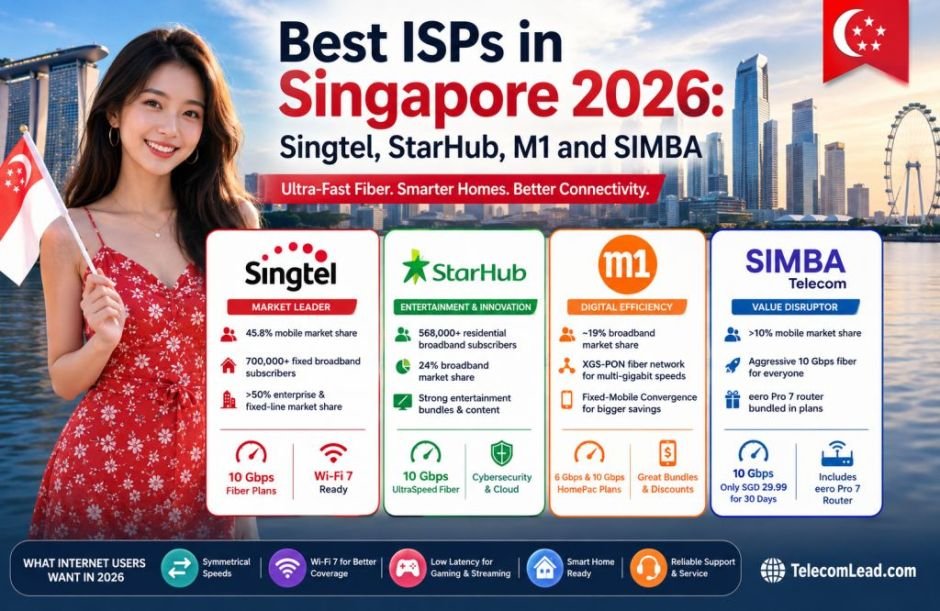
For internet users looking for the best ISP in Singapore, Singtel remains the market leader with a 45.8 percent mobile market share and more than 700,000 fixed broadband subscribers. The company also holds over 50 percent of the enterprise and fixed-line market, making it the largest broadband operator in the country.
Singtel is promoting premium 10 Gbps fiber plans, integrated with Wi-Fi 7 routers and supported by its expanding 5G standalone network capabilities. The Internet provider benefits from nationwide coverage, although premium pricing remains a consideration for some users.
StarHub continues to be one of Singapore’s strongest broadband providers, serving approximately 568,000 residential broadband subscribers and holding around 24 percent market share. Through its DARE+ transformation strategy, StarHub is investing in entertainment, cybersecurity, cloud services, and next-generation connectivity. Its 10 Gbps UltraSpeed fiber services are designed to compete directly with Singtel’s premium offerings. StarHub’s entertainment bundles remain a key attraction for households looking for integrated broadband and content services.
M1, backed by Keppel Corporation, accounts for roughly 19 percent of Singapore’s broadband market. The operator has focused on digital efficiency, flexible broadband packages, and Fixed-Mobile Convergence offerings. Leveraging its advanced XGS-PON fiber network, M1 offers multi-gigabit plans including 6 Gbps and 10 Gbps HomePac packages. The company appeals particularly to remote workers, SMEs, and customers seeking bundled mobile and broadband discounts.
SIMBA Telecom has emerged as a disruptive force in Singapore’s broadband sector. With more than 10 percent mobile market share, the company is rapidly expanding its residential broadband footprint through aggressive pricing. Its headline 10 Gbps fiber plan costs SGD 29.99 per 30 days, making ultra-high-speed broadband significantly more affordable for cost-conscious consumers. SIMBA further differentiates itself by bundling premium hardware such as the eero Pro 7 router with long-term subscriptions.
Singapore’s fiber infrastructure continues to advance rapidly. The Infocomm Media Development Authority (IMDA) has completed a SGD 100 million nationwide broadband upgrade program, aimed at extending 10 Gbps capability to 500,000 homes by 2028. As a result, traditional gigabit broadband packages have become the standard entry-level offering, while 3 Gbps, 5 Gbps, and 10 Gbps services are becoming increasingly mainstream.
Investment in broadband infrastructure has reached record levels as operators prepare networks for emerging workloads such as artificial intelligence applications, smart city services, cloud computing, ultra-high-definition streaming, and online gaming. The focus is shifting from subscriber acquisition to network monetization through premium connectivity services.
Internet users in Singapore are increasingly prioritizing real-world performance rather than advertised download speeds alone. Demand is rising for symmetrical upload and download speeds, low-latency connections for gaming, reliable support for hybrid work, and advanced home networking equipment. The growing adoption of Wi-Fi 7 routers reflects consumer demand for stronger coverage, reduced congestion, and better performance across connected devices.
Looking ahead, Singapore’s broadband market is approaching full maturity in subscriber volume, meaning future growth will largely come from technology upgrades. The 10 Gbps broadband segment is expected to become the leading revenue generator as customers migrate away from standard gigabit plans. With nationwide fiber coverage, ongoing infrastructure investments, and increasing adoption of multi-gigabit services, Singapore is strengthening its position as one of the world’s most advanced fiber broadband markets and a benchmark for next-generation internet connectivity.
FASNA SHABEER

